Author: samjshah

MV Calculus Projects 2010-2011

One class that I think I am pretty free about, and we have some fun in and get to explore and go through a lot of productive frustration, is my multivariable calculus class. I had 5 students in it last year. (*As he ducks from the rotten vegetables hurled his way, and collective groan from the crowd.*) Sadly, next year, there will be no students eligible so I won’t be teaching it.

My favorite thing from this course is the fourth quarter projects that all students do. We don’t have problem sets, we don’t have any tests or quizzes. Just this thing.

At the beginning of the year, I tell students to write down random things that pique their interests, whet their appetites, for the fourth quarter project. Whether it be higher dimensions, to the notion of curvature and what that might mean for surfaces, to the use of optimization problems in various fields, to whatever. As the class goes on, I’ll mention some interesting tidbit here or there and sometimes they’ll add it to the list in the back of their notebook. And then comes the fourth quarter, where they basically get to pick anything they want, they write their own project prospectus, they write their own rubric, and they just go at it. I give them some options, but they don’t always go that way.

I meet with them once a week or every other week (or more if they need it) and provide guidance and support, sometimes needed, sometimes not.

This year I had some excellent projects. I can’t believe I didn’t outline them for you when we finished the year, so I will outline them now. What was great is that some parents got to come to the final presentations, and so did my department head, the head up of the upper school, and some math teachers. Different days had different audiences.
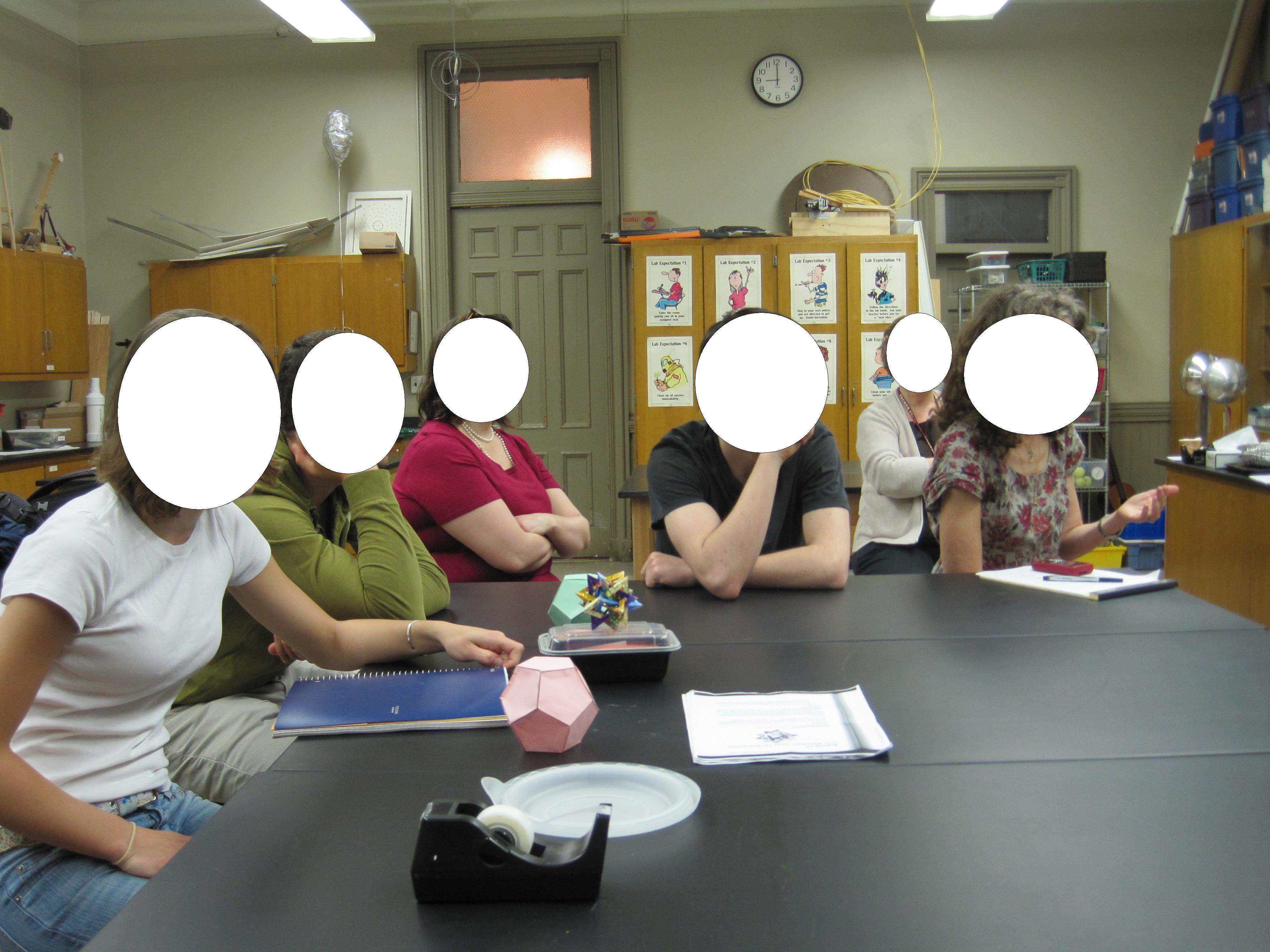
1. The first project involved constructing 5 intersecting tetrahedra out of origami and figuring out the “optimal strut width” (the width of the “beam” of each edge of the tetrahedra) so the tetrahedra just sit beautifully within each other without having them wiggle around (too small) or bend to fit together (too large).

This problem involves multivariable calculus, believe it or not, but also involved some really beautiful precalculus work meshed with 3D (basically, using roots of unity and some right triangle trigonometry) to find the vertices of a dodecahedron.  I also have to say that making the darn thing was totally hellish and the student who did it is a super rockstar. She also wrote a really comprehensive final paper explaining the calculations. Color me impressed.

2. Another student, who is a nationally recognized runner, wanted to investigate the following question: if you have a random surface with a local maximum, and you put yourself on that surface, and you wanted to get to the maximum, how would you get there? Instead of taking the shortest path (which would follow the gradient), the student conjectured that if you ran along the least steep path you will run faster, and if you run along the most steep path you will run slower. So there is a tradeoff, and there will be a path to run in between those two choices which will be optimal. So the student and I constructed a function to model the velocity of this runner. Although together we couldn’t actually get a general answer, or even a specific answer for a specific surface and point we chose, we had fun struggling through it. The student also created an accurate model of a one surface that the runner would be running on (the one that he did his calculations for).
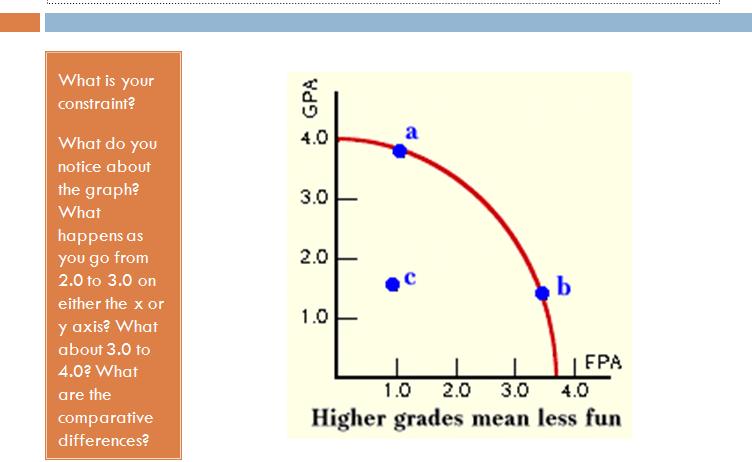
3. Another student, for an earlier problem set where they were asked to write their own problems, studied the idea of marginal utility in economics and related that to Lagrange multipliers. This student was one of those kids who is interested in everything and he really loved studying marginal utility, and wanted to extend it and see how else multivariable calculus was used in economics. So he pretty much devoured this book on his own. Although he didn’t find too much multivariable calculus, he became enamored with the idea of the utility function, and decided to make a 50 minute class lesson on economics and calculus with an emphasis on the utility function. It was so well thought out, and so well delivered, that I think that teaching and simplifying ideas might be this kid’s calling. He also wrote an amazing paper outlining everything from the presentation (and more that he couldn’t fit in), and a problem set for students to work on after the presentation.
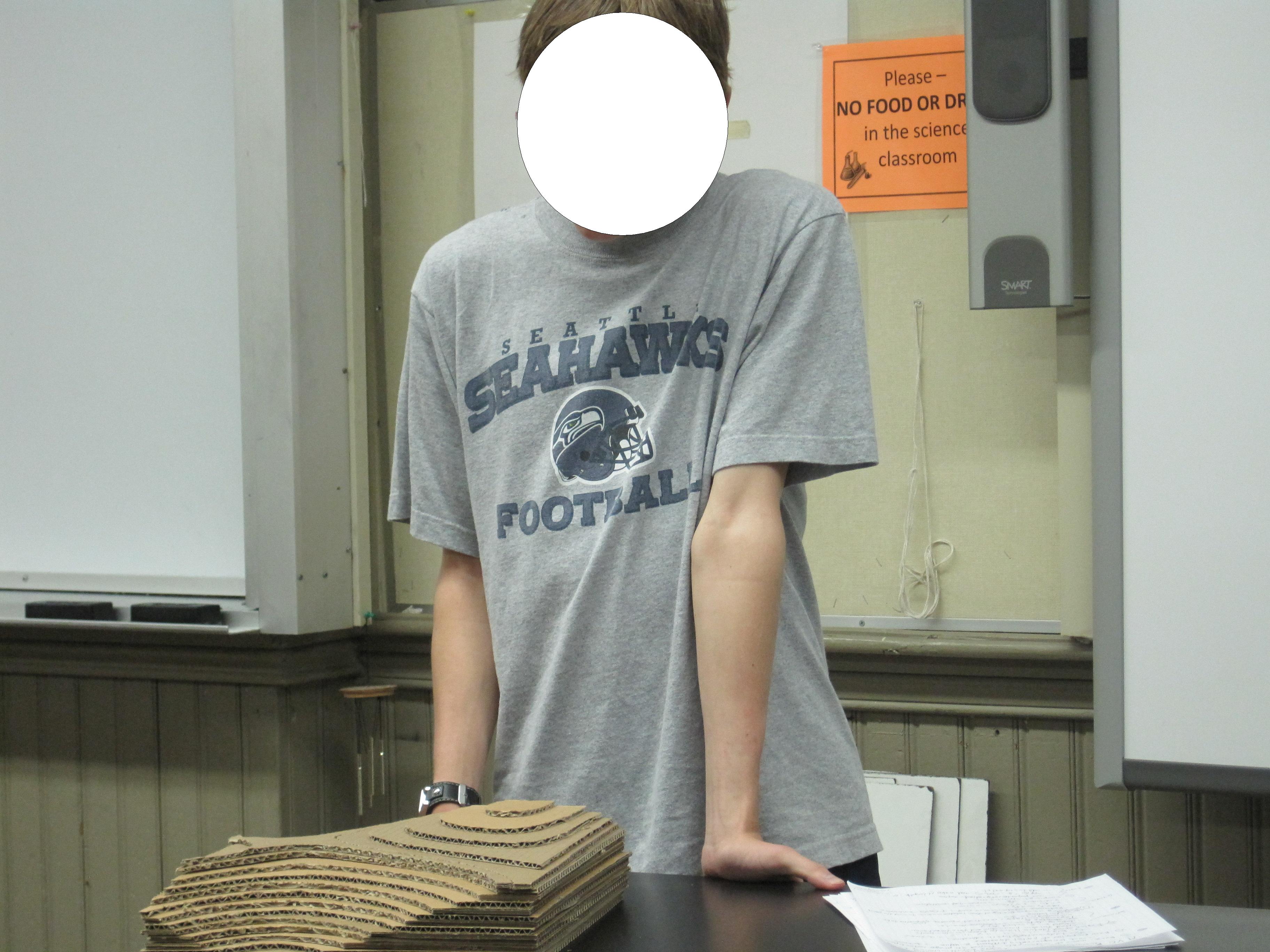
4. Say you have a blob drawn on graph paper, and you wanted to measure the area. What if I said: there is a mechanical device that if you drag it along the perimeter of the blob, it would calculate and tell you the area? True story, this exists, and when I described this to a student struggling to find a project… a project he was insistent he wanted to make with his hands… he was hooked. The device is called a planimeter. It sort of makes sense that something like this could exist… I mean:

(that’s Green’s theorem). So this mechanically minded student first built a trial version of a planimeter, using pencils, binder clips, and a bottle cap. And it worked fairly well. So then he built a giant and much more sturdy one. You can see this student holding his “draft” version and on the table is his professional version.

This student did almost all the work without me (which is good because I have no idea how to work with things mechanically). I basically only helped him understand some of the math behind how the mechanical device worked. The end result was that the professional device worked fairly well, but I think given another week, it could have been tenfold more accurate. Time is always the sticking point with these end of year presentations.

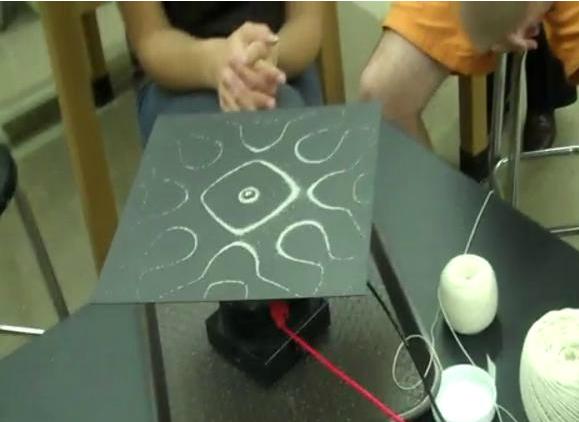
5. The final project was one of my favorites, because it involved me really going back and learning some simple partial differential equations. How this project happened involved me showing this student the following video:

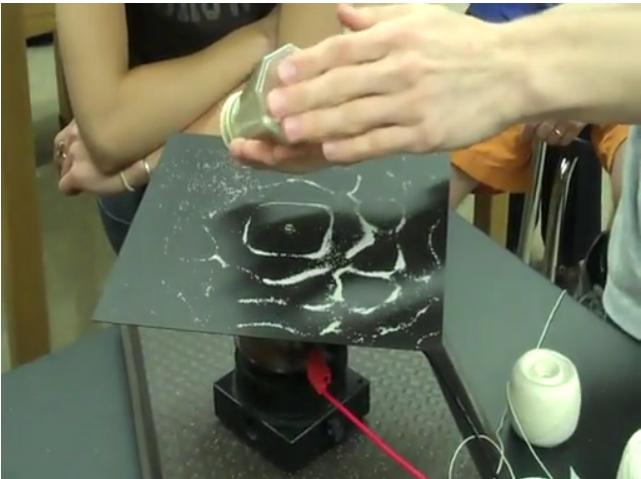
Of course this video can’t but help stir the imagination. So this student wanted to build the device (called a Chaldni plate) and study the math behind it. It turned out that building the device was a bit beyond our capabilities, so we enlisted the help of the science department chair who super generously ordered a chaldni plate (he had the driver already) and helped get him set that up. I, on the other hand, did some research on what causes those beautiful patterns. Together, that student and I spent hours upon hours tearing through a paper — me doing a little lecture, him reading and asking questions, and so on and so on. And at the end, this student wrote his own paper based on our reading — explaining the math behind the designs. Although I don’t think he fully understood everything (we had not nearly enough time to make that possible), I loved that he got a touch of all these small things in higher level math. Orthogonal functions and Fourier series. 2D and 3D waves. Boundary conditions and time-dependent partial differential questions.

And his Chaldni plate worked.
PS. Apparently, I didn’t do a good job of blogging about my projects from previous years. Two years ago, here is what my kids did. And last year, I didn’t really write about it. Yikes! One student did a wonderful investigation on higher spatial dimensions, and how to extend what we’ve done into them — focusing on actually visualizing these dimensions (she really really really wanted to see them). The other extended a 2D project on center of mass that someone worked on the previous year, and I wrote about it obliquely here.


I’m alive, I’m alive

I’m alive, I’m alive // And I’m sinking in.

Acknowledgements

First off, thank you very much to Bowman for his amazing, thoughtful, well-written guest blog posts. I told you he was a tour-de-force and I can only say that I hope you’re finding his ideas as inspiring as I have. I’m stealing everything I can from him. I hope you are doing the same. I’m all about the concrete, and he gives me the concrete. Inspirational, he is.

Personal Update

So I’m now back in New York City. Home. I attended 5 weeks of professional development. Two weeks at the Klingenstein Summer Institute in Lawrenceville, New Jersey, followed almost immediately by three weeks at the Secondary School Teacher’s Program at the Park City Math Institute in Park City, Utah.

Yes, I’ve gone from this to this:

Current Status of My Thoughts

I have to say: I am burned out. Five weeks is a long time. I am also inspired, and hope to soon sort through all that I’ve taken away to make some serious changes in my classroom. And next year, I am only teaching two preps (Algebra II and Calculus, but not the AP Curriculum). So I will have the breathing room to make changes, I hope.The changes will involve intentional group work and formative assessments, coupled with much more intentional atmosphere building of a place where mathematical thinking (right or wrong) is valued and errors are celebrated and not something to be feared.

Yeah, I know. These are small changes and you think I need to be more ambitious.

JK. I know these are huge. It will take a lot of thinking to figure out how concretely to enact them. It’s easy to say these ideas, but it’s way harder to actually visualize them happening, if I close my eyes. I have some ideas, but not nearly enough.

I’m also worried about finishing the curriculum (especially in Algebra II) next year I try to go for depth and misconceptions and mathematical thinking, rather than try to go at those things but then succumb to the expediency of the moment and don’t allow time for grappling and productive struggling and discussion. But I’m less worried than in previous years, for some reason, and I’m ready to just go for it and see what happens. I suppose it’s because I’ve taken a vow to not underestimate my kids and their thinking abilities. Which I think I’ve done, unintentionally, and now I have to correct that. So if any of you have experiences of making the transition from teaching procedures to teaching thinking, any want to share any advice, puh-leese help me out here in the comments. (I don’t only teach procedures, to be fair to myself, but if I had to put myself in a camp, I would put myself more in a procedural camp than the thinking camp.)

I promise I’ll share my thoughts about changes I’m going to make in the classroom next year, as I sort through things, just like I did with my maybe-too-extensive blogging about standards based grading last summer.(That being said, I also suppose I have to talk about how I’m going to revise SBG for next year in calculus. Which means I have to figure out how I’m going to revise SBG first. Hu-uh. Feeling daunted now.)

Last year I was timid about making changes. I did Standards Based Gradings, and I felt that was “enough.” I think that was a good start. But it was like a bandaid on a bigger problem. I need to work on my craft in the classroom, and SBG didn’t change that too much. And so this year: I’m going for a sea change. No more glacial change, I’m jumping in whole hog, and mixing metaphors like similes are to analogies. Or something.

Contradictions

I praised Bowman for being specific and concrete, and look at me here, being all musing. Sorry. It almost feels like I’m trying to psyche myself up for next year, and committing myself to change by announcing it publicly. Yes, I suppose that that’s exactly what this is.

I hope to be more concrete soon. It’s just that, well, this here blog has always been for me, partly to archive what I do (the concrete) and partly for me to sort through what I’m thinking and get some ideas down… because when they slosh around in my head: 1. I can’t sleep 2. I get a headache 3. I get paralyzed with the overwhelming sense that I need to do something but I don’t know what. It’s the paralysis that I hate the most. So I’m hoping to avoid that by starting to put thoughts to page. But I know: I hate reading these kinds of posts too. So if you got to this point: sorry.

Introducing Bowman

Here’s Kiki!

I mean Bowman. Bowman (@bowmanimal) is a math teacher I met at the Klingenstein program I attended earlier this summer. He has only been teaching two years, but he’s The Real Deal. He has this passion and curiosity for mathematics that infects everything he does in the classroom. He has a personality of a superstar — an eternal, nice-guy, optimist. He’s focused on student learning, jumping in the SBG waters in his second year. He is multi-talented, teaching physics (not next year tho!), and is able to sing (among other things) the hokey pokey in Arabic. To put it another and more crass way, he’s one of those teachers that when you meet them you immediately get insanely jealous because you want to be them. But you aren’t. (Shut up, guys, I know you all get that feeling. David Cox, you know I dream about becoming you. But shucking the wife and kids, and spider infestation. Wait, you think that’s weird that my only dream in this world is for us to play Freaky Friday? Naah.)

I asked Bowman if he’d like to “guest blog” here for the summer, and he said yes.

You lucky ducks.

YOU LUCKY DUCKS.

So now that I’ve sung his praises, I’ll let him take over and introduce himself. I don’t know when he’s going to start, or precisely what he’s going to blog on, but hells bells, it’s going to be fresh.

Indeed, one of these strange creatures may or may not be Bowman. One of these strange creatures may or may not be me. One of these strange creatures may or may not be Chief Justice Roberts.

Participation Quizzes

I am going to be doing a lot more intentional group work next year with my classes. I’m definitely envisioning this for my Algebra II classes, and if I can come up with some good materials, for my Calculus classes too.

Today at PCMI, I was introduced to a way to do groupwork well. I am dismayed that I haven’t seen this before, because in some ways, it’s so obvious that I don’t know why it hasn’t made the rounds into my brain. I need to type it out here to codify it in my brain.

It’s called a “Participation Quiz.

What I’m going to do is describe the video we watched of a teacher implementing it.
The teacher has students sitting in groups of 4. She introduces a worksheet she created to help students multiply binomials, but with some positive and some negative constants — because she saw that it was tough for her kids to deal with negative numbers when multiplying binomials. She had everyone’s attention on her, at the front of the room, and she says “today will be a participation quiz.” She then lays out her classroom norms for groupwork, some of which included:

  1. Everyone in the group must participate equally. There isn’t a leader, or the same person leading the show. The voices are shared.
  2. Students should not work too quickly. If they work simply to finish the sheet, without any other consideration, they aren’t doing it right.
  3. No one moves on until everyone understands. This isn’t about everyone having the same thing written down — but everyone has to know why.
  4. Students should think out loud. Students should check in with each other. Students should ask questions of one another.

She then let’s them get started.

As the groups work, she is both circulating, and sometimes at her laptop. When she is at her laptop, she is taking notes on each group — and displaying her notes on her smartboard live. Initially, her smartboard has group names (“purple group” “red group” …) written on there. It also has some specific actions which can be copied/pasted under each group, if they occur. Examples are:

negative actions: too quiet, talking outside group, off task, texting, different problems [students in the group are on different problems, not on the same problem]

good phrases: “I don’t get how you…”, “What did you get for…?”, “Can you also do it this way…?” “How did you…?” “Are we ready to move on…”

good actions: quick start [group started right away], reading directions out loud, same problem [everyone in the group is on the same problem], pointing and explaining, WHY???, BECAUSE!!!, calling group members out, all heads in, checking calculations/work, thinking out loud, equal participation.

Notice that these are specific things the teacher is listening for and looking for. They are actions — body language, speaking, interactions, etc.

The teacher watches and listens as she walks around or is at her computer. If she noticed any of the actions/phrases/comments, she typed them in her computer under the group name. It appears automatically on the SmartBoard for all to see.
At one point, one of the groups wasn’t working together. The teacher sat down and re-explained what the participation quiz to them, and even said “I’d rather you all work together and be stuck on one problem the entire class. This is about working together and coming to a shared understanding.” She then started getting them talking to each other, and then left.

The teacher also didn’t only copy and paste from the pre-written list on the SmartBoard, but also transcribed specific phrases/actions: everyone trying combos,  oh right, you’re multiplying” “would it be -21?” “so you mult… and…” “I got… that’s because…” “what do you think about that?”

At the end, her SmartBoard was full — a bit messy, but full. She did not shy away from writing the negative comments too. One group had “off task” written 3 times! What’s nice is that the teacher had a mathematical learning goal, but the lens through which she viewed the class (and the lens through which she had students view the class) was about classroom participation/engagement/teamwork. The two aren’t divorced.

She recapped the mathematical goal, but then she talked briefly about what she observed. She asked them questions about her SmartBoard. Under one group, her note said “I don’t know what to do after this?” and then she asked the class if that was a good or bad interaction. Most of the class said “bad” but through discussion she got them to realize it was good! That by saying that, someone is going to help that student, and the student may soon understand something. Through this process, she started clarifying the group norms for teamwork.

Fin.

There are so many amazing things about this. For me, this sort of activity, done a lot at the beginning of the year, is a concrete way to provide meaningful feedback for kids when talking about something as vague and “in the air” as participation. It builds the expectations for the rest of the year. It generates good conversations about what good groupwork is, and why. It provides the teacher a tool to get students to talk mathematically, and provide feedback. (Carol, one of the PCMI organizers, told me she will sometimes told me that sometimes she will do this and tell her kids she will only be looking for students justifying mathematics and those are the only notes she puts on the board.)

I don’t know if the teacher in the video actually assigned grades to each group. I think that’s something we’re going to be discussing in our groups tomorrow. But at the very least, it’s a really powerful way to spend 50 minutes on a mathematical goal while you are inculcating your class with a more “hidden curriculum” goal too.

I also think that a class, collectively generating groupwork norms (and the teacher adding missing but important ideas) could be a powerful exercise before engaging in this activity the first time. And using those norms as the lens to which to watch and critique students.

Virtual Conference on Core Values: The Heart of my Classroom

The conference is here.

The question of what’s at the rapidly beating heart of your classroom is a tough one. Let me rephrase that: for me, it’s tough, because it is totally evolving. Also whatever is at the heart of your classroom is your hidden curriculum — something that isn’t content, but just as important (if not more so) for kids to take away. So it’s pretty hard to get a handle on. It’s values.

Beginnings

In my first three years, I would have said the heart of my teaching revolved around three words:

clear

consistent

fair

Yes. Those three words drove me. The thing about having a core philosophy is that: everything revolves around it.  Every assignment. Every interaction. Every expectation. And although there are hard decisions that have to be made, when I struggled through them, I found I eventually turned back to my core beliefs, and I saw the light. Do I let that kid, that sweet sweet kid, take a re-test? Do I really need to create a super involved rubric with benchmarks, or can I just outline the project? If everyone in the class bombs an assessment, what do I do? [1] When holding core beliefs, every choice has to be intentional. Because these are what you value, and you need to enact those values. If you can only “say” your values, but you can’t “see” your values… then you’ve failed. [2] [3]

This philosophy has helped me out a lot with classroom management. It has helped me gain the respect of at least a good number of students. But I have started to see that philosophy as a baseline, now, of what I am doing. I believe in more.

Current Status

In the past year, the heart of my classroom has expanded to include more than clear, consistent, and fair. Thanks to the philosophical reorientation that Standards Based Grading has given me, it now includes metacognition and proactivity. [4]

I want my kids to be aware of what they know and what they don’t know. I want them to aware of the process of learning, and strategies to help them along the way. And I want them to be able to act on that knowledge. This is my hidden curriculum.

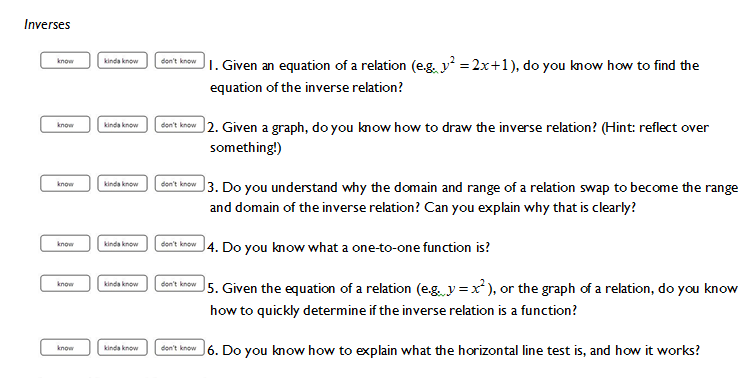
In Calculus, I used Standards Based Grading, which is all about kids getting a handle on their own learning. It forces them to understand what they know, and what they don’t know, and really articulate it! [5]

Dismantling the course into individual skills allowed me to have a specific breakdown of what the student knows and what the student doesn’t know. A student might have mastered how to apply the product rule, but struggle with explaining in words where the formal definition of the derivative comes from.  With SBG, I know this. In a school newspaper article written about my calculus class, one student was quoted: “The fact that the material is broken down into very specific skills as opposed to chapters or sections means you can focus on what you don’t know and figure out what you need to improve.”  More than me knowing where my students’ strengths and weaknesses are, my students themselves can recognize them.

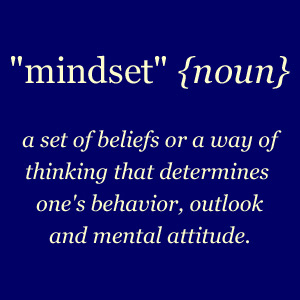
I talk about metacognition, but that’s only half the battle. Who cares? Kids knowing about their learning habits, that’s great. But it doesn’t help them unless they believe they can grow from it. This is something I’ve been thinking a lot about since reading Carol Dweck and her notions of growth mindset. If a student — especially my students who tend to come to class never really appreciating math — thinks they suck at math, that they aren’t a “math person,” they’ve already stabbed themselves in the eye, shot themselves in the foot, whatever. There is blood everywhere, and it sucks. My kids come in with a fixed mindset. To get them engaged, to act on the “metacognitive” work, to see that doing well in math isn’t a matter of being “born with it,” I need them to see themselves as people who can change through hard work. Because really, if they don’t believe that, they won’t be doing hard work. They’ll simply continue to try to get by in math.

The thing is, we’re human beings. We suck. It’s hard to alter our own perceptions of ourselves. It’s also hard to say “we suck” and then decide to move on from there to say “let’s do things to suck less”!

This year I’ve been trying to do some good work in getting kids to be proactive, and to build their confidence. It involves a lot of individual communication with students. It involves me showing them that I care. It involves me avoiding ever comparing a student to another. It involves me demonstrating passion which occasionally translates into passion in them. It involves me talking explicitly about how math is a process, a journey, and how anyone can do it. It involves me not falling into the trap of thinking of certain kids as “smart.”

Standards Based Grading has helped me get kids to be proactive. My favorite example of this is a student reflection I’ve blogged about before:

1. I like the way that even though I was falling rapidly into a hole, and it felt almost impossible to get out, once you talked to me I became proactive and tried my best to do better. I like to continue meeting with you. I also like to continue to participate in class and asking questions. I think asking questions in class was the biggest way for me to better understand the topics.

2. I wish I would have started from the first day of school in this attack math mentality. I was acting very passive and like ‘oh I don’t get it now, but I will later,’ which honestly was the worst thing I could have done. I also wasn’t used to the class setting and the grading system. But once you emailed me and I met with you and I know that this is a class that I have to be in it 100%, and that your method is one that helps us actually learn, it was just beneficial. I needed that scare and wake up class because I was in serious denial. I became more on top of things. However, I had to dig myself out of a huge hole that I put myself in, but eventually the rhythm has become one that I used to. And I’m almost in a weird way glad that I learned the hard way because now I truly understand Math.

But that’s just one example. For as many kids as I might have helped, I know the struggle of SBG was enough to turn some of my kids off to math. I couldn’t get them to act. I don’t think it was laziness on their part, but despair. They hadn’t fully embraced the growth mindset and realized they could do it. I failed to be able to counter this.
I value a growth mindset, and I try to promote it through my actions. That is the current central core of my classroom. I’m still working on it, but here’s where I stand now.

[1] Of course I don’t mean “clear, consistent, and fair” to mean everyone gets the same treatment. Context matters, and what’s fair is not always “treat everyone the same way.”

[2] See Sizer and Sizer’s The Students are Watching (my review here)

[3] A grand experiment would be to have someone watch a video of your class, and try to suss out your values, and where they are expressed through your actions and words.

[4] SBG also has helped me remember the point of teaching: student learning. And now I have a razor sharp focus on that goal.

[5] In Algebra II, I deal with metacognition also, but not as well. I do this by talking to my kids explicitly about categorizing what they know and what they don’t know.

I tried to make homework more meaningful, by creating a full feedback loop. If a student got something wrong, they were asked to re-do the work and correct it. Otherwise they would have practiced the skill incorrectly, or illuminated the concept poorly, and never fixed it. (The “ill-leave-it-to-learn-before-the-test” syndrome.) I did this using binder checks (and redux), which had the added benefit of keeping (most) students organized.

Video Analysis: Feedback

So as I wrote before, I had a dickens of a time getting the courage (courage, as they say in French… not that different) to share my teaching video with others. But I did it, and here are my general thoughts based on my feedback — thoughts reinforced by what y’all commented:

(1) To do video analysis, there needs to be some sort of safe space for teachers to share. This was terrifying for me, because I felt like I was going to be exposed as a fraud — someone who can’t teach. And more importantly, I was afraid that people who lose any respect they had for me. I think teachers who are participating in video analysis need to have someone help them deal with the emotional aspects of this. The thing that helped me, personally, was realizing that I would be a pretty sucky teacher if I never learned to grow. So I had to change my outlook about sharing the video: from a vulnerable place where we feel we’re exposing ourselves to a cruel world, to an exciting but challenging opportunity to really improve my practice through the help of friends. It’s like with our kids… we don’t want them to see our class as an unsafe space to make mistakes and grow from them… we want them to see our class as a place to learn and grow and be excited about what they do.

(2) I sent out the 50 minute video and asked my friends to look at it without any directions. Basically because I hadn’t learned how people actually analyze videos. I got a diverse set of responses — each focusing on different things.

EXCERPT ONE

–Wow, great way to respond to a kid asking a question that was just asked. I’ve never thought of having kid 1 respond for me and will be stealing that for next year.

–Thank you for using the word ‘exemplar’

–I wonder what other students would have done if you had written what [STU] had originally said at 9:15; 10x vs 10^x.

–You use the phrasing “will you..” when intro-ing the problems on the board. Sounds like kids have the option not to.

–I like your use of ‘crazy’. A lot of your side-comments to the students are super-similar to mine and it’s just nice to hear that I am not the only teacher that talks like that.

–I like how at 14:20 you have her point to things on the page instead of doing it for her.

EXCERPT TWO

EXCERPT THREE

EXCERPT FOUR

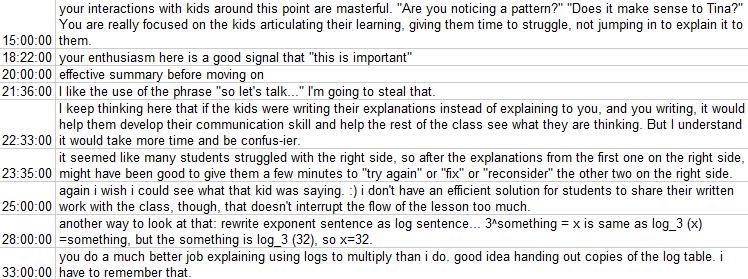
There were a lot of things that I didn’t notice, or acknowledge, about my own teaching that came through in these. Especially the things the reviewer liked. I also really appreciated when I was given a suggestion for an alternative thing I could have done (e.g. “I keep thinking here that if the kids were writing their explanations instead of explaining to you, and you writing, it would help them develop their communication skill and help the rest of the class see what they are thinking”).

(3) Of the various ways I got feedback, I think the third one (+, delta, ?/notes) made the most sense for me. I would love for it to also have had approx times on the video (like in the second one) so I could go to the video and look at that particular point of the video without having to do a lot of skipping around.

(4) I don’t know if sharing 50 minutes (a whole class) was worth everyone’s time. I wonder if picking a 10-15 minute clip and having the reviewers focus on three things (e.g. my questioning, my body movements, the students engagement) would have worked better. It’s hard to know exactly what to do with all the feedback I got, because it’s not targeted. It would make sense to have some particular things I want to work on, and get feedback just on those. Also, making explicit what I need to work on makes the notion of getting negative feedback less nervousmaking, because I already have admitted to everyone “I suck at these.”

(5) I wonder about doing this in person vs. doing this virtually. One thing about doing this virtually is that people can do it on their own time, and it might feel safer for everyone. At the same time, there isn’t any discussion about the clip. If there were three reviewers and the presenter together, it could generate some fantastic discussions.

Thanks for those who helped me with the video analysis! I appreciate the time you took and the comments you gave me!

UPDATE: One reviewer writes about her process.

Random Ideas Gathered from the Klingon Math Curriculum Group

I also wanted to archive the random ideas I gathered from the Klingons, before they got lost in the ether:

  • Keep a physical toolbox somewhere in the room. And when kids are stuck, make a dramatic point of walking to the toolbox, taking it out, and loudly plopping it on the desk. “What tools are in our toolbox?”
  • Bring a construction helmet to class. When you need to get things settled and move on, put it on. “This is a work zone, people, a work zone.”
  • Play “Math Taboo” where you have kids evidence their understanding of concepts. Have notecards with things like “Coordinate plane” and have them try to explain to their team what it is, but without using other words on the card, like “x-axis” “y-axis” “graph” etc.
  • Ask a lot of what if questions. So, if you are in geometry and have covered that triangles have 180 degrees, ask: “What if we didn’t have a triangle, but a quadrilateral or pentagon? Would this still work? How many degrees do those have?” (This is very much under Polya’s art of problem solving philosophy.)
  • On the top of every homework page, students need to write a list of problems they had difficulty with and circle it. If they didn’t have any difficulties, they can write the null set and circle that. On that vein, don’t put up the solutions to the homework problems that weren’t from the book (or the even ones from the book) until 2 minutes into class. Students need to be talking with their partner and comparing answers and asking questions first. Then halfway through “homework check time” project answers. (This is only for classes where you check homework.)
  • Have practice tests (call them “scrimmage quizzes”) before tests, asking students to solve problems to assess their own understanding. But do NOT make them exactly like the summative assessment. They need to learn how to do problems without having the numbers be slightly changed. But make sure they cover the same ideas / understandings.
  • When you’re in a zany mood, use phonetic punctuation (http://www.youtube.com/watch?v=lF4qii8S3gw). You know, just for fun.
  • Have the class, at the start of the year, come up with a collective list of classroom norms. Make sure to refer back to that list throughout the year, and enforce it. These norms should be enacted each and every day. And students have ownership on them. (Add to the norms too, when need be.) Frame the norms positively. Also, collectively make a list of attitudes shared by good math students (e.g. tenacity, willingness to ask questions, etc.) and refer to those.
  • Change language. Don’t call problems “problems” but “challenges.” Don’t call tests “tests” but “celebrations of learning.” Don’t write the number of points off, write the number of points earned.
  • When students are asked to show their work to the class, don’t tell them to “show their work” or “show their solution.” Tell them to “teach the problem.”
  • If a student shows up late, say to them “I’m so glad you’re here. Thanks for joining. We value your thoughts.”
  • Keep a stack of postcards/little notes in your desk drawer. If a teacher does something really nice, or well, write a short note to the teacher telling “I appreciate…” and leave it in their mailbox.
Throw in other things below, if you want!