Author: samjshah

A Benefit and Peril of a Laptop School

Tomorrow my Algebra II students are going to take their final exam. The year has come to a close. I’ve taken stock of the year in a number of ways. Here’s another summary of my year (a la my SmartBoard notes data).

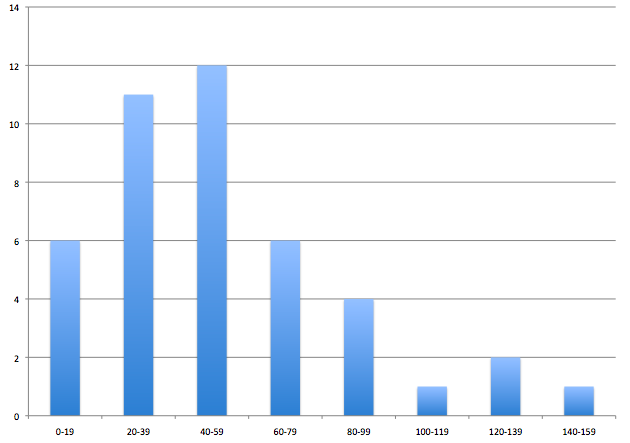
In order to keep myself organized throughout the year, I make a separate email folder for each student. All emails to, from, or about that student (e.g. with parents, with deans, with their adviser) get archived in this folder. I compiled the data and saw that I’ve done a lot of individualized emailing. To be precise, 2,270 individual emails. I teach only 43 students, so this comes to about 53 emails per student. Most aren’t extensive emails — sometimes it’s just them asking me a quick question, or trying to schedule a time to meet, or me asking them if anything was up. The picture of how these 2,270 emails were distributed is below.

The number of students is on the left, the email range is on the bottom.

I don’t really have many conclusions.  I just wanted to see what the data would look like. The students on the right — who I emailed a lot lot lot with — were the ones I was trying to reach the most. So it’s nice that there was a correspondence between this data and that.

I do spend a lot of my time on email. As for whether it is worth it, well, that’s still up in the air. I think it is.

Histograms, Standard Deviations, and Digital Cameras

Our last unit in Algebra II was statistics — and it was a hurried unit. (As last units always are.)

One of the topics I was covering was histogram basics. And I wanted to make it somewhat interesting. So I went online, and came across a page which explained how to understand histograms that your digital camera produces. You know what I’m talking about, right?

That’s the one. How do you get it on your camera? Heck if I know. I just pushed a lot of buttons and eventually the histogram appeared.

Because I had about 20 minutes, I just lectured my kids on how this histogram worked.The histogram has 256 columns (numbers 0 to 255). Each pixel on your camera is assigned a number from 0 (representing pure darkness) to 255 (representing pure lightness). Then the height of each bar represents the number of pixels with that particular level of darkness/lightness.

By that one little piece of information, you can start telling a lot about a photo. Such as when it is over-exposed and under-exposed, and when there is too much or too little contrast. You might wonder how photo editing software can increase the contrast or correct for a photo being over/under-exposed. One you learn about this, the answer is pretty simple. The program reassigns each pixel with a different brightness.

See examples that I cribbed from the website on my smartboard. Pay special attention to how the over-under exposed histograms differ from the “ideal” histogram (and similarly for the too high/too little contrast):

I really enjoyed learning about this, and sharing what I learned with my students. But next year, I want to do something more. I want students to take photos and play with them in some image editing software — and see what happens to the data as they modify the image in certain ways. What does brightness mean? Will things change if the image goes from color to black and white? What does sharpening the image do to the histogram? I want them to talk about mean, median, and mode — and how they change. I want them to talk about standard deviation — and how it changes. I want them to talk about range and shape — and how they change. I want them to make a short writeup explaining their findings.

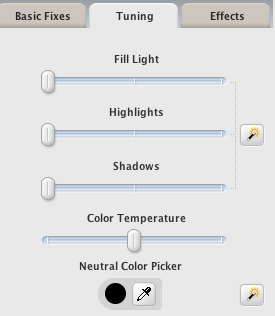
Look at what Picasa (free) offers:

You get the histogram (bottom left)! You also get all these ways to modify the picture!

And the histogram changes as you modify it! In REAL TIME as you slide sliders!

I don’t know quite yet how to make this rigorous or ways to ensure they’re learning. It’s kinda bad, because I just want to play around with this and discover what all these things do myself, not knowing what I want them to get out of it. I just want to explore. I’m not thinking backwards. But I suspect a good short bit on the shape of data can be made from this. (Alternative reading: I wouldn’t begrudge any of you if you, say, went out and made a short unit based on this and sent it to me.)

Yet again, following f(t)’s lead

[UPDATE: Posts on starting blogs… Kate’sMiss Cal.Q.L8’sRiley Lark’s (scroll down)… all definitely better than my two cents…]

I can’t help it. I really dig Kate Nowak. (In the platonic way, obvi.) And everything she wants to do, I want to do too.

(On that note, I have a competition idea that I’m contemplating rolling out for the summer…)

(Kate, don’t say you want to eat a vat of fresh tomatoes, please. I HATE tomatoes.)

She gave her few cents about starting a math teacher blog — and things to do and things not to do. I thought I’d piggy back on that and give some totally unsolicited advice of my own.

Actually, I think it would be good if all of us who blog do this. [1]

1. Don’t worry about your blog name. I know a few people who want to start blogs but agonize over getting “the best, most punny, insightful name that captures the essence of what you want to do.” That’s cool. I think I spent an eternity trying to find the best Google Voice phone number, so I get it. I remember I spent at least 2 hours trying to come up with a killer name. But I’ve known people who’ve agonized over it to the point where they never got started. So agonize, but give yourself a short deadline. “By the end of today, I will have started my blog. No. Matter. What.” A rose by any other name…

My story: I gave up on my search for ‘the best name’ and just went with a cool fact I learned (that you can have a function which is continuous everywhere but differentiable nowhere). Totally makes no connection to what I write. So what.

2. Choose WordPress. I know everyone says it doesn’t matter whether to choose wordpress.com or blogger.com. I’ve used both and I have a strong preference for WordPress.com. The themes are sleeker (in my opinion), there are more control options, and most importantly, you can easily type equations (y=ax^2+bx+c). I am a huge, huge fan.

My story: I’ve written in livejournal in college, started two blogs (one of them a group blog) using Blogger in grad school, and now I’m a committed devotee of WordPress. However, maybe Blogger has more options since I abandoned it? I won’t knock it, but I know WordPress is awesome.

3. Write like nobody’s watching. Okay, this piece of advice might either sound obvious or counter-intuitive. But it’s the one I most believe in. And I assume you want to blog because you want to engage with others, right? You’ve been out there reading stuff, and you’re like, “ME WANT TOO!” At least that’s what happened to me. But guess what? If you blog for yourself, you’re going to want to write stuff — and it won’t be a chore.

And write about anything and everything related to teaching that you want. Don’t feel restricted to post only about this or that. Make your blog less about being your blog and more about whatever you want to say, and let it grow organically into whatever it turns into. Try not to make it into something — let it grow into being something.

In other words: blog for yourself.

My story: I kept my blog private for four (or more?) months. I was writing for me. I eventually got fed up with just leaving comments responding to others, and never really getting to say anything of my own. So I made it public. But I just kept on keeping on. Writing about whatever I felt like. If I cared about getting a readership, I wouldn’t have posted about multivariable calculus. (Something I post about a lot, actually.) My blog was and always will be (until I grow tired of it) an archive of my teaching.

4. Corollary: Keep at it. Guess what? Don’t be concerned about blog stats and visitors. Remember, you’re writing for you. People will see it. I promise. Okay, yes, you’re going to start looking at the stats. You won’t be able to help it. And you’ll feel good when the numbers are up and the numbers are down. That’s cool. I mean, who doesn’t want to be popular? But I guess the message is: be popular on your own terms. Or another way to put it: be yourself.

My story:  My first post was in August 2007. I’ve written 422 posts since then — not including this one. The average number of visits for my first couple months was 15 and 14 visits/day respectively. It took me until July 2008 (11 months) before I broke the 1,500 visits in a month. It took Kate Nowak 10 months. What you’ll notice is that if you keep chugging away at it, your numbers will go up. Just by the sheer fact that you have been writing more. So more people will stumble upon it. And more google searches will end up on it.

5. Watch what you write. Okay, so I said write for yourself, and I went on and on about it. But you are making this public. So the best rule of thumb: don’t write anything you wouldn’t want your kids, your administration, or a potential employer to see.

My story: I stick to this. I don’t write when I’m angry. I sometimes write when I’m disappointed – but mainly with myself.

6. Perfection isn’t attainable. I know some bloggers talk about having a ton of posts in draft form. Writing and revising. And revising. Heck, if you have an idea, just take the 30 minutes to pound it out and press PUBLISH. Agonizing sucks, and isn’t worth it for something you do for fun. As a lark.

My story: I write, I publish. Sometimes two or three things in a day! Sometimes only once in two weeks. I don’t let a schedule dictate anything. But sometimes, when it’s been a week or two, and I haven’t written anything and I have some spare time, I try something. I sit down in front of my laptop and for 10 minutes, I think if I have anything to write about. Usually I come up with something. The only time I let time linger between when I write something and when I post it is if I hesitate pushing that publish button — which is a sign to me that there is something in it that I’m not comfortable with. Usually something that relates to #5.

Obviously this is what works for me, and it may not be your style. I just really want to say: DON’T STRESS ABOUT IT. Just have fun with it, and don’t worry about it too much, and have fun with it. Oh wait, I said that twice. Well, I meant it.

[1] I sometimes think that some ed grad student should stumble upon our little community and write about its evolution from 2006-present. I got this thought probably because I was trained as a historian for a few years, before I became a teacher, and this is exactly the type of grad student seminar research paper that a sociologist or information scientist who joined our seminars talked about writing. Then we’d talk about Foucault and I’d want to bash my head against the heavy wooden seminar table while I attempted to figure out what “the form making a sign and the form being signalized are resemblances, but they do not overlap” meant. I digress. These posts would be good research fodder for the grad student. [Update: this post and comments at dy/dan would also be good fodder.]

On The Dangers of Continuous Improvement

My school has a set of explicitly stated core values. They were derived at one or two faculty meetings in my first year. I remember we broke into smaller groups and talked about values that are, and I quote, “bone deep” at our school.

One of these core values is continuous improvement.

It sounds great when you say it to your kids. I mean, “We’re always working together to get better!” Who dares say that continuous improvement could be anything but positive?

In fact, I do. I have come to see that it isn’t always good.When done right, for example with all those Standard Based Grading enthusiasts who have seen results, it can be powerful. Carrots and all that. But it can be done wrong — and I think I’ve finally come to see the insidious side of continuous improvement.

It implies that we should always be working to do better. It also implies that we are never going to be good enough.

I’m in a bit of a teacher funk — and for those of you who read this, you might know by now that I get this way every so often. And then I do snap out of it. But it’s a cycle. I know some of you out there feel the same way as I do. I read it in your posts and your tweets. The sentiment: “I never knew how much I sucked until I met all of you.”

I have over 120 blogs in my google reader, I follow twitter daily (until a few days ago), and I stand up with all of you and engage when writing this blog and commenting on other blogs and tweeting about interesting things I read. I am constantly engaged and engaging and interested. And for 90% of the time, I love it. I love it because it brings meaning to my vocation — meaning that lies outside of me talking to myself in a self-contained bubble. It encourages me to have high standards and always keep striving to do better and provides me with models which to emulate.

And then, then, I get overwhelmed by it all. Usually brought on by a contemplative realization. Where I feel like I should be improving and I’m not. Where I’m making the same mistakes that I did as a first year, and wonder how is it I can’t overcome them? And where I’m just never going to get to that place where I want to be at.

Which is to be great. Which is where I can reach every kid and have them not hate math at the least, and love math at the best.

And I know it’s idealistic and Sisyphean and naive. And it’s what I want.

It’s the dark side of continuous improvement. Because I start feeling like I’ll never get there, and in fact, I won’t, because perfection is impossible.

I will snap out of it. I always do. But I don’t want to be in this cycle forever. I fear burn out if this continues to happen.

So I’m wondering if I should do what I tell my students to do when approaching a huge task. Break it into smaller chunks. And those into smaller chunks. Then the gargantuan task won’t seem so impossible, because in those chunks is an actionable plan. And then work on achieving some of those chunks.

Here’s my thought: I should make a list of 5-10 goals I want to accomplish next year (e.g. build a sense of community in each of my classes). And break those things into smaller actionable chunks (e.g. concrete actions I can do and check off which will hopefully build a sense of community). And make a sticker chart which I have on my desk — which I can see if I’m actually taking the steps I’ve outlined to achieve those goals. [1]

Perhaps if I do that, I won’t have this insidious and amorphous “continuous improvement” thing looming ahead of me. But something that I can realistically accomplish, and keep track of, and feel good about. Because who doesn’t feel good when looking at a chart full of stickers?

[1] Yes, you SBG enthusiasts out there, like your standards…

Ready for Summer

I’m tired, and ready for my well-deserved vacation to start. I am ready to pack up this year and put it behind me. I have a lot I want to say about my failures, but I can’t write about them here. I’ve tried writing them down for the past hour, but they get too specific, in ways I don’t want to be specific. So we’ll leave it at this:

This year was overall less successful than the year before. I think classroom dynamic has a lot to do with it. I wish I could have gotten a real community feel in one of my classes in particular. We never really bonded, and honestly, I don’t know if we could have. But I could have done a lot better by them if I could have convinced them we were on a team together and that I was on their side. On the other hand, I learned some valuable experiences this year about the importance of consciously building atmosphere. It’s important to develop it early on, and it’s important to maintain.

Binder Checks, Redux

Introduction

As you may remember (or not, because come on, it’s not like you commit to memory everything I write here), I have been using a binder system in Algebra II this year. I made it a conscious goal this year to teach organization, and to try to make homework more meaningful. The basic idea behind these binders is to (a) help students learn how to be organized and (b) allow students to view homework as not just a chore to “get it done and forget about it.”

Conclusion

So I thought I’d end with the punchline. The binders were a darn good success, for the first year I used them. I saw the results in class when we talked about homework. And for the most part, students themselves bought into the system and saw the benefits themselves. I’ll probably change things here and there a little, but not much.

Signs of Success: Evidence for the Conclusion

I already knew they were doing something seriously good when I threw up answers to the homework on the SmartBoard, and almost all my kids marked the questions they got right with a CHECK and the questions they got wrong with an X. They were also much more proactive in asking homework questions. For that alone, I knew I was probably going to continue these binder checks.

On our last and final binder check, I asked the following:

For 5 more points, I ask your honesty when answering questions on two things. I would never penalize you for being honest when I ask you to be honest. I really am looking for some thoughts on this binder thing.

(1)  Has keeping a binder kept you more organized throughout the year than without the binder?

(2) What is your process for correcting homework/assessments? When and how do you do it? Does it help you?

I also verbally talked to them about how this feedback wasn’t about them, but was about this thing we did this year, and I need them to be completely honest in their responses — even if it meant bashing the binders.

I contemplated typing the most positive responses, letting y’all think that those were representative, and moving on. Because overall I think that the binders were a success, and these responses would have illustrated that dramatically. But heck, things are nuanced, and skipping over the details leaves out the juicy and important bits. So…

Here are a some of the responses to the first question.

(1)  Has keeping a binder kept you more organized throughout the year than without the binder?

It has kept me more organized for the long term versus the present. I think that more frequent binder checks would help us keep us up to date, so like after each unit/assessment.

Yes! Honestly it does because in past years when it comes time to study I can never find the notes/hw/tests I need.

Keeping a binder has made me less likely to lose my work and more organized. It is likely that this will help me in studying for the final. Although it is a pain, I am glad that we do it.

Yes!!! I honestly am so happy that you made us do this, even though it is a bit of a hassle. Now that exams are coming up I am so grateful I have all my material. I wish I had done this for all my classes.

I really did not enjoy doing it. I thought it was really annoying but now when studying for finals it is very helpful. And it has definitely made me more organized.

I guess it has forced me to keep a lot of my old things together but it is not necessary.

I didn’t type all the responses because most read like the one in italics. Overall, when looking at the responses, I distilled the following. The binder checks are slightly annoying, but definitely helpful. For the few students who are already organized, nothing much changed with organization. For the rest who aren’t consistently organized, many seemed to find it frustrating but helpful, and a few just found it frustrating. Many also said they are happy they’ve done it because now they have everything set in order to study for the final exam.

I typed out most of the responses for the second question.

(2) What is your process for correcting homework/assessments? When and how do you do it? Does it help you?

Either I correct them when we go over them in class or I check the course conference later and correct them. It doesn’t always help because sometimes I forget to correct them and then I lose points, but for the most part it helps.

I do it the night before the binder check and it helps me because it’s review and usually I forget how to do the problems at first.

I usually do it before the binder quiz and I go over it with someone for the corrections. Honestly it does help even though it is tedious and hard to do corrections. When I study for tests it is very helpful. It is also good because I know what I have and don’t have.

I try to do it when we go over answers in class or when I get an assessment back. If I realize I’ve not done that, then I will try to correct it when studying for an assessment or before a binder check. It’s helpful to have the right answer to study, but sometimes we go fast going over them and it usually messes me up if I missed out on correcting them.

I usually correct homework when we go over it in class. It is pretty helpful because if I don’t understand something we will go over it when I usually wouldn’t ask too many questions. I correct my assessments out of school on my own. Usually I’ll try and figure out what went wrong but afterwards if I can’t figure it out I’ll ask a teacher for help.

I correct homework when we go over it in class. And I usually correct my tests the day I get them back but sometimes later. It is helpful because then you know what mistakes you have made and how to fix them, and also what you need to work on.

I correct them when we go over it in class. Sometimes before binderchecks I’ll go thru them to find wrong questions. It doesn’t help me personally.

I correct homework assignments in class when we go over the homework and I correct assessments as soon as I receive notice of a binder quiz. Correcting homework helps me better understand problems that I did not know before. It also compels me to be more proactive in my learning.

I correct homeworks in class when we are going over how to do the problems, because that is when I understand what I did wrong and I correct test[s] before the binder checks. It would help me if it were just for the sake of correcting, but binder checks hurt my grade more than help.

Yes, it helps.

With HW I do it in class as we correct it, but for tests, I usually do it a little before the binder check by pulling out notes and old HWs on the topic which helps me overall.

My process is checking in the back of the book, writing down right answers in class, and revising my work in class so I have it correct. It helps me keep track that I’m doing it correctly.

I do it all at once when the binder check comes. Probably not the best idea, but it works.

I do it when we go over it in class or before the binder check. It doesn’t really help me. I never really use that material to help me study anyways.

I was most interested in reading the answers to this second question. Because it was on this front that I predicted that my kids would all tell me that they do all their homework and assessment corrections the night before the binder check, and that they didn’t find doing them useful, and that there would be an outpouring of complaints about their grades (many got Cs and Ds in the first quarter for the binder checks). I suspected that most would say it was just an annoyance and not helpful at all.

But clearly most students explicitly or implicitly talked about how being forced to correct their work helped them, and be more proactive in their learning. I was happy that many found it useful in consciously separating their knowledge into what they do know and what they don’t know.