The Problem
I care a lot about how groups in my class work. I know some teachers switch groups regularly, but I actually keep my groups together for many weeks (over the course of the school year, kids have about 6 different groups total). The point is: I want kids to learn how to work collaboratively, and for group dynamics to evolve and grow over time — hopefully for the positive.
Although it is important to me, I have only started becoming intentional about developing groupwork. I did a couple of activities at the start of the year to generate conversations about what groupwork is and how it can be effective [1], I have kids have conversations about groupwork when they switch groups, I have kids write reflections about their group and their place in their group, and sometimes I have groups create “group goals” which they write on fancy colored cardstock and keep in their group folders (and when I remember — which admittedly isn’t often — I have them revisit, reread, and add/revise them). All of this is scattered, but it does show kids that I highly value how they work together and I’m watching them work.
But what I realized is that although kids have conversations about groups and groupwork when they have a new group, and they reflect at the end, there was no safe way for kids to “course correct” if their group wasn’t working for them. Most of the time, groups work well, but I’ve had a few times when people felt they weren’t valued or listened to, or the group never formed a cohesive whole and were more like three or four kids working independently. And if you’re in this situation, how do you “course correct”? This whole reflection was triggered by an individual meeting I had with a student a few months ago where they were in a situation where the group wasn’t really working, and he didn’t know what to do. At that point, I talked to him about his agency in the scenario, and ways to be brave and speak up in a thoughtful and vulnerable way (and if he wanted, I could facilitate). But kids don’t know how to do this. It takes a lot of courage to tell friends and/or classmates that you aren’t learning as well as you could be partly because of their actions.
I wanted to create a safe way for kids — after spending a good amount of time with their group — to have The All-Important How Is This Going? Conversation.
Part I of My Solution
Here’s what I did… The next time I switched groups, I explained to my classes what I was grappling with, and that we were going to try something out. As a whole class, what kids valued in a group, and I took notes. Here’s an example of one class’ responses:
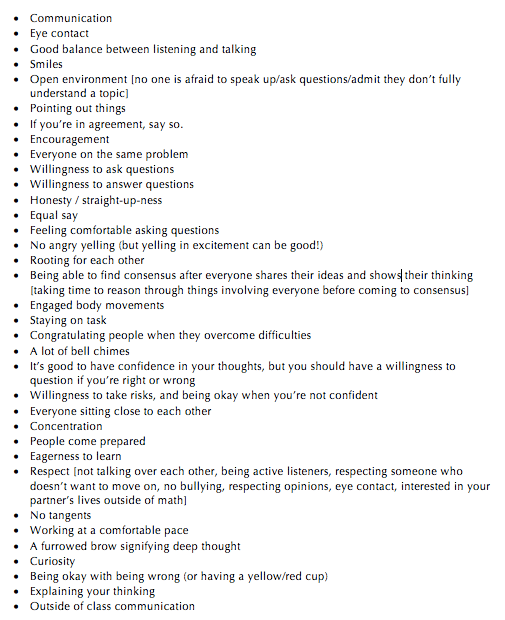
I wrote everything they said down. I asked if anyone had any questions about anything written, or if they disagreed, and we made refinements. Then I left the conversation. It was good to have this conversation because kids had just joined a new group.
That weekend, I created a personalized “form” addressing every single thing on the list:
It took a while, but not as long as I thought. (And since many of the things that kids came up with overlapped from class to class, I reused a lot of these questions… And I think if I do this again, I will be able to use many questions from this bank again.)
Part II of My Solution: Four Weeks Later
So here’s how I used this to have The All-Important How Is This Going? Conversation…. After four weeks, I had kids individually fill out this checklist at home. Notice some of the questions deal with the kid themselves…

… and some of the question deals with the group…

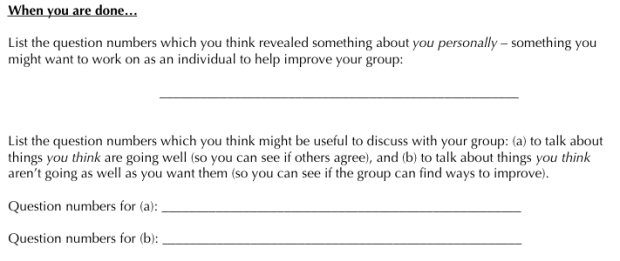
After kids fill out the checklist, they are asked to note a few things:
Part III of My Solution: Four Weeks and One Day Later
Students used these questions to have a facilitated conversation. The facilitation wasn’t awesome — it was too structured, so I have to rethink that. But in essence, each person in each group had a chance to talk about one or two things they thought was going well for the group — and then the rest of the group got to respond (did they see things the same way? did they disagree slightly? completely?). And then the important moment when kids got to talk about what they felt wasn’t going as well. It was here that I loved being a fly on the wall. Kids were honest, and responding positively to hearing what others were thinking. Just for those minutes when this was happening, I knew that this was a worthwhile endeavor. (I think I also asked kids to talk about some specific changes they could commit to to address these things moving forward.) There was, in fact, a lot of agreement among group members about what wasn’t working! Finally, I had each kid publicly make a pledge, based on what they learned about themselves while filling out the checklist, of something they were going to consciously work on.
I decided since we did this four weeks in, I would keep the groups together for another three or four weeks to allow for changes.
Part IV of My Solution: Hasn’t Happened Yet
I am asked to write narrative comments on my kids twice a year. I usually include a specific paragraph for each kid about their group. But I am going to try something different. I am going to have kids draft (either individually or collectively, I’m not sure) their own comment on their groupwork — and about any changes or evolution that might have happened. And I’m going to include their own comment on their groupwork in my narrative comments.
[1] Activities from Jessica Bruer, her slides, my notes from her presentation; Sometimes I do this.

 Then we have the rest of the class on Tuesday, consisting of going over the new trig review answers for a few minutes, and then working on sequences and series.
 or how to graph
  immediately. I wanted us to build up to it, slowly, so they had time to practice and get feedback. It was my job to make sure that before we resumed trig that they had refreshed themselves with the basics.



 radians is a half rotation about the circle. Then we can see that each pizza pie slice is
  ,
, ,
,  , and
, and radians. [The “top” half of the pizza is divided into two, four, three, or six pieces! And the top half is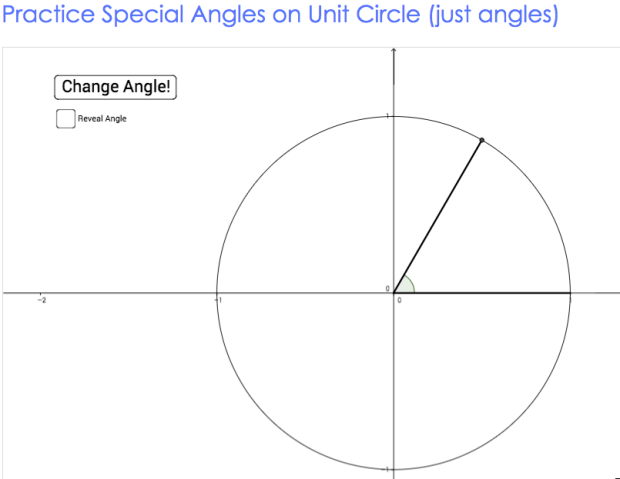
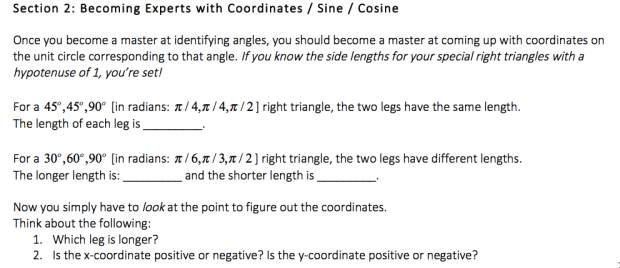
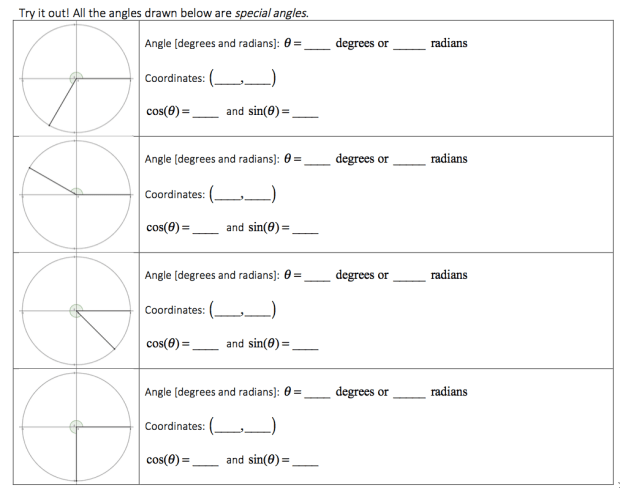
 . They hopefully would have mastered that from the previous exercise. They also will see that if they would draw the reference triangle, the x-leg is shorter than the y-leg, so they know the x-coordinate must be
  (but negative), and the y-coordinate must be
  (but negative).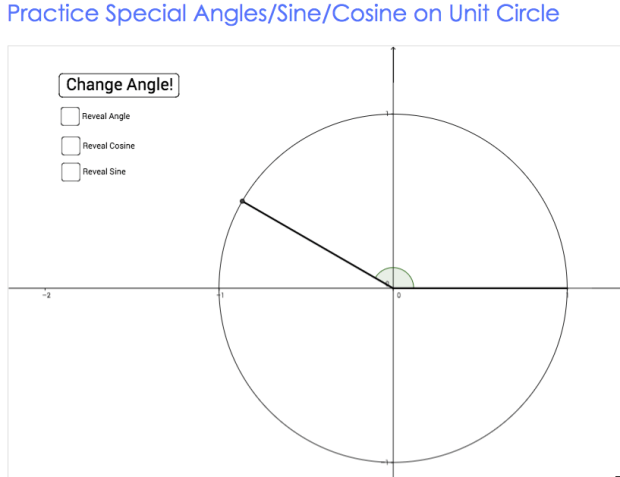
 and
and  . No one is going to be giving them nice pictures!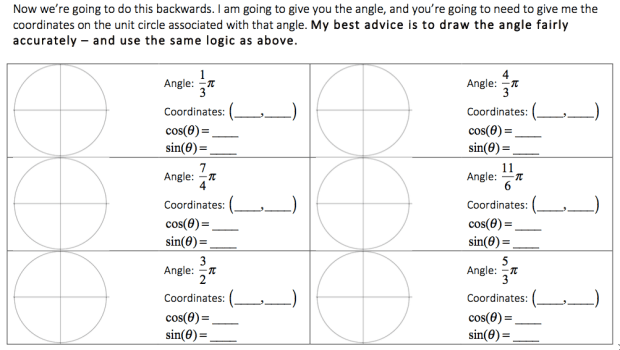
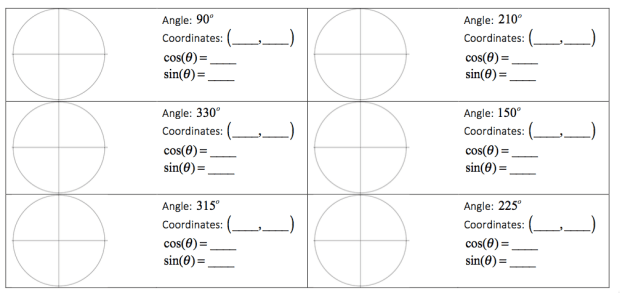
 and
and  (the term number and the value of the term), but it wasn’t a huge number. I actually was pretty proud of that.

 Continuous Everywhere but Differentiable Nowhere