Teaching the Crossed Chord Theorem

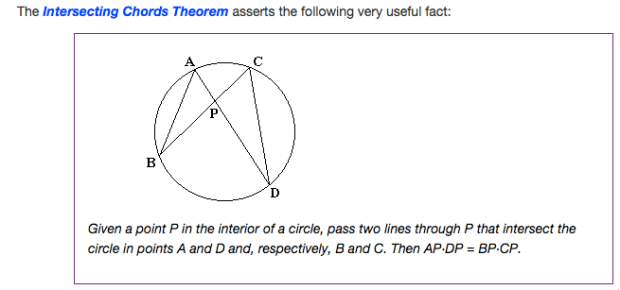
At the end of the past summer (oh how long ago that was! glorious days of freedom!), I hunkered down at a coffeeshop with @jacehan in preparation for this school year. I was fixing up some of the things we did last year in geometry. One thing I wasn’t pleased with was how we taught the crossed chord theorem…
chord.png

So I created a totally new approach. Instead of having students discover the theorem, I would work backwards. Here is the TL;DR from my last post — after I had created the activity.

The TL;DR version: students investigate all quadrilaterals where the diagonals satisfy the property that ac=bd. Students are guided to make a conjecture which we as teachers know will be wrong. Then we show a counter-example to blow their conjecture up. And them bam: they have to try again. Using geogebra and some more encouragement, students discover that all cyclic quadrilaterals satisfy ac=bd. And so the circle emerges out of this investigation of quadrilaterals and diagonals. This is, then, the crossed chord theorem. Which students got at by investigating quadrilaterals. Weird. Now they are in a prime place for wondering why the circle shows up. Proof time!

When I shared the activity, I got a couple suggestions from @k8nowak and @bowenkerins and so I modified it with a single tweak which made it oh so much more powerful. In this post, I will talk about my experience implementing the activity, as well as share the modification I made. However I entreat you to read the original post as I’m not going to outline everything again! So go read! Okay? Okay.

(1) First off, the change. I made a change to the very last question on the sheet… Instead of having students look for blermions “in the wild,” I had them fix three points and find a bunch of different locations for the fourth point (so the quadrilateral would be a blermion).

[docx: 01 Crossed Diagonals [new]]

At the end of class, I had students fill out a google form with their possible fourth points location.

(2) In class, when students were filling out the conjecture in #4, I saw a number of interesting conversations happening. Their conjectures were essentially: (a) all blermions need at least one pair of parallel sides, (b) all blermions have supplementary adjacent angles, and (c) a blermion has opposite angles supplementary. Most students didn’t find any kites that were blermions, which is why they came up with conjectures (a) and (b). But when the few students who found blermion kites said this to the class, we realized that (a) and (b) couldn’t hold anymore. But conjecture (c) was a possibility still.

Now to be clear, I was expecting conjectures (a) and (b). I was floored when not one but two groups out of five wanted to persevere and find a good conjecture, and used geogebra to measure angles. It was awesome. And it led to a great discussion later on. More on that later.

(3) I asked kids why I had put question #5 on the sheet… what might have been my motivation? I liked asking that question and having groups discuss, because they all recognized that by only looking at “nice” shapes (which, granted, I asked them to do), they could only make limited conjectures. And as soon as they see the blermion in #5, most conjectures would go out the window. The point? To show students that all quadrilaterals aren’t “nice.”

(4) The moment when students saw all their group’s data together in #6… Well, two of my groups got to this point in class. It was … incredible. Kids had their minds blown. Something totally unexpected happened.

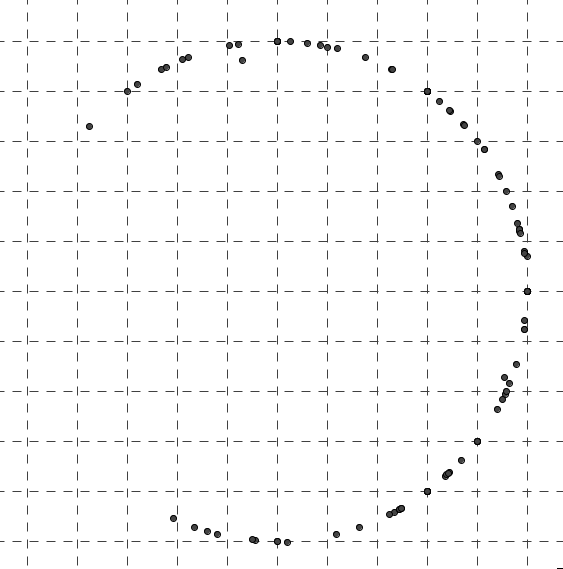
For the other groups, I shared the class data (from the data they entered in the spreadsheet):
GGB.png

Holy cow! It is so beautiful! All possible fourth points of a blermion seem to lie on a circle!

(5) Students then wrote a conjecture, and we said if the conjecture were true, we’d suspect (from the Always Sometimes Never questions in #3) that all squares, rectangles, and isosceles trapezoids could be inscribed in a circle. And we discussed how we were going to prove the opposite: If you have a cyclic quadrilateral (yes, I introduced that term!), that product theorem thingie (a)(c)=(b)(d) holds with the diagonals. Okay, we were a bit more formal, but that was the crux of things.

(6) Before proving that, I wanted to exploit the conjecture (c). I had students prove that all cyclic quadrilaterals had opposite angles that were supplementary. They struggled a bit with this, but once they had their insight, BOOM. (They used the inscribed-central angle theorem thingie — a central angle is half its corresponding inscribed angle).

(7) Then I left students to prove the crossed chord theorem. I gave them this sheet:

[docx: 01 Crossed Diagonals (proof)]

Almost all kids got to the point where they recognized two pairs of similar triangles. And they recognized that if they could prove one pair of similar triangles were congruent, they could set up a proportion and be done! But the problem was proving the triangles similar. Almost all groups got stuck here — and even though I said: you’re almost there! Think about the inscribed-central angle theorem! — they couldn’t progress. I didn’t do a great job of knowing what to say next.

What I did was show them this (which they had created earlier). For some reason, this did not work for them as a hint.

Inscribed Angle Conjecture.png

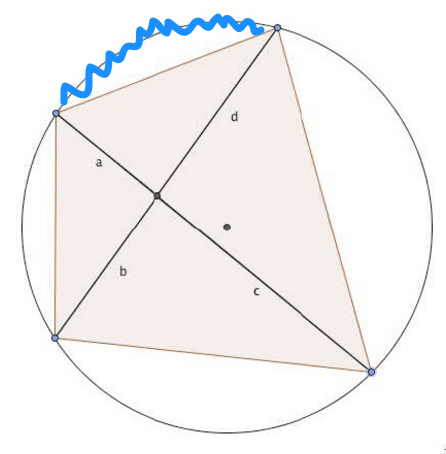
In the future, what I should do is just highlight an arc for them… and say “this arc can guide you!”
arc.png

Maybe that will work better?

However, eventually all groups got the proof.

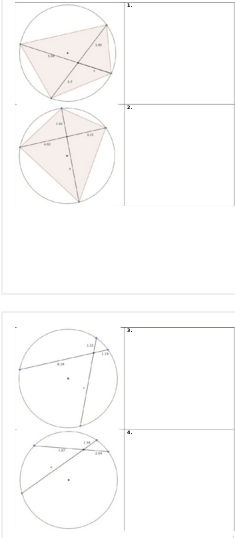
(8) At this point, I had students start solving problems. Two with quadrilaterals and two with chords.
questions.png


Again, I asked them why I included had the second two types of questions, and had the discuss in groups. They recognized that the theorem didn’t need to be stated with cyclic quadrilaterals… Instead it held if we are talking about two line segments in a circle (at that point, I introduced and defined the terminology “chord”). Then I had students write the theorem we had proven without reference to the quadrilateral, and we went around and shared and critiqued the wording.

***

I don’t always love the stuff I come up with. Sometimes it flops. Sometimes it’s pretty good. But rarely do I think it’s so awesome that I would give it the stamp of “highly recommended.” This gets that from me. It is interactive, there is a moment when kids’s minds are blown, and it ties together so many interesting ideas.


For context, I did this after we did our unit on similarity. We then proved that the base angles of isosceles triangles were congruent. We then used that to prove the inscribed-central angle conjecture (download here: A Conjecture about Inscribed Angles). And then this. It flows so nicely.

***

Yesterday, as we were wrapping this all up, I said to my kids:

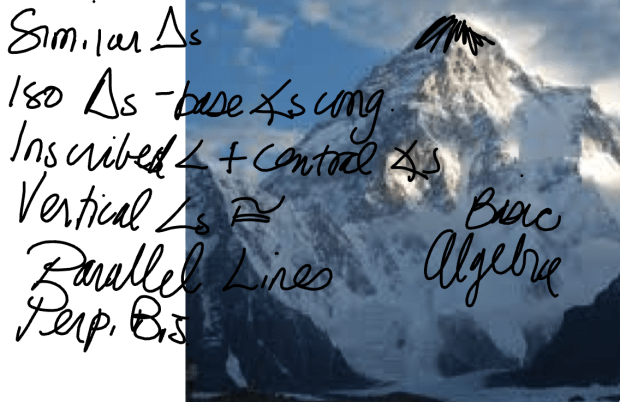
“This thing we just proved about circles and chords… this is at the top of a mountain… this theorem is based on lots and lots of other things. If I gave you a bunch of circles with two intersecting chords in it at the beginning of the year, and said, give me some conjectures about this, I doubt you would ever have stumbled upon this… or if you did, it would have taken you a long time and it would have been an accidental discovery. You still wouldn’t have known why it was true. But now you have built so much mathematics throughout the year that this wasn’t an insurmountable feat. What ideas did this theorem lie on?”
mountain.png

And we even had more. We had to know a lot to get there. But wow, it might have seemed impossible at the start of the year, but it was totally doable with all the tools we’ve put in our toolbelts. And how wonderful and inspirational is that?!

Update: Here is a post about an extension I did on this — involving merblions.

Fold and Cut

Brendan — my geometry coconspirator — and I went to the Museum of Math recently to see Erik Demaine give a talk about math and magic. It was a special lecture for me because I saw Prof. Demaine speak at the very first Museum of Math lecture (before the museum was built), and this was the five year anniversary of that talk.

Prof. Demaine and his father Martin Demaine both are mathematical artists — playfully using mathematics and art in search of higher truths. The most mindblowing thing that he discovered was that by folding paper however you want, and making only one single cut, you can cut out any polygon. Evenmoreso, the theorem goes further: “Thus it is possible to make single polygons (possibly nonconvex), multiple disjoint polygons, nested polygons, adjoining polygons, and even floating line segments and points.” [1]

Whoa, right? So say you want to cut out each letter of the alphabet? Done.

Or you want to cut out a swan or jack-o-latern?

You can do it. It boggles my mind.

When we went to Prof. Demaine’s talk, on each chair was a packet of paper and a pair of scissors. We were challenged to “fold and cut” each of the shapes out. The shapes were scaffolded well, and so I got pretty far along and was figuring things out. At that time, Brendan and I realized that both angle bisectors and perpendicular lines were key for much of what we were doing. We also realized that the puzzle nature of the challenge got us obsessed. We both were stuck on a single page [I’ll write about that in the P.S.] and as I was waiting for the subway home, as I rode the subway home, and all throughout the next morning, I grappled with it. I still have no clue how to solve it.

In any case, we both wanted to expose our geometry students to this puzzle. We figure next year we could turn it into a lesson — having them play and then have them analyze what they figured out. But for this year, we wanted to just see what happened if we gave our kids the puzzles.

I faintly recalled my friend Bowman doing this in his class and blogging about it, so I found that post and used his recommendations about what to have the kids cut out in which order, with the scaffolding that Prof. Demaine used in his packet, with some ideas that Brendan had, to create our own packet of fold and cut puzzles.

Fold and Cut Figures [PDF download]

What happened? Well, we gave kids 25-30 minutes. We had extra copies of pages for if kids messed up and wanted to try again. And we said “go at it.” Of all the kids in my class, only one seemed not to get into it… at the beginning. That student was trying too hard to have a “method” and their intuition wasn’t as strong as the others… but they showed me proudly at the end when their star! All the other students were addicted. Paper flew about. Kids called me over to proudly show me their successes, and wailed in frustration when their cut didn’t work (and then hurriedly asked me for another copy of the page they messed up on ). It was exciting to see kids focused but also having fun playing with math. I would say that 25-30 minutes was the right amount of time, because at that point, I saw kids start to fade. (It could also be that we met at the very end of the day, and this was the last 30 minutes of a 90 minute block…) No kid in the time given was able to get the scalene triangle (many got close) or the last quadrilateral. But almost every kid was able to get all the figures before ’em.

Next steps from here? I want to turn this into something more formal. I like the play. I love the play. But then we need to come up with some general conclusions and talk about why they work. Why are we doing lots of folding along angle bisectors? [Hint: the answer has to do with reflections!] Why are we doing lots of folds perpendicular to the lines of the polygons we’re trying to cut out? [Hint: if we imagine a “vertex” at the place where we have a perpendicular fold, we can consider our fold an angle bisector — bisecting the 180 degree angle of the vertex!] If kids understand those two principles (and the scalene triangle is the most perfect shape to make them both come alive!), I will have a way for kids to tie their puzzling to our geometry curriculum.

What most impressed me was how much intuition kids already had with regards to these. It was amazing to see them take to it as adroitly as they did.

And who knows? Even though I say we should tie this to the curriculum formally next year, maybe I’ll get to it this year after we complete our mountains of salt investigation. Because heck if they aren’t perfectly related to each other!

P.S. So… Here’s where we got stuck. We were given the following paper… no polygon, just a line segment that we had to cut.

impossible

You might say: duh, fold it vertically in half and make a half cut. But here’s the thing: you have to make a COMPLETE cut. So once you start cutting, you have to keep cutting until you have completely hit the end of your paper. And BOOM! Suddenly I am perplexed.

Radical Musings

This is a short post to archive some thinking I did on the subway home from work today. I had a Geometry class today and it was clear to me that their understanding of radicals was … not so good. And I don’t think it is their fault. I remember teaching Algebra II years ago and tried building up some conceptual understanding so puppies don’t have to die… and it was tough and I didn’t really succeed:

puppy

(Poster made by the infinitely awesome Bowman Dickson.)

I also remember having this exact same conversation with my co-teacher last year. We considered the following “thought exercise.”

How would you explain to a student in Algebra I why \sqrt{15}=\sqrt{5}\sqrt{3}?

I would like to add the corollary “thought exercise”:

How would you explain to a student in Algebra I why \sqrt{15}\neq\sqrt{10}+\sqrt{5}?

And so on the subway home, I thought about this, and had the same insight I had last year.

We define (at least at the Algebra I level) \sqrt{15} to mean “the number you multiply by itself that yields 15.”

I want to highlight the concept more than the notation, so let’s call that number \square.

So for us \square is “the number you multiply by itself that yields 15.”
Now let’s similarly call \heartsuit “the number you multiply by itself that yields 5.”
And let’s call \triangle “the number you multiply by itself that yields 3.”

We know from this \square \cdot \square=15. Why? Because that’s the definition of “square” for us.

But we also know \heartsuit \cdot \heartsuit=5 and \triangle \cdot \triangle=3 for the same reason.

Thus we know \heartsuit \cdot \heartsuit \cdot \triangle \cdot \triangle=\square \cdot \square.

Here’s the magic.

Let’s rearrange:

\heartsuit \cdot \triangle \cdot \heartsuit \cdot \triangle = \square \cdot \square .

Study this a minute. It takes a second (or it might for students) to see that \heartsuit \cdot \triangle = \square.

Now remember I used symbols because I wanted to focus on the meaning of these objects, not the notation.Let’s convert this back to our “fancy math notation.”

\sqrt{5} \sqrt{3}=\sqrt{15}

So that gets at our first “thought exercise.”

I wonder if trying the same with the second thought exercise might work? The tricky part is that we’re trying to show a negative statement. I know… I know… most of you probably say “hey, just show the kids \sqrt{1+4}\neq\sqrt{1}+\sqrt{4}.” But that doesn’t stick for my kids!

So let’s try it: for us \square is “the number you multiply by itself that yields 15.”
Now let’s similarly call \clubsuit “the number you multiply by itself that yields 10.”
And let’s call \spadesuit “the number you multiply by itself that yields 5.”

So:
\square \cdot \square=15.
\clubsuit \cdot \clubsuit=10
\spadesuit \cdot \spadesuit=5

Then challenge students do something similar to show that \square = \clubsuit + \spadesuit. They hopefully will start failing in their endeavor!

I predict they will start with: \square \square = \clubsuit \clubsuit + \spadesuit \spadesuit. Yay. That’s true… So from that true statement, they are going to try to show that \square = \clubsuit + \spadesuit.

But they can’t really go anywhere from here. They’re stuck. I still predict some weaker students may say: “But clearly we can just say \square =\clubsuit + \spadesuit. It’s like you have “half” of each side of the equation!” But it is at this point you can ask students to do two things:

1) Ask ’em to show the algebraic steps that allow them to make that statement. There won’t be valid steps. And in this process, you can see what other horrible algebraic misconceptions your students have (if any).

2) Or say: okay, let’s see if you’re right. If \square =\clubsuit + \spadesuit, then I know \square \square=(\clubsuit+\spadesuit)(\clubsuit+\spadesuit). And as soon as you start distributing those binomials, they’ll see they don’t get \square \square = \clubsuit \clubsuit + \spadesuit \spadesuit (our original statement).

Okay I just needed to get some of my initial thoughts out. Maybe more to come as I continue thinking about this…


Snug Angles

In Geometry this year, I wanted to write a few more problems to have kids practice with angles of regular polygons… so as I was coming up with a few problems, I realized they had a nice theme to them.

“Which polygons fit together snugly? Which don’t?”

[02 Snug Angles download][Note: There is a typo on #6… It refers to problem 2d, but it should refer to problem 2c]

I made this the day before the class I was going to teach it. But I wanted to have a hands-on “playful” component to this. I asked teachers in my school if they had regular polygon tiles with the same side length… I got a set which included triangles, squares, and hexagons. No pentagons, no heptagons, no nonagons, no decagons, nada.

Of course these tiles were probably produced for lower school kids precisely because they fit together “snugly” at a vertex. But no “play” could really happen if sometimes things didn’t fit nicely together. So — for future reference — I asked on twitter to my math peeps if anyone knew where I could buy regular polygon tiles of all sorts. No links were forthcoming. Sigh.

In class, I expected #1 to be challenging. I wanted students to come up with a reason they had found all the possible regular polygons (of one kind) that fit snugly together. It was nice to see students reason through it, and when we came together as a class, we had a few different cogent explanations. Some involved calculating all possible factors of 360. Some involved recognizing that the more sides you have in a polygon, the fewer of them can fit together “snugly” at a vertex (and the minimum number of polygons that can fit at a vertex is 3).

Although I was expecting #2c to be challenging, I didn’t realize how challenging it would be. I thought I had built a scaffold with the previous problem so it wouldn’t be too hard. What turned out to be the problem? The fact that a regular 7-gon had a non-integer interior angle value. Kids didn’t know that could happen, and that really threw them. Also: setting up the equation was challenging, because kids were confusing “the sum of the interior angles in a regular n-gon” with “the measure of one interior angle in a regular n-gon” (a calculation they had never been formally taught, and were supposed to figure out themselves during this exercise).

I’d say only about half the groups could deal with 2c without any help.

However, all groups ended up being successful. And I just graded their assessments on polygonal angles, and almost every single student got the problem that was similiar to 2c!

The very last question asks students to discover as many possible combinations of regular polygons that could fit together snugly at a vertex. I assigned this as a nightly work problem — and the next day, students came in with lots of great combinations. Unfortunately, I didn’t do anything with this. I should have — but I felt pressed for time.

We could have talked about why 6 polygons were the maximum number that could fit together, or 3 polygons were the minimum number that could fit together. That could reduce our searching! Then I could have asked how people approached the task. Guess and check? Geogebra? Is there a systematic way they could have approached this problem — if they had infinite time and patience — that they could guarantee they had found all possible combinations? Do all combinations need at least one 3, one 4, one 5, or one 6?

Or we could have spent some more time looking at all possible combinations. Some kids noticed — after looking at the comprehensive list I threw on the board after they finished sharing their values with me — that many of the values had common factors: so 3, 7, 42 is one crazy combination that works. And both 3 and 7 are factors of 42. What else could we find?

What I’m trying to say is: the last question was kind of a dumb question to put on the sheet without having a good way to debrief it, and a meaningful conclusion we could have gotten from it. Sigh.

Okay, on to the exciting part. I said I asked on twitter if anyone had a site to buy these tiles. No responses. BUT Christopher Danielson then asked what I was looking for. Kate Nowak jumped on the bandwagon and brainstormed what a teacher might want, ideally. Yesterday, I came home from school and had a box waiting for me. In it:

20160116_130324

They are beautiful. And gosh do they smell awesome. Real wood, that smells awesome. I was in heaven when I saw them. So beautiful.

And even more satisfying: you’ll notice that the 3, 7, and 42 fit snugly together!

Now the million dollar question: assuming I had however many of each tile I wanted, what would I do with them? How would I restructure the unit to use them in a way that is compelling? I wanted the tiles initially because I thought some “play” with the tiles would be fun, before delving into the algebra to see the justification of why some work and some don’t work. But I want something more! Something that will have them figure out the 3, 7, 42 connection and gasp! And the 4, 5, 20. And the 3, 8, 24. And the 3, 10, 15. And the 4, 5, 20. And GASP with surprise and horror and delight!


I don’t quite know… But maybe envelopes with index cards in them. And some of the index cards have some configurations they have to “check” to see if they work or not. And some of the index cards have two of the tiles, and students have to see if there is a third tile that works. And for each configuration that works, students get to come to the front of the room, grab those tiles, and check to see if their algebra worked by checking to see if the tiles truly do fit snugly. If they do: they record their discovery on the board for all to see. And by the end of the class, students will have had practice, and in the last 5 minutes, we could all gather at the front, and view some of the weird snug angle configurations together. And see how configurations that are “close but no cigar” don’t work (like 3, 10, 16… which is close to 3, 10, 15). When doing this, we could also talk about why 4, 10, 15 is “worse” than 3, 10, 16 in fitting snugly.

That’s all my musings for today! I’m going to be chaperoning a trip to Spain in a few days, and that will last two weeks, so goodbye for a while!

Interested in Presenting at TMC16?

TMC

We are starting to gear up for TMC16, which will be at Augsburg College in Minneapolis, MN (map is here) from July 16-19, 2016. We are looking forward to a great event! Part of what makes TMC special is the wonderful presentations we have from math teachers who are facing the same challenges that we all are.

To get an idea of what the community is interested in hearing about and/or learning about we set up a Google Doc (http://bit.ly/TMC16-1). It’s a GDoc for people to list their interests and someone who might be good to present that topic. The form is still open for editing, so if you have an idea of what you’d like to see someone else present as you’re writing your own proposal, feel free to add it!

This conference is by teachers, for teachers. That means we need you to present. Yes, you! In the past everyone who submitted on time was accepted, however, this year we cannot guarantee that everyone who submits a proposal will be accepted. We do know that we need 10-12 morning sessions (these sessions are held 3 consecutive mornings for 2 hours each morning) and 12 sessions at each afternoon slot (12 half hour sessions that will be on Saturday, July 16 and 48 one hour sessions that will be either Saturday, July 16, Sunday, July 17, or Monday, July 18). That means we are looking for somewhere around 70 sessions for TMC16.

What can you share that you do in your classroom that others can learn from? Presentations can be anything from a strategy you use to how you organize your entire curriculum. Anything someone has ever asked you about is something worth sharing. And that thing that no one has asked about but you wish they would? That’s worth sharing too. Once you’ve decided on a topic, come up with a title and description and submit the form. The description you submit now is the one that will go into the program, so make sure it is clear and enticing. Please make sure that people can tell the difference between your session and one that may be similar. For example, is your session an Intro to Desmos session or one for power users? This helps us build a better schedule and helps you pick the sessions that will be most helpful to you!

If you have an idea for something short (between 5 and 15 minutes) to share, plan on doing a My Favorite. Those will be submitted at a later date.

The deadline for submitting your TMC Speaker Proposal is January 18, 2016 at 11:59 pm Eastern time. This is a firm deadline since we will reserve spots for all presenters before we begin to open registration on February 1st.

Thank you for your interest!

Team TMC – Lisa Henry, Lead Organizer, Mary Bourassa, Tina Cardone, James Cleveland, Cortni Muir, Jami Packer, Megan Schmidt, Sam Shah, Christopher Smith, and Glenn Waddell


Clock Puzzle

In our last department meeting, one teacher presented a puzzle/problem for us to figure out.

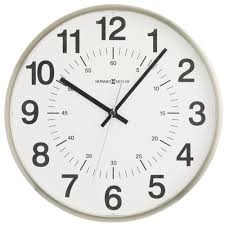
At 3:00, the hour and minute hands on a clock form a right angle. What is the next time that happens?

clock

The presenting teacher had a pretty darn elegant solution. But I enjoyed working it out using brute force. (That’s pretty much my go-to.) I’m going to type my solution down below the jump.

(more…)

Playing with Blocks: Three Dimensional Visual Sequences

During this school year, we now have occasional 90 minute blocks with our classes. I was trying to decide what to do a couple weeks ago with my precalculus class, and stumbled upon the embryo of a good idea. Kids playing with blocks to create 3D sequences. (This idea was inspired by Fawn Nguyen’s site Visual Patterns.)

I got blocks from our lower school math coach. I told kids (either working individually or in pairs) to play around with them until they found a pattern that looked interesting to them. I didn’t want them thinking about the sequence yet… I wanted them to create patterns that looked neat. The only restriction I put on them is that the pattern had to be three dimensional. If it could be represented in two dimensions, I didn’t want to see it.

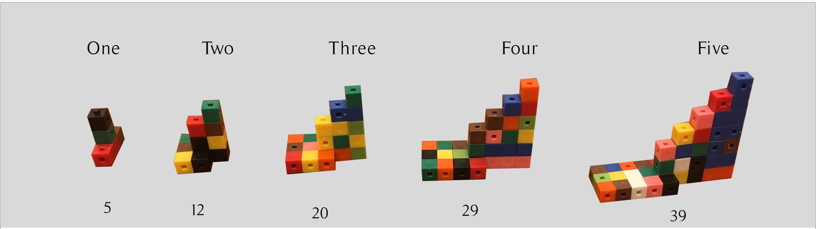
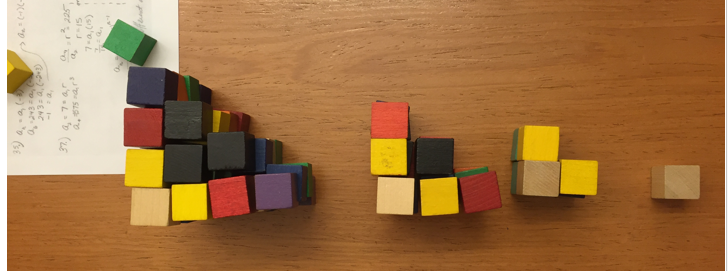
They made some really nice sequences! Here are a random set of 4 to look at:

visualsequence1 visualsequence2 visualsequence3 visualsequence4

I then had students work on filling out this form. It asks them to articulate their “rule” (for building up the sequence) and has them attempt to come up with both explicit and recursive forms to get the nth term. I make it clear to them that if they can’t get the formulae, I’ll give them full marks as long as they show a serious attempt. (Some of the sequences they built involve some mathematical hoops they might not be able to traverse… for example, one group needed to find 1^2+2^2+3^2+...+n^2 which is lovely, but not something they are going to easily figure out.

[.docx version here]

If I had time, I’d love to do two more things with this.

(1) I think it would be neat to take the photographs of one person’s sequence and give them to another person, to see what they figured out for the explicit and recursive definitions for these sequences. Why? Not only is it sharing more publicly the sequence the kids created, but many of them got a bit stuck on an explicit formula that they do have the capabilities to find, but couldn’t. I think a fresh pair of eyes, and a conversation, could be beneficial for both the original sequence creator and the new person approaching the sequence. (Additionally, there are often many ways to look at these sequences, so even if both got the same formula, there is a good chance they came up with it in different ways.)

(2) Students created a table with the first 5 terms of the sequence in it. I’d love for students to extend the table to 7 or 8 terms in the sequence, and then have students work on finding the first differences, the second differences, the third differences, etc. If students understand that having the same first difference means they have a linear relationship, having the same second difference means they have a quadratic relationship, having the same third difference means they have a cubic relationship, etc., then students who got stuck will have a new tool in their arsenal to find the explicit formula for the sequence. If, for example, they had 5, 9, 15, 23, …, and saw a common second difference, they could do the following:

Finite-Differences

Since they suspect the relationship is quadratic, they could say: t(n)=an^2+bn+c. And then they’d be hunting for the a,b,c to make this the correct quadratic for our sequence. And then use the following three equations, they could come up with the a,b,c.

5=a+b+c

9=4a+2b+c

15=9a+3b+c.

In fact, this is an awesome thing to revisit when we get to matrices to solve systems of three variables!!!

UPDATE: One more thought before I lose it! What if I gave students the numerical sequence (e.g. 5, 9, 15, 23) expressed either written out as a list, written out as an explicit formula, or written out as a recursive formula, and had them generate a visual sequence to match it. I’d love to see how many different and interesting sequences might be created that go along with a single sequence!