Inverse Trig Functions

At TMC13, I was in a group of people talking about precalculus. One of the exercises we did was make a list of some of the topics we found challenging to teach as teachers — and we broke out in groups to try to come up with ways to tackle those topics.

My group’s topic was inverse trig functions. (This was with April, Dan, Greg, and Andrew.)

Our initial task was to find the deep mathematical idea behind the topic… why we teach it, what we think we can get out of it conceptually… and what we sort-of converged on is that the topic really illuminates the idea of inverses and restricted domains. And that’s about it. And when push came to shove, we decided we didn’t find that restricted domain is something we really care about. We decided we didn’t really care about the inverse trig graphs, and the work we put into that side of things wasn’t really worth what we little we were able to squeeze out of it. It’s not that it is horrible, but we just didn’t couldn’t justify it.

So, honestly, we decided to just focus on inverses, and the idea of them as “backwards problems.”

Thus, we came up with two things:

1. A packet that has students secretly engage with inverse problem work before they even know what they’re doing. So the first packet is meant to be used before any unit circle trig is introduced. (A few of us, especially April, did something similar in her classes, and randomly, Greg Taylor did a my favorites on the same essential idea!)

In fact, if I were to use this in the classroom, I would not even mention the words “trigonometry.” I would focus on the idea of coordinate planes and circles, and simply leave it there.

2. A packet that students work on after they learn unit circle trig — and that more formally introduced the idea of the inverse trig functions. It tries to draw connections between the unit circle, the sine/cosine graphs, and their calculators.

There are concept-y questions for both packets. I’m including both packets below in one document. I’m posting one with a few teacher notes, and one with the teacher notes hidden. (The .docx is here if you want to edit!)

Packet with teacher notes 

Packet without teacher notes

We did all this planning in pretty much an hour and a bit — from start to finish. And then I pulled together the ideas to make this document. I’m not sure I was able to capture everything we talked about, but I think I got most of the big things. Apologies to my collaborators if I totally botched the translation of our vision to reality!

TMC13: The State of Things (for Me)

I recently went to TMC13. If you don’t know what that is… there is a community of math teacher bloggers and twitterers who met up at a conference called “twitter math camp 2013.” It was a conference “for us, by us.” I’ve been doing a lot of thinking about our community in the past two years. Here’s my current iteration of my thoughts, after this conference.

I want to be clear that this is my experience and thoughts. I know I am not everyman, and I know my musings maybe (probably) do not match everyone’s experiences out there.

***

The day I came back from TMC13, I was scheduled to give a talk to about twenty peeps about to enter their first year of teaching in New York City. My goal was to show them that the mathtwitterblogosphere is a place that can help them – if they put in some initial legwork, and keep an open mind. I did my schtick for around 90 minutes, and then I left, feeling like I had failed.

It wasn’t that I actually had failed. I asked them to fill out notecards at the end with their honest opinions/thoughts/questions, and I had gotten really uplifting feedback.

But here’s the thing. I wasn’t able to package what we were, and how insanely perfect a community this is, and how insane it would be for someone in their shoes to not take advantage. And that’s because I don’t know how to bottle up that kind of fire and passion. All I can do are pale shadows of pale shadows. I showed them a bunch of things, I had them read tweets from others, I let them explore (in an open-ended but guided way) resources that I thought would be especially helpful to them. But I left knowing I could have done much better.

We’re inspirational. But how the hell do you get that across without sounding like a zealot? Maybe sounding like a zealot is the answer.

Because coming on the heels of TMC13, I have nothing but the most amazing feelings about MTBoS. Last year I left TMC12 grateful that I could now call my tweeps “friends” and mean it in the entire sense of the word. They got me – to the core – because who I am at the core is a math teacher. It defines me. And the  people at TMC12, with their “unnatural obsession with teaching math,” reveled in being with others of our own kind. We’re a rare breed.

This year, I had all those feelings – yes – but the main takeaway of the conference was new. It was that we are a powerful force. We are not a loosely connected network of professionals, but we are a growing, tightly-connected network of professionals engaged in something unbelievably awesome. Through this community, we are all – in our own ways – becoming teacher leaders [1].

Here’s what I mean. I have been teaching for only six years. I took a total of 5 classes on education in college during my senior year. And the honest truth is: I’m not amazing in the classroom. I will repeat that because it is crucial for this post. I’m not amazing in the classroom. Conclusion: I am not – by anyone’s criteria – an expert.

But I’ve learned through this community that I have value. And this, here, is precisely it. This is what I tried to make clear when talking about our community and TMC13, but kinda failed, to those about to embark in their first year in the classroom. Every single math teacher out there who cares about their students and their student’s learning has value. I don’t care if you’ve been teaching one year or one month. And that value could be confined to your classroom, or to your school. But what the mathtwitterblogosphere does is it allows us to have value for each other too. And that means suddenly that have value beyond our own local neighborhood. [2] By having our little cabal of math teachers connect online, things like age, years of experience, the type of school we are at… those things begin to matter less. It’s the personalities, the way we interact with each other, the ideas that we share and the resources we freely give, the emotional support that we provide… those things matter more.

I want to unpack the “tightly-connected” adjective used above, because I think this is actually what TMC13 is helping cultivate. The good things about the community that have made us tightly connected: compassion and empathy, encouragement, inspiration, generosity, and most importantly, a willingness to help each other out at any costs.

What aren’t we willing to do for each other? I’ve fielded midnight phonecalls from tweeps in distress, and written pick-me-up emails to people who are feeling down. I’ve shared a whole year’s worth of calculus materials I’ve created with people teaching calculus for the first time. I’ve had people share their entire precalculus course materials with me, when I said I was teaching it for the first time last year.  I’ve had chocolates sent to me and my department from a tweep, just because. I wanted to make a mathtwitterblogosphere website, and I had so many people immediately volunteer to make videos for me. I’ve been mistreated by (you name it and it’s probably happened) and have gone home in tears, where I felt listened to and supported by people in our tribe. I’ve written letters of recommendation for tweeps looking for new jobs, and I’ve had tweeps write a collective letter of recommendation for a summer program I was applying to. We’ve moved past just being a way to give and receive amazing resources and ideas for the classroom.

We’re invested in each other’s success. We’re invested in each other’s happiness. We’re invested in each other.

That’s why we’re tightly connected.

Another word to describe this? After TMC12, I argued that we could now call each other “friends.” Now, with another year under our belts, I kinda think we can call ourselves a “family.”

How do you bottle that feeling when you realize you, only a sixth year teacher, are valued by others outside of your school? That you are significant to a whole bunch of someones out there in the world? The confidence you get about your own teaching when someone comments saying kids in their classroom loved an activity you created?

How you share that phone call your tweep fielded when you were ready to give up and quit, because you felt like you sucked? And you left that phone call not only feeling better but en energized?

How do you share the rolling, side-splitting laughter that you get when you read a tweet about Air Bud?

How do you share the transformation that the community can give you in your outlook? When you felt like there were so much on your plate and so many obstacles that felt insurmountable – that all you had was a pit in your stomach and only anxiety about returning to school next year… and then you go to TMC13 and you suddenly began to see all the hurdles as opportunities, and you suddenly get excited about attacking them?  

I know this is a schmaltzy post. I know that different people are at different levels of familiarity with those in the community. But I have only love — with recognition that there are real people behind the words on a blogpost and behind the tweets, just trying to do their best, suck a little bit less at teaching, and being generous as much as they can. I have much love for that.

I learned a lot about TMC13 about teaching and learning. And I was going to make a blogpost recap all about those things. But this seemed like a better investment of my time.

(Dedicated to Lisa Henry, Shelli Temple, Max Ray, Anthony Rossetti, James Cleveland, and Jessica  Bogie.)

\\

[1] That’s something I’m coming to realize recently. This community not only puts glass walls around our classrooms, so we can constantly be peering into multiple teaching laboratories and see best practices, but many people are peering into our own classrooms via our online presences. Being a part of this community allows us to grow professionally, and allows us smooth ways to become teacher leaders. We can offer to lead a session at TMC13. We can host a Global Math Department. We can compile a comprehensive set of resources that others can use to align with the Common Core. We can lead online initiatives or start online collaborations that result in something bigger than ourselves and our classrooms. And it’s all done in our safe, encouraging, accepting, helpful, generous community . We can begin to spread our wings as we emerge into professional leaders.

[2] We can have value by sharing windows into our classrooms. Sharing activities and lessons and worksheets. And experiences and ideas. And notes on what didn’t work. We have value by freely giving our experiences and work products to each other.

On the flip side, we can have value by using someone else’s ideas/lessons/activity in our classrooms. It may seem backwards, because we are consumers – freely taking from others. But when someone posts a comment on my blog saying they totally used something I did, I feel uplifted. I feel valued. I feel like my opinion and thoughts matter. So anyone who has ever used any of the things I’ve put out there have so much value to me.

You have value whether you are a consumer, a producer, or a consumer-producer… a lurker, an occasional pop-in-er.


Students know themselves better than we do: Recommendation edition

I teach high school, but until last year, I did not teach a class filled with mainly juniors. However every year I still get asked to write between 5 and 10 college recommendations. This year, I was asked to do more. I have a process, and it works for me, but it’s not efficient yet. Probably because I have this tendency to be loquacious and undisciplined when I write. This post is not about that process.

I wanted to share something I’ve started doing, which might be like a “duh, obvious!” thing that everyone does… or maybe it is going to be “oh, that’s such a great idea! why don’t I do that?!” moment for people. Who knows. But since I’m consumed with recommendation writing (more accurately: procrastinating recommendation writing) I figured this is the time to post it.

I used to have kids write letters of recommendations of themselves. I would send them this email to explain it better (after I explain it in person — because I do not write letters of recommendation unless a student sets up a time to meet and asks me formally and thoughtfully).

As I told you in person, I’m more than delighted to write a recommendation for you. As I told you, I ask everyone I’m writing a recommendation for the same thing:

When you have all your colleges picked and the forms gathered, will you give me the forms paperclipped to stamped and addressed envelopes? It would be good to have them at least two weeks in advance of when you want them sent out. That way I can do them all in one fell swoop.

Also, when I write recommendations, I usually ask students for two things: (1) things you want me to highlight in your recommendation [math or non-math related], and (2) for you to write a sample recommendation for yourself. Why? Well simply put, it is this: recommendations become strong recommendations if there are lots of specific details/specific instances/stories. And you know things I wouldn’t know — like if you formed a study group or something. Don’t feel like you need to be humble. Just write it honestly and with confidence.

For (2), the more specifics you have, the better my recommendation can be. You know your own experience with me, with math, much much better than I do. The more details you can give me about that (e.g. “I remember helping students X, Y, and Z each time before a test” or “I remember asking Mr. Shah for more difficult problems to work on…” or “I remember one class where we did X and I remember thinking ‘wow, this is…'”), the stronger the recommendation I will be able to craft. Even if there was a specific instance where you felt things were hard and frustrating, what you pulled through learning about yourself/about math? Or even how you feel about math, and if these feelings changed over time?

Those are things that will help me craft something really wonderful for you. I mean, of course I can craft something wonderful already, but I want it to be extra wonderful (!).

I got a lot of good mileage out of this. I wanted kids to write their own recommendations because I wanted them to focus on what was important to them, without me getting in the way. They had free reign to write about what was important to them. (I also secretly was happy that it showed them what a challenging thing they were asking me to do.)

The rub with this… The kids who were more abstract thinkers, who were good at reflecting, would do a good job and produce something I could use. Something that would inspire me on how to frame the kid in the letter. Often times I would get a juicy quote or two that I could snip out and use to quote the student themselves. But then there were the kids that just either didn’t understand what a letter of recommendation was (understandable), so it would be garbage, or kids who didn’t know what to write about and couldn’t deal with the openendedness (also very understandable). I’d say the latter kid was more common than the former kid.

So inspired by my colleagues at my school, I stole and adapted a questionnaire they asked kids to write on. And I think this year I hit a pretty good iteration of the questionnaire.

(.doc version)

I make sure to emphasize when we meet in person the reason for the questionnaire. I explain how details and stories make solid recommendations into really strong recommendations, and how their words help me bring them to life. Most importantly, I tell them that I want them to know that I don’t presume to know them or their experiences better than themselves. I value them enough to say that they know themselves better than I will ever get to know them. And so this is my way of honoring that. (Though I’m sure I’ve never quite said it that way.)

I tell them to not do it in one sitting, but to really think about it and do it well over a few days. And that comprehensiveness and completeness and thoughtfulness is really important — because it will make their recommendation better, but also importantly, it shows me the their work-ethic and the awesome student they are who are willing to go the extra mile. I then say the same thing in an email I send to them with the questionnaire attached.

This year I have gotten the most amazing set of responses back from this iteration of the questionnaire. I have so many quotations I want to pull and include. I’ve learned so much more about my kids than I ever knew — there is so much depth to their worlds that come through.

In about half of the recommendations, I already go in with an idea of what my “thesis statement is.”

Examples:

1. There are certain students as a teacher that you feel so lucky to have in your class. These are students who have something unique about them, that set them apart from the class-at-large. This year in X Class, Y is that student. I am a teacher at Packer Collegiate Institute, a small, independent school in Brooklyn, NY. What Y has going for him is something I don’t see often, even among the advanced students: an insatiable curiosity (which many have), and the independence and drive to actually do something with that curiosity (which very few have).

2. In this letter, I hope to share with you the wonderful kid that I have gotten to know, and talk about the two very significant ways she has transformed herself in our X Class. The first is with Y’s ability to work in groups; the second is with Y’s passion for mathematics. The thing I personally was most proud of Y for was the complete revolution she underwent in her conception of (and her interest in) mathematics.

What’s awesome for me is that I tend to get total confirmation about my framing of kids after I read their responses. I feel pretty awesome that I got to know them as well as I did.

But for the other half, I either haven’t gotten to know the kid well enough to frame them, or I struggle with coming up with the most positive framing possible. After reading these questionnaires, I never struggle on how to frame these more challenging recommendations.

I gather these questionnaires, my narrative comments, my gradebook, and reflections I have kids write twice during the year (as a way for me to take the temperature of the class and check in) in a packet. These are my source material for my recommendations.

Then I procrastinate.

Exploring the MathTwitterBlogosphere

Coming in October 2013!!!

This year, we’re going to be holding a updated version of the Math Blogger Initiation that happened last year! We were crazy surprised by how many people were interested in joining up and trying something new — blogging with other math teachers! This year, we are planning to have a slightly different program for people to join called…

We’re designing it to help those who are either just starting out with the mathtwitterblogosphere or for those who have dipped their toes in and want to get even more involved. Or even if you have dropped off the face of the virtual planet and want to join back in!

Each week we will post a new adventure for you to participate in involving the online math teacher community. And we are planning a virtual reward for those who participate in every event! However you don’t have to participate every week — you have to do what’s good for you. By the end, we hope you feel like you know much of what’s out there. Ultimately, the end goal is personal growth (not comments and blog readership).

Join us on this exciting adventure! Meet new friends! Get tons of new ideas!

So y’all can start school smoothly, we’re going to be starting this in October, and we’ll release more information in mid-September.

Let the fun begin!
Julie, Justin, Sam, Tina

My thoughts on #MTBoS

That acronym stands for the bulky and unwieldy (in name, in actuality) mathtwitterblogosphere. There have been some heated discussions lately online (on blogs, on twitter, on email) around a post that Dan Meyer wrote about the Global Math Department session called “Choose Your Lunch Table: A Warmer #MTBoS” (you can watch it online). My internet wasn’t working when the session was happening so I was only able to listen in from my phone.

I don’t really want to spend the energy to engage deeply with Dan’s post, as others have done (Approximately Normal, Divisible By 3, f(t)). Briefly, I think Dan has some really valuable things to say in his post, but when it came to his analysis of the session, I believe he was misreading a lot of what was going on. (There were no “corporate resolutions.” And there was no “High Council of the Math Teacher Bloggers.”) There is no better evidence for me thinking Dan was looking at what was happening through a strange lens than simply looking at the google doc that was made during the session, where I just see a thoughtful discussion and some great points.

But I don’t think anyone there saw it as anything more than a rich conversation. (And if I saw what Dan saw, I would agree with him wholeheartedly. I just didn’t see it that way.)

That being said, I wanted to throw my two cents out there during the session, but since I could only listen from my phone, I’ll type what I wanted to say here.

My Two Cents

I love that we’re a disjointed community. There are many conversations going on in many different places. On twitter, yes. On blogs, yes. Over emails, yes. At the global math department, yes. In person, yes. On facebook, yes. There is something ridiculously amazing about how non-centralized and grassroots this all is. And that it has sustained itself for so long, and has been growing so fast.

One of the awesome-est things for me is thinking about how many different ways someone can get involved. Lurking, of course, by reading blogs and tweets. Writing your own blog. Submitting to other blogs (a special moment on the one good thing blog, a graph to daily desmos, a student misconception to the math mistakes blog, an assessment to the better assessments blog…). Attending the global math department. And even starting your own thing because heck, you wanted to (e.g. the a day in the life initiative)!

It’s disjointed, and doesn’t have a center, and that allows for so much creativity and so many different entry points for people. I attribute that this is precisely why this whole community evolves in a positive way, and can grow in the way that it has. I don’t want the disjointedness to change. I don’t want to be an organization. I don’t want a hierarchy.

However, just because we’re disjointed and decentralized does not mean that we can’t ask who we are (knowing the answers are going to be multiple and individual) and what we want to get out of this community (knowing the answers are going to be multiple and individual) and what our experiences have been (knowing the answers are going to be multiple and individual). You get where I’m going here. I think these questions are great because they can lead to some awesome stuff. Approximately Normal got it right…

 I think it will continue to grow and evolve into whatever we need it to be.

But I have to say: growing and evolving doesn’t happen passively. We’re not bystanders in the process. We are actively doing it in the ways that we’re participating with the community — whether we’re conscious of it or not. So questions like: who are we? what do we want to be? how can we make our experiences better? what can we give back to others? How could those be bad questions — as long as we understand the answers are going to be multiple and individual? Those sorts of questions can lead to some awesome collaborative work by like-minded people.

Simply put, there is no taming of the #MTBoS, because it’s all of us, and we are not homogeneous. And that I love.

Engagement with the #MTBoS

There’s no right way to participate in this weird disjointed passionate community. Do what moves you. Do what makes sense for you. And give others those same allowances.

I limit who I follow and have a protected twitter account. That’s okay.

I don’t comment on other peoples’s blogs regularly anymore. That’s okay.

I have never done a 3 Act with my kids. That’s okay.

I like doing collaborative projects with other teachers online, but I rarely have time to. That’s okay.

I often ignore everything in the #MTBoS (sometimes for a month or more) because I’m too busy. That’s okay.

I almost never criticize/push back on other people’s teaching ideas. (I would rather do that sort of work in person when I have more context.) That’s okay.

I skip past almost 95% of blogposts in my rss reader, unless they give me concrete things I can do in my classroom. That’s okay.

I constantly feel anxiety that there are so so so many better teachers out there and I’ll never get there. That’s an okay feeling.

I haven’t updated my virtual filing cabinet in months or revamped my very very very outdated online portfolio or done a major overhaul on the mathtwitterblogosphere site since it was created. That’s okay.

I sometimes take an idea from a blogpost to use in my classroom, and forget to say thank you in the comments. Though rude, even that’s okay too.

I don’t care about the “big questions” about teaching and ed policy. That’s okay.

You should never feel guilty engaging with the community in ways that make sense to you [1]. We’re all coming at teaching from such different places in our careers, such different backgrounds, and such different environments. We all need and want different things. I’m okay with that. I’m more than okay with that, because the fact that we’re all coming together from such different vantage points is what makes this little village work well for so many different people.

[1] As long as you’re not a know-it-all-jerk-face. GROSS.

My Introduction to Rational Functions

Going into Rational Functions

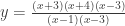
My impression is that most people introduce rational functions by showing something like…

y=\frac{(x+3)(x+4)(x-3)}{(x-1)(x-3)}

… and then spend the rest of the time asking kids some questions, like “what’s the x-intercept(s)?” “what’s the y-intercepts?” “what’s the vertical asymptotes?” And so from one big equation, you pull out all this individual stuff…

But from what I’ve seen when most kids approach rational equations, it is all very procedural. And every time I dug a little deeper to see what they truly understood about these equations, it became clear that a procedure to “solve” these questions was taking the place of understanding what was going on. So pay attention. You might recognize students don’t know what a hole truly is and why it appears in a graph… or they might not understand why vertical asymptotes appear… at least not on a deep level. The answers I have heard from kids are procedural, and rarely have any deep stuff underneath.

To counter this, I made two major changes to how I approach/introduce rational functions this year.

First, initially, I focus heavily on the graphical side of things. To the point where on the first day, students do not see a single equation, and are asked (entreated!) not to write a single equation down.

Second, I want kids to build up rational functions, instead of breaking them down. I want them to see how they are constructed term by term by term.

So  for example, when we see the rational function listed above, we find it easier to view it as:

y=\frac{x-3}{x-3}\cdot\frac{1}{x-1}\cdot\frac{x+4}{1}\cdot\frac{x+3}{1}

Kids need to understand what the first term is doing — not just “as a rule” but conceptually/graphically. I expect them to say that for any x value other than 3, the fraction will evaluate to be 1 (thus it will not affect the rest of the multiplication), but when x is 3, we clearly get something undefined.

Kids need to understand that the second term is creating the function to blow up in a certain way at x=1. Not just because we’re dividing by zero so things go crazy and explode, but being able to articulate precisely why the function blows up. (The explanation I’m looking for says that at x-values closer and closer to 1, the denominator is getting smaller and smaller, but the numerator is staying at 1. Thus the output is getting bigger and bigger and bigger.)

And of course kids need to understand how the third and fourth terms are (graphically) creating x-intercepts in the final graph.

Of course once this is done, you can throw in the other stuff…

Here are my files in .doc form [Rational Fxns 1, Rational Fxns 2, Rational Fxns 3, Rational Fxns 4]

My Awesome Introduction

Although there are definitely ways I can improve this, here is how I started off rational functions. My goal — gentle reader, to remind you — is to do very little explaining and have the kids figure as much out on their own as they can. I felt wildly successful with this when it came to the introductory materials for rational functions.

It took my kids about a class period to do this first packet (they finished the rest up at home). I started with the admonition that no equations should be used and everything needed to be thought of graphically if it was going to be an effective exercise.

Out of this came nice discussions of holes and vertical asymptotes.

For their nightly work on the first day, I had kids finish this packet and then write down all the equations for each of the graphs.

The next day, we went through our answers, and started working on this, which they were crazy adept at doing:

Taking Things Further

I link to a couple more sheets I created above if you want to see what came after… how I introduced end behavior and horizontal asymptotes, and how I introduced graphing.

It wasn’t anything innovative, and could use a lot of work to refine it, but maybe you’ll find something you can work with?

The two things I did like that happened when going over this less basic stuff is:

(1) When kids make sign analyses, they don’t always understand why they are plotting the points they are plotting on the sign analysis. Why do they plot x-intercepts, holes, and vertical asymptotes? I like having my kids discuss why those particular graphical features, and then draw pictures of various graphs where the function does switch from positive to negative (or vice versa) at these points… and have kids draw pictures of various graphs where the function does not switch from positive to negative at these points. Kids, from this, start to understand that if we wanted a sign analysis, these special places (vertical asymptotes, holes, x-intercepts) are places we want to look… and they also start to understand that a function doesn’t necessarily have to change signs at these special places.

(2) I have found in the past that students find it challenging to go from a rational equation to a rational graph, without any scaffolding. So before throwing them in the deep end I like to give them sign analyses and end behaviors, and ask them to sketch a graph that matches the information we know. They start to think of it like a puzzle. Once they have practiced that a few times, they can start doing everything from an equation.

I wish I were less exhausted and could explain more. I literally passed out for a few seconds while typing the end of this post. However, check these lessons out. See if you might want to join me in switching up how we think about rational functions.

Update: 

Some questions that you might want to bring up in your study of rational functions…

1. Why do we plot x-intercepts, vertical asymptotes, and holes on the number line when doing a sign analysis?

2. Why do you only have to test one number in each region in a number line… how do we know all the rest of the numbers in that region (when plugged into the equation) will result in the same sign?

3. What is a hole?

4. Why is a hole created? Why does the creation of a hole not affect the “rest” of the equation when it’s graphed?

5. Why do vertical asymptotes appear?

6. Why does the end behavior look like it does?

7. Why can rational function cross a horizontal asymptote and why can it not cross a vertical asymptote?

The key to all of these is why, and if kids can give a procedural answer (e.g. “A hole is created when you see the same factor in the numerator and denominator”) then you know you need to dig more and ask the next question (“so why does having the same factor in the numerator and denominator create a hole?”).


Senior Letter 2013

Each year I write a letter to my seniors and give it to them on the last day of classes. I have done it since my first year of teaching. And I keep doing it, year after year, but this was the first year I questioned why. It’s been a long year for me, and for reasons not worth going into, I just didn’t feel I had it in me. I was exhausted, drained, and I didn’t think my kids would get much out of it. So last week, I sighed and declared to myself I wasn’t going to write one.

But even though I was firm in my declaration, I felt unsettled.

And I realized: I don’t write the letter for them. I write the letter in honor of my own high school English teacher who handed me a letter at graduation, a letter I still have today. It was thinking of him in my first year that inspired me to write that initial letter. And each year since, now understand it is my way to pay homage to him.

So at the last minute, I decided to write one. It says the same thing I always say: learn stuff, because the world is ah-maaaahzing, and if you can see the world through curious eyes it becomes so potent and energizing. Because of the lateness of the decision to write it (which also involves printing it out for each student with their name on it, stapling and signing them, adding something they filled out on the first day of my class, and throwing in two personalized business cards with different things on them… all in an envelope), I had to crib some of my favorite language from last year’s letter. And although I tend to have the same general message each year, this year I realized I was hinting at something new: there is something really sacred about knowledge, and throwing away opportunities to learn stuff is a choice you make… so go to college with your eyes on the prize.

I wasn’t going to post my senior letter this year, because I just felt it was rushed, I don’t think I got my points across well, and about 1/3 of it was cribbed from last year’s letter. I don’t know how writers do it! But today, a senior who I have great respect for, who I have come to know fairly well throughout his years at school, told me with such earnestness that he really appreciated the letter, and that he felt like there was something about articulating the passion of learning that his teachers felt that really was powerful for him.

I feel awesome that one kid sincerely took something away from me writing it. And that is enough for me.