A calculus optimization poster project

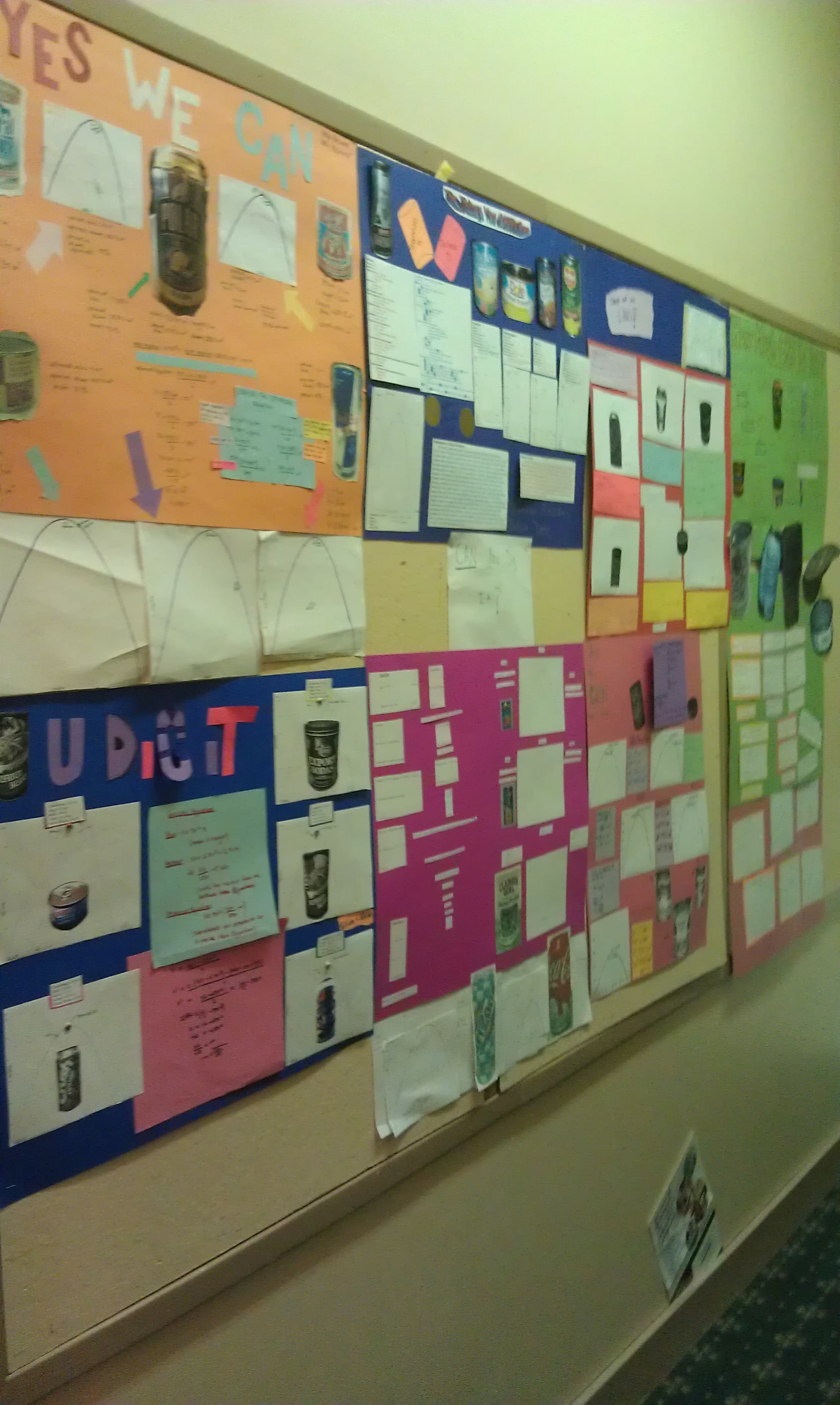
I covered optimization very differently this year, as I started documenting here. Besides their assessments asking them to solve optimization problems both algebraically and on their calculators (and explaining how they did both), they did a poster project. Here are some of the finished products:
And here was the assignment…

[.docx version]

I never do projects, so this was new to me. But my kids really took to it in a way I really enjoyed. I had most of them pair up and find how “volume optimized” a can in. In other words, they took photos of cans, they decided how much metal was used to make the can (the surface area… we ignored thickness), and we asked if we could recast the can to hold more volume. That was our overarching question…

We started this the week before spring break. I think students had three days in class to work on it, and then it was due after spring break (many just had some gluing to do). I provided the posterboard and colored paper. They provided the rest.

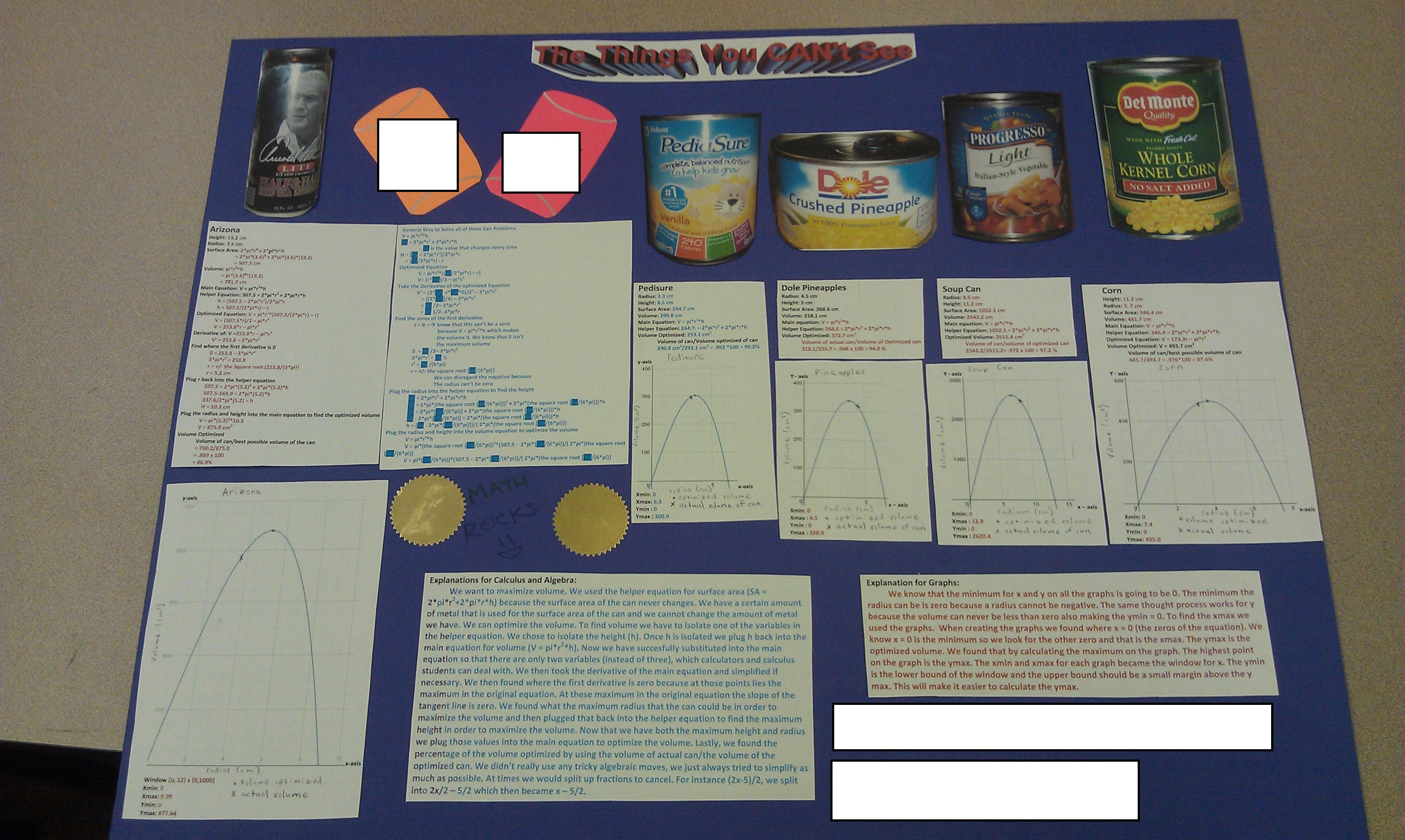
An Example Close Up
Student Thoughts

I asked students to talk about the project in their third quarter reflections. Here are all the quotes from the reflections, where I asked them to talk about the quarter, and about the can project in particular, and give advice for changes I should make next year on it:

* I am particularly proud of the project that ___ and I worked on together. We worked really hard on it and stayed after school and although it was sort of confusing at first, once we got the hang of it I began to really understand optimization… I generally prefer projects because it allows me to be more creative and think more deeply than tests so I actually did enjoy the can project. I thought that that having to do the same thing for five cans got a bit repetitive so maybe if you were to do it again have the students do some different kinds of shapes or types of problems.

* The can project I was really proud of. ___ and I worked for hours and it and I think the end result was really good. Our poster was well made and looked good… I really liked the can project. I think we could have gone over the project more before starting because the goals were a little unclear.

* This may seem insignificant, but one of the most memorable things [from the quarter] for me was the way that this mountain of math for the cans project simplified into this beautiful little thing (h=2r) after doing all this calculus. It was quite cool when I saw that… [As for making changes for the project next year] Honestly, I’d ditch the poster element. It added nothing to my understanding, and ended up being more of a burden than anything… The calculus was certainly worth-while, but that was only like a quarter of the work. The rest was repeatedly plugging the numbers into a program I made (I tried writing a python script for the first time) and writing them down. So basically, make us do more complicated (and more in general) calculus warter than a wee-bit of calculus and a lot of “filler” kinda stuff.

* I did like the can project, but I was sometimes confused about the exact requirements. It was also difficult to finish everything in class, but it worked out when we had the extention until the Monday we got back [from Spring Break].

* The most memorable event from this quarter must have been the “Can Can” project. It gave the class and I time to apply our calculus knowledge to real world concepts… I thoroughly enjoyed the can project because I felt like I understood it entirely from day 1. The amount of work when done between a pair was not tedious at all as well.

* As for the can project, I did enjoy working on it but found it to be a bit repetitive and tedious. I also think had we more time to complete it I would have had more fun with it. I did feel I understood exactly what we were doing. I think if you were to do it next year you should allow more time so students can be more creative with their project.

* The can project was definitely worthwhile. The only thing I disliked about the project was that we used the same shape every time. I think we could have optimized different objects to make it more interesting, just  because the process became kind of repetitive. I think you should still do it next year if you would like but you could choose to alter it a little bit.

* I really liked the can project. For me, the can project was able to show directly the connection between what we were learning in Calculus and the real world which is something that really interests me. I felt like I understood what was being asked of us, and I think that it would be a good addition to next year’s Calculus curriculum as well.

* In general, optimization was my favorite/most memorable part of the quarter. It’s probably the only math I’ve ever done that requires logical, real world thinking at every step (for example, who cares about the optimization of the graph when it’s less than x=0, because you can’t have negative distance). In the past, I’ve felt that a lot of math does correlate closely to things in the real world, but this is the first time where it’s so clear how everything relates. That said, I felt like the can project went extremely well, considering this is the first time it was done in this class. I felt like I totally understood everything that was going on, and I enjoyed taking measurements, doing calculations, and seeing how much the lima bean companies were ripping us off (hint: they’re not! It’s the tuna companies that are evil). The only change I would suggest is allowing one or two days more of time to finish it. Although we got all our measurements and calculations done, the most difficult and lengthiest part of the project proved to be printing everything out, cutting it, and creating the poster.

* Volume optimization, more than any other topic, really stood out for me this quarter. When we first started doing it, I was confused and didn’t entirely understand what to do. I think I was a bit taken aback by translating words/pictures into mathematical equations, but once I worked at it and practiced a bunch I became better at making that translation. I thought that the can project was very interesting, and it helped me make the translation better, as well as illuminating an important real-world connection. I was interested to see which companies used their material properly! I did feel, though, that 5 cans was more than was needed — it was basically the same thing every time, so fewer cans could have been enough to still get the point across.

* I really actually liked the can project and got pretty into it. I liked it because it felt like we were working independently on applying what we learn in class to the real world. I think it should be done again next year.

* I liked the can project a lot. It was cool figuring out how much volume a can could hold if we changed the dimensions of it. At first I did not understand what to do after I found the things I needed to know (height, radius, etc.) — if there was a group where both partners did not know how to figure out the equations needed, then the project would be difficult for them. Maybe having a quick intro/hint class discussing the project will help. I think you should do it again.

* I thought that the can project was very effective because it took what we were learning and applied it to real life. I thought it was very good in allowing us to see how optimization works in reality. I definitely think it should be done again in alter years.

* Even thought I like the idea of the project, my experience with it was not a good one. It certainly illustrates the idea of optimization very well and it’s always nice to see a practical application of things we learn. But due to the circumstances of my partnership with […] it felt very tedious. I don’t think there is much you could do to change it if you are going to keep it, so I would recommend devoting more class time to this project.

* I liked the can project, however it was a little hard to do while also focusing on the problem set. It was also hard to focus on both of those in the week leading up to spring break, so if possible I would recommend splitting them up and doing at least one of them in weeks other than the one before the break. I did enjoy the project, though with the problems above I probably did not enjoy it as much as I could have. I would say to do it again next year because (as math classes don’t always directly relate to the real world) it was cool to apply what we have learned to something we may experience once we leave school.

* I actually really enjoyed the can project. It was a nice break from regular busy work and I definitely got a good handle on the concept it was trying to teach. I would highly recommend doing it again next year.

* I enjoyed the Can Project, making our poster, and working with my group members to find the optimized volumes. I definitely think you should do it again next year.

* I though the can project was good. I liked working with people to create something fun and pretty, and I liked the splitting up of labor rather than doing it on our own. I would say next year maybe give people a bit more time for the project — I felt very rushed doing it. Of course we ended up finishing, but kind of just barely, and so maybe a big more time would help.

* The most memorable thing from this quarter is the can project. In the beginning, I had difficulty understanding optimization but after doing the project it made a lot more sense. Applying the concepts to real life made them much more understandable. At first I had difficulty understanding the purpose of this project, however it proved to be beneficial to me.

Thoughts for Next Year

I got a lot of good feedback from the students, and I am glad that they are comfortable enough to share their thoughts as frankly as they did. Overall I think this thing, which I whipped up in a couple hours the day or two before I decided to do it, worked out as a good thing to do before spring break. It was low key, kids were working independently (with their partners), it allowed for some mindless work and some very mindful work, and kids seemed to learn from each other. I also got the sense from their responses that they really had their understanding of what is truly going on with optimization problems solidify.

I clearly have two big changes to make next year.

First, I need to give more time. I think the three class days that they had was appropriate to get the math done and the poster started, but I think that after this class time, I should give students a week to work on it at their leisure outside of class, while we forged forward with the material. That seemed to be one of the biggest problems — me thinking students could do everything in three days.

Second, I think I need to give a bit more choice and make things a bit more scaffolded. For some, doing 5 cans was tedious. For others, it felt appropriate. Ways to do this would be to require 3 cans, and then some options of other things to take their knowledge further. One question (which I almost did) I could ask them is to measure the volume of a can, and ask them if they could create a can with the same volume but smaller surface area (so it would be cheaper to produce). Or, as a student suggested, I could assign them different shapes and ask them to volume optimize it (boxes, spheres, cones, etc.).

Finally, an observation of my students reflections. I am surprised at how many of them seem to crave or find happiness in the “real world application” activity. I just don’t find “real world” stuff that interesting, compared to the mathematical ideas themselves. And most of our real world applications/problems feel forced or fake, or too simplistic compared to what really happens. So I tend to eschew these sorts of things. But these comments remind me that even though I eschew them, my kids (for some reason) like them. It helps them to find a purpose for what we’re doing, and apparently they need that because I’m not able to totally convince them of the inherent beauty and interestingness of what we’re doing. (Something I work on every year.)

Students communicating mathematics has opened my eyes to mathematical ugliness (and what that means to me)

This year, as I have been in the past few years, I’ve been attempting to incorporate more writing in my math classes [note: Shelli found a post from 2009 I wrote on this endeavor]. It’s been extraordinarily enlightening, because what this has done is show me two things: (1) kids don’t know how to explain their reasoning in clear ways, and (2) I’m usually extraordinarily wrong when I think my kids understand something, and the extent to which I am wrong makes me cringe.

(wow, been too busy to shave, have we Mr. Shah?)

For the first point, I don’t actually do much. I ask them to write, they write, I comment. And we discuss (more at the start of the year, but I always let this go and I forget to talk about it a lot). In Algebra II, they get one or two writing questions on every assessment. And each quarter they had problem sets where they had to write out their thought processes/solutions comprehensively and clearly. Even though I didn’t actually do anything systematic and formal in terms of teaching them to write (mainly I just had them write), I can say that I’ve seen a huge huge improvement in their explanatory skills from the beginning of the year. What I used to get just didn’t make sense, honestly. A random string of words that made sense in their heads, but not to anyone reading them. But now I get much more comprehensive explanations, which usually include words, diagrams, graphs, examples. They aren’t usually amazing, but they’re not ready to be amazing.

For the second point, I realized that the types of questions that we tend to ask (you know, those more routine questions that all textbooks ask) don’t always let me know if a student understands what they’re doing. It just lets me know they can do a procedure. So, for example, if I asked students to graph y < 2x+3, I would bet my Algebra II kids would be able to. But if I showed them the question and the solution, and ask them to explain what the solution to that question means, I would expect that only half or two thirds of the class would get it right. (Hint: The solution is the set of all points (x,y) which make the inequality a true statement.) They can do the procedure, but they don’t know what the solution means? That’s what I’ve found. And you know what? Before asking students to write in the classroom, I had deceived myself into conflating students being able to answer y < 2x+3 with a full understanding of 2-D linear inequalities. [1]

Before having students write, I actually believed that if I asked that question (“What does this solution mean?”), almost all the students would be able to answer it. (“Like, duh, of course they can!”) But since asking students to explain themselves, explain mathematics, I’ve uncovered the nasty underbelly to what students truly understand. The horror! The horror! But now that I recognize this seedy underworld of misconceptions or no-conceptions, I’ve finally been able to get beyond the despair that I originally had. Because now I know I have a place to work from.

The counterside to this point is that when kids do understand something, they kill it.

This simple question I made for my calculus students early in the year, and this student response, says it all. I have no concern about this kid understanding relative maxs and mins. No traditional question would have let me see how well this student knew what was up.

For me the obvious corollary is that: we need to start rethinking what our assessments ought to look like. If we want kids to truly understand concepts deeply, why don’t we actually make assessments that require students to demonstrate deep understanding of concepts? I am coming to the realization that the more we keep giving the same-old-same-old-assessments, the more we are reinforcing the message (implicitly) that we don’t reallyreally care to know about their thinking. We are telling our kids (implicitly) that we are content if they show their algebraic steps. But as I’ve noted, my big realization is that students performing those algebraic steps don’t necessarily mean that the student knows what they’re doing, or what the big picture is.

I don’t know have an example of what I think a truly ideal assessment might look like, but I do know it isn’t anything like I gave when I started off teaching five years ago (has it really been five years? why am I not better at this?), and I do know that each year I am slowly inching towards something better. Right now, my assessments are fairly traditional, but with each year, they are getting less so.

Sorry if I’ve posted something like this before. I have a feeling I have. But it’s what’s been going through my head recently, and I wanted to get it out there before I lost it.

[1] Another good illustration might be having students solve -3x<6. Sure, they can get x>-2. But does doing that really mean they understand that whole “if you divide by a negative in an inequality, you switch the direction of the inequality” rule that has been pounded in them since seventh grade? Nope. The traditional questions don’t tend to check if the kids know why they’re doing what they’re doing.

Senior Letter 2012

Each year at the end of the school year, I say goodbye to my seniors. And each year, I’ve written a letter to the seniors with some imparting thoughts as they go off in the world. And each year, the message in the letter stays fairly constant, even though the way I say my message might slightly change. It always goes something like this:

Knowledge is precious and vast, it keeps us curious and engaged in the world, and simple ideas can — when taken to their thoughtful conclusions — be extraordinarily powerful. And thought it may seem like we have forever to cull this knowledge, we don’t, so take advantage!

Without further ado, my letter to my seniors. I know, it always comes across as hokey. But when I get sentimental…

Let’s do a solid for @cheesemonkey

Dear you,

Yeah you, my super awesome teacher friend!

I am about to start composing a letter of recommendation for @cheesemonkey [blog, twitter], and I wanted your help. For me, her constant upbeat spirit and cheerleading of every one of us  in everything we do has been glorious. Heck, in my opinion, she’s a lynchpin to our online math math community. Full stop. The activities that she posts about are constantly on my list of things to steal. And just as importantly, the thoughtfulness that she writes about in all her interactions with students — whether it be in her zillion recommendation letters to her conscientious work to build up each student’s math confidence — is an inspiration.

I want to write a collective recommendation, one where the reader can see that @cheesemonkey has a broad impact on the math teaching world.

So let’s do a solid for @cheesemonkey. If she’s done something large or small, inspired you, helped you, given you something to use in her classes, keeps you engaged in teaching, pay back the favor. Throw your mini-recommendation in the submission box below (it will be emailed to me) and show her how much you care! A few sentences to a few paragraphs, just share. We’re a community that helps each other out all the time, and I need your help!

It is a bit time sensitive, so if you could do it soon (translation: in the next day or two), I would be ever grateful.

← Back

Thank you for your response. ✨

Thank you, all!

Always,
Sam

Comment Time Is Over!

This is a post of celebration.

This past weekend and this week, I’ve been consumed with writing narrative comments on all my students. In the past two years of teaching, I have been trying to be more thoughtful about what I’m writing. To put all the cards on the table, I don’t think that comments themselves really effect change in students. However, I do think there is a powerful thing that comments can do: it is a way to tell students I see you and I care about you and I am thinking about you and your learning. Not literally, but a comment can send that message implicitly.

So even though I have serious doubts about the efficacy about what I write in helping students to change their practices, I hold firm to the belief that the implicit message is worth it. So I write, and hope that for a few kids, it matters.

It’s almost 9pm. I’m at a coffeeshop now, and I just finished my last (my 49th) comment of the year. 58 pages later, I am breathing a sigh of relief that I’m done.

I’m totally drained.

I’m so tired of writing that I don’t have it in me to talk about how my comments have evolved in the past two years, or how standards based grading has made writing comments so much easier. Or list the places I know I could still improve on. And maybe I will at some later point.

For now, I just wanted to write a post now sharing the good news with everyone:

I am done!

(If  you want to see the type of comments I wrote in my first three years of teaching, I’ve archived that here.)

Spring Break 2012

As this Spring Break comes to a close (it’s Friday, school starts on Monday) I am a little wistful — thinking about all that I could have done, and all that’s still on my plate to do. But I do that to myself. I don’t take time to appreciate all that I do and stop looking for what’s next. So in this post, I’m going to recount some awesome things about this Spring Break.

I know I don’t use this blog to talk about my non-school life, but that’s only because it’s only about 1% of my life.

So at the start of this spring break, I did something I’ve been dreaming about for years. You see, when I was in college I had a bout of insomnia so I started to listening to Supreme Court oral arguments to focus my mind on something boooooring so I could fall asleep. Little did I know I would become a Supreme Court junkie. And so I went with a friend (who teaches history and constitutional law at my school) to Washington DC where I had a glorious time. The night before the oral argument, I invited @rdkpickle to dinner and didn’t get psychopathkilledtodeath. You’ll all be pleased to know that she’s just as personable in person as she is online.

The following day I got to Supreme Court

early enough that we got tickets to hear the arguments. It was similar to what I expected in terms of the argument, and also nothing like I expected in terms of the room. It wasn’t as grandiose as I imagined — I imagined the justices to be higher up, the room to be wider, and the seating for the visitors to be nicer (we were like sardines put on very cramped wooden chairs). The two cases we heard were Astrue v. Capato and Southern Union Company v. United States, both fascinating. (And for those of you who are dying to know, yes, I took off my hat in the courtroom.)

In DC, I also got to meet up with two dear old friends who I hadn’t seen in ages, and just in time, because they are moving to Korea for two years, soon. And one high school friend who I consider one of my besties even though we never see each other or keep in touch. He’s that kinda guy.

In addition to my trip to DC, I had my sister in NYC for a day, where we ate delicious food, traipsed around a lot, walked the high line, read a bit in Bryant Park, went shopping at the Strand (I didn’t buy anything!), and then met my parents and family friends for dinner. It was a full and lovely day.

Then I scampered to San Francisco for a whirlwind trip. I got to see a ton of high school and college friends, do a bunch of shopping, eat delicious food, watch the Hunger Games, and throw a party! That’s right — one of my best friends from high school just moved back and I convinced her throw a house party — and I invited all my friends.

Additionally, and this is going to make all of you jealous, I got to hang out and have dinner with the following math twitter people at Bar Tartine: @woutgeo, @btwnthenumbers, @cheesemonkeysf, @ddmeyer, and @suevanhattum. I only wish we had started earlier. It was totes amazing (@cheesemonkeysf wrote about it). And again, I didn’t get psychokillerkilled. Although when I talked smack about ed researchers, I thought the towering Dan Meyer was going to kill me with his laser stare! But he is too much of a Good Guy Greg for that.

And then I got back, and have basically been doing nothing but watching bad TV and thinking (but not doing anything) about all the work I have to do but haven’t done. I even finished the two seasons of Party Down (amazing, btdubs), and the season of Summer Heights High (also amazing, btdubs). Go me!

So even though I felt like that I could have done, all those roads not taken and all that, I think I’ll always feel that way. It’s just the way I am. And I have to learn to appreciate all that I have done, instead of focus on all that I could have done. In fact, that’s probably a lesson for me in teaching. There you go — I have a sickness. Everything is about teaching. 

With that, I’m out.

PS. I would love to have shown more photos, but I feel weird using photos of people who might care if their photo is out in the world. Dan, he’s probably okay with it. He has a TED talk and all that.

Optimization: An Introductory Activity & Project

I switched things around with optimization in calculus this year, and I realized if I had the time, I would spend a month on it. [1] I wonder if this shouldn’t be a crux of the class. Not the stupid “maximization and minimization” problems but finding some real good ones — in economics, physics, chemistry, ordinary situations. There have got to be tons of non-crappy ones!

Anyway, I wanted to share with you two things.

First, how I introduced the idea of optimization to my kids. Instead of going for the algebra/calculus approach, I wanted them to toy with the idea of maxima and minima, so I had them spend 35-40 minutes working on this in class:

[doc]

I thought it was pretty cool to see my kids engaged. I rarely do things like this, but I did it (I was being videotaped during this lesson… and I had never done it before… and I had the idea to create it the night before…). It was fun! And although I cut the debrief the next day short (ugh, why?), I enjoyed seeing kids engaged in problem solving through various strategies. And there was a healthy level of competition. (The winners for the 1st and 2nd tasks got a package of jelly beans, but they were so gross I threw them out! One student gave them to his rabbit who likes jelly beans, and even the rabbit didn’t like them!) But when it came down to it, it drove home the idea that optimization was something that trial and error is good for, sometimes we do it intuitively, sometimes our intuition is terrible and sometimes it is good, and sometimes we get an answer but we don’t know how to prove there isn’t a better answer (e.g. in problem #3). Some kids liked that this felt more “real world” than this world of algebra and graphing that we’ve been meandering in.

Second, I have allotted a few days for students to work on this project during class (it’s the week before Spring Break and kids are overburdened, so I didn’t want to have them do something which involved a lot of at-home time). They’ve been working on it this week, and I’ve heard some good conversations thus far. (They’re doing this in pairs, and I have one group of three.) The fundamental question is: with a given surface area, what are the dimensions of a cylinder with maximal volume?

[.doc]

Now I don’t quite know how their posters will turn out yet, or whether students will have truly gotten a lot of “mathematical” knowledge out of it. But each day, I’ve had a couple kids say things that indicate that this isn’t a terrible project. (I don’t do projects, so that’s why I’m very conscientious about it.) A few said something equivalent to “Wow, the companies could be giving me x% more creamed corn!” or how they like doing artsy-crafty things. At the very least, I can pretty much be assured that students — if I ask them if there is any question that calculus can answer at the grocery store — will be able to say yes.

Next year I will probably add the reverse component (for a given volume of liquid you want to contain, how can we package it in a cylinder to minimize cost… what about a rectangular prism… what about a cube… what about a sphere… etc.?).

[1] The one thing I found in this book my friend gave me (on science and calculus) was an experiment where you shoot a laser at some height at some angle into an aquarium, so that it hits a penny at the bottom (remember the laser beam will “change” angles as it hits the water) to minimize the time it takes for the photon to travel from the laser to the penny. I almost did it, but deciding to do it was too last minue.