ThankThankThank You Bowman

I’ve been stuck in Grand Jury Duty for the past week and half, and for the weeks before then I was trying to eek every last fun thing I could think to do in New York City before jury duty and school started. It’s been a pretty ridiculous few weeks, and these weeks have almost nothing to do with school. I needed it, but now I’m feeling the anxiety creeping over me like some evil, insidious ivy. I’m still in the see no evil, hear no evil state of mind, and I will be in it until after jury duty is over. I’ve resigned myself to that, even though it’s doing nothing to dissipate that growing anxiety.

In these days, we’ve been fortunate to have Bowman Dickson write some fabulous guest posts:

1) Make It Better: Drawing with Geogebra
2) Make It Better: Memory Modeling
3) How I Grade Tests To Mine Learning Data [quickly]
4) Frankensongs and Frankenfunctions: Using Mashups to Teach Piecewise-Defined Functions
5) “Sticky” Notes
6) Our Experience with Understanding By Design (written with me!)
7) Math Taboo 

Bowman did a bang up job. Not only did every post have something immediately useful and concrete, but heck if Kiki ain’t a fantastically engaging writer too!

I wanted to thank Bowman for agreeing to guest blog.

And more importantly, Bowman has started again blogging on his own blog, which he’s devoting to math teaching now, at the appropriately named http://bowmandickson.com/. I don’t know what to say except he’s so much of the real thing. Not just with this blog, but with teaching. He’s jumped in and isn’t scared to take risks and try things out, but he does so with such depth of thought coupled with passion for student learning, that I can’t help but hate him for being so much more awesome, and love him for being so much more awesome. You would be exercising crusty and reprehensible judgment if you didn’t add his blog to your reading, like, now. 

And he tweets too at @bowmanimal.

Thank you Bowman! Peacocks for lyfe!

Math Taboo

I participated in a great twitter conversation the other day where we brainstormed a few strategies to help make our courses more accessible to English Language Learners (we used the hashtag #ELLmath, the approximate transcript is here if you are interested). It was a great start to what needs to be a running dialogue for me, as I teach almost 100% students for whom English is not their first language. If anyone has any ideas about #ELLmath, I would love to hear them in the comments. The conversation reminded me of a little idea I had last year, playing the game Math Taboo to help students expand “definitions” to actual understandings of concepts. Now, I’m sure other people do this, and a quick Google search leads me to believe it’s not all that novel, but while discussing #ELLmath, it struck me as a particularly good exercise for ELL students.

The idea of the real game is to get your partner to guess a word by describing without using any of the five taboo words, which are usually the first words that anyone would go to in a description. So the obvious math equivalent is to pick a term that you are throwing around in your class and get students to describe it without using their go-to math descriptors.

We played during beginning-of-the-year-review as a class, with the word to guess already known to everyone, and I gave students a chance to take a stab at verbalizing a definition without using the taboo words, one at a time until we got an acceptable description. However, this could easily be adapted to be a much more interactive activity (though its creation might take just a bit of time).

So why play this?

Whenever working one on one with students, I found myself trying to diagnose why they were not understanding a problem. I would ask them things like, “Well, what is a derivative anyway?” and they would often answer with something that I found acceptable, but perhaps could have been just something that they had figured out should be said as the “correct” answer. Even if they weren’t saying book definitions (which would actually be easier to deal with), many times they were using my informal definitions – words that they had internalized about the concept that might not actually display a deep understanding, but that I had been mistakenly accepting as evidence of learning. Definitions are important, but assuming that those are indicators of deep understanding is, of course, very problematic, no matter where those definitions come from.

So, this Taboo game serves a two-fold purpose: learning for the students (by forcing them to think deeply about a mathematical concept; by having them trade in math jargon for conceptual understanding; and by hearing classmates describe something in more accessible vernacular) and learning for me (by seeing how well students actually understand a concept; and by seeing what language students use to talk math in the hopes that my mathematical narrative can better reflect theirs in the future).

Alternative game: In how few words can you express this definition?

I have never tried this game I’m about to describe, but the idea is to start out with a long definition from a math textbook and see how few words you can use to express the same idea. Delving into the Twitter world this summer I have realized how wordy I am, and the process of editing my tweets down has made me realize how many words I use that are unnecessary. Twitter forces me to think about what is the core of my idea, which led me to think up this exercise. This could be done competitively (give groups 5 minutes to brainstorm), or you could do it countdown style, trying to lower the number of words by one each time. This could get students to really consider what is important about a mathematical concept and to get them to realize that the thing itself is more important the words you use to express it.

Feedback on SBG

This is going to be a super short post, directed to you SBGers. One of the things we talked a lot about this summer at PCMI was feedback! [1]

Here’s my question about feedback and SBG.

Let’s say you give a skill test with 3 or 4 skills on it, and you want to give feedback. Let’s also say that you give a numerical score for each skill. Besides that score, what sort of other feedback do you give on the test? 

I’m wondering how explicit you get with identifying the issue, and what the goal(s) of you feedback is/are. Do you…

…circle where the student first started going awry?
… write a sentence (or two! or three! or more!) using words to explain where the work went awry?
… focus on something other than where the error crept in?
… give the total solution, written out for ’em?
… give some broad thoughts, encouragement?
… do something else?

 
Basically, I am super curious what your feedback looks like — in addition to the numerical score. The reason I ask is this… we talked a lot about feedback, but we didn’t talk about what effective feedback looks like. And for me, I don’t tend to give too much feedback. I’ll do some circling, some encouragement, I might write a sentence or two if the error is easily identifiable, but then I expect the student to figure the rest out on their own, or by working with a colleague.

And at first, as we talked more and more about feedback at PCMI, I felt a little guilty for the paucity of my feedback. But the more I thought about it, the more I thought: I think what I do is actually good for them. I don’t want to do all the work for them — they have to be a little more proactive. But I also wonder what and how others do, to see if there are things to steal to improve!

I wish I had scans of actual assessments to show you and have you give suggestions about how you’d mark them up, but in lieu of that, I’d like to hear how you do it (or would do it).

[1] One thing that struck me was how feedback given with a grade tends to be ignored by students, but feedback given without a grade tends to be really considered.

Our Experience with Understanding by Design

This post was written by both Sam and his guest blogger, Bowman.

At the Klingenstein (Klingon) Summer Institute, we (the illustrious Sam and Bowman) participated in planning a unit in the style of a Performance Based Assessment, which is very similar to method of planning advocated in Understanding by Design. Normal people just call it backwards planning. Whatever you name it, the core of this philosophy is that Enduring Understandings should be the focus of curriculum design, and not skills or learning activities. With a third (also illustrious) Calculus teacher, we put together a rough draft of a unit planned in this manner.The big idea of the unit was the Relationship between Limits and Rates of Change.  We decided that by the end of the unit, we wanted students to understand that: curves can be conceptualized as a joining together of almost linear pieces; and an infinitely fine approximation of a quantity is often needed to yield the exact value.

This was a difficult process. We thought it might be helpful to share some thoughts about planning this way and share some of the ways that we approached backwards planning at KSI. Here is the completed, though still rough rough rough, product [update: see the bottom of this post for another group’s work]:

What do you think an Enduring Understanding is?

SJS: It’s funny. When I was first introduced to UBD at my school for curriculum mapping (barf, BARF, BARF), it was exactly at “enduring understanding” that everyone threw up their hands and gave up. Partly because we’d show it to the consultant, and she’d say “no” and then give us no guidance from there. Partly because it forced us to grapple with exactly what it is we wanted the kids to learn, and dig down to the core of what we really valued about what we taught.

At the Klingon Institute, our math leader (also illustrious) said something that really spoke to me. He said “an Enduring Understanding is something you want your kids to remember 5, 10 years from now.” It sounds lofty, even corny. But when I took a moment to really think about it, it struck me: I need to know what it is I truly care about, and this is it. But thinking in this way — what truly is at the core, mathematically, of what you’re teaching? — is terrifying and hard. Especially if you’re something who has always focused on units and skills. It is also exciting, because you get to come up with Big Ideas and use those as your lesson/unit/yearlong themes. But honestly, more terrifying.

The other half of what an Enduring Understanding is, is that “it has to be something general, but not vague.”

If a student asks you “why are we learning this?” and the best you can do is say “well, you’re learning that so you can learn calculus [or X]…” and then they get to calculus [or X] and you say “well, you’re learning this so you can do engineering and open doors…” I’ve been known to do this. BARF. How unsatisfying for a student. And if I’m not mistaken, every time you say something like that, you yourself get a sick, guilty feeling.

A really good enduring understanding should put a stop to this infinite regression, and those guilty pangs you feel. Because you know exactly what it is you want a student to take away — and you can tell ‘em, loud and proud. Okay, it may not always be sexy, but it is something fundamental they can latch onto now.

BD: I think that everything that Sam just said is perfect, and considering we learned about these at the same program, I’m not all that surprised that we have a similar enduring understanding about what enduring understandings are. The only piece I would add is that it helped us to start all Enduring Understandings with the sentence “I want students to understand that…”

SJS: I’m going to emphasize that “I want students to understand that…” is needed when creating your enduring understandings, but you cannot lazily make it into a skill. Something like “I want students to understand that when solving a radical equation, there may be extraneous roots” sucks. That’s too specific, and is a single skill. It should be something that applies more generally, like “I want students to understand that sometimes the best way to count in math is to not count.” (That might be for a unit on combinatorics.)

BD: One additional point I would like to make though is that, though the final product (your list of enduring understandings) is hugely helpful, I found the most helpful part of curriculum design like this was collaboratively going through the process of trying to figure it all out. Attempting to articulate ideas and sift through the wide world of math to find the meat forced me to think so deeply about my curriculum. To be honest, I’m not sure how useful a list of someone else’s enduring understandings would be to you. It’s like taking someone else’s lesson plans – unless you think about it and modify it to be your own, it’s hard to implement in your own classroom.

SJS: I also think the process was valuable, but I’d disagree with Bowman about not finding others’ enduring understandings useful. I have limited time, am sometimes (often) lazy, and I can get on board with someone else’s enduring understanding if I buy into it. Like, for example, Bowman is going to come up with a whole host of enduring understandings for calculus, and I’m going to steal them. Right, Bowman? Right? Why reinvent the wheel when Bowman will carve it for you?

BD: If you’re happy with slightly-to-horribly-misshapen wheels…

How can Big Ideas and Enduring Understandings help you organize your curriculum?

BD: It’s easy to get caught up in using the book’s sequencing of content, but thinking about big ideas and enduring understandings can help rearrange everything else to help promote those enduring understandings above everything else. For example, next year we will explore solids of a known cross section before solids of revolution, because the enduring understanding in solids is that if you stack up a bunch of infinitely thin cross-sectional areas, you can create a solid. Solids of revolution are really solids of known cross section too, just with circular cross sections – the revolution is just a way to construct the solid, not the main idea behind the integral. By talking about solids of known cross section first, it might be a good way to highlight the deeper idea without getting caught up in a multitude of smaller ones.

SJS: You might think textbooks give us Big Ideas — quadratics, conics, etc. But Big Ideas are not topical, but transcend topics. As for how they can help me organize my curriculum, I don’t know yet. I do think they are going to be the anchors of a class.

BD: A list of big ideas in mathematics that we generated with a group of 13 awesome math teachers at KSI: models, functions, dimension, relations, transformations, estimation, comparison, distributions, measurement, operation, conjecture, representations, rates of change, logic, proofs/reasoning, inference, mathematical objects, classification, systems and structure, definitions, inverses, algorithms, patterns, symmetry, equivalence, infinity/infinitesimal, and discrete vs. continuous.

SJS: We like this list, but it seemed too birds eye view for us. When we worked on it, we found it made more sense to just zoom in a wee bit. Our big idea again was “The Relationship between Limits and Rates of Change”. It’s not like there’s a right answer to how to do this. You have to do what’s useful to you.

BD: So what’s the different between a BIG IDEA and an ENDURING UNDERSTANDING then? The point of big ideas is to give you thematically lynch pins around which to organize your curriculum instead of the typical CH 1.4, CH 2.3 – i.e., what ties all these topics together? The same big idea can occur across many different math courses. Then the enduring understandings are the learning outcomes that you want to come out from exploring these big ideas (see above for a much better description).

How do you assess Enduring Understandings in SBG?

SJS: Right now I honestly have no idea. Right now I’m thinking of making SBG 70% of the grade, and Big Things (projects, enduring understanding assessments, problem solving) 30% of the grade. Or something like that.

BD: The big thing that I am going to add to my class next year is writing for informal assessment. Even if it doesn’t count for standards grades in SBG, I think that I might just keep a list of enduring understandings for my own purposes and informally assess the students as I go through the semester. Then, when larger assessments come around, I will explicitly focus review around enduring understandings. Since standards in my SBG-hybrid system only account for around 40% of the grade, I think I will keep my SBG standards to be skills and focus my summative assessments around larger ideas, though I will make sure to be explicit about this with my students. This of course is not perfect, but like Sam, this is something I’m wrestling with.

How can you do this sort of work without having Noureddine (who was our curriculum group leader) giving you feedback?

SJS: That’s why we have blogs — for feedback! But I suppose the some questions you can ask yourself (regarding if you have a good Enduring Understanding):

1) Is it general, without being vague?
2) Do multiple “skills” fall under the mathematical principle/idea your Understanding encompasses?
3) Of all the content related things, is this something you’d want a student to remember 5 or 10 years from now? Honestly? REALLY? Okay now, really?

BD: One of my goals next year is going to be to more effectively utilize the resources at my school, i.e. the other teachers in my department. The more people that collaborate on something or check out your work, the better chance it has of being something valuable. I know this is a general principle, but I would have the temptation to not go to other members of my department because they don’t already plan like this – I am definitely not going to fall into that trap next year.

Does this sort of thinking re-orient (re-frame?) the way you look at teaching, or the meaning of what math class is?

SJS: For me, it’s helped me see the value of looking for a bigger picture. It’s complicated,  the question of “what do you teach?” Right now I teach skills, and I can do that pretty well. But skills for what? That’s the real question I’ve done a bang up job of dodging. So when I worked on this, it forced me to countenance that head on. What do I really want to give to my students, mathematically? [1] Example: It’s not completing the formula, say, but it’s the idea that you can transform a non-linear equation (x^2+6x-3=0) into a linear equation to help you solve it (by reducing it into x+3=\pm \sqrt{12}). I suppose it makes you think more about the larger themes of a class, or something.

[1] I’m not talking about habits of mind, or those sorts of things. What I’m talking about here is purely mathematical content.

BD: When you have a group of unruly students who will be sitting in front of you for 45 minutes every day, it is easy to get caught up in the day to day of lesson planning. The first thing I always jump to is the learning activities. To give myself a bit of credit, I think I often had an idea, though subconscious, of the bigger picture, but by never spelling it out for myself, I could never really spell it out for my students either. It’s hard to take the time when you start planning to think about big ideas, but I found in just the one unit we planned together that once we had identified the enduring understanding, solid learning activities were so much easier to come up with. This hierarchy has helped me see that I can’t really implement learning in my classroom until I frame what learning really means in terms of big ideas and enduring understandings.

SJS: Here’s a gedankenexperiment. If you asked your kids at the end of your course what the big mathematical takeaways were, what answers would you get? If I asked my kids that question at the end of the year… well, it would be a crusty hodgepodge of things. They don’t know my mathematical goals for the course, and clearly that’s because I myself don’t know my goals. Not broadly, not meaningfully.

What was the most frustrating part about curriculum design like this?

BD: I am someone who is good at working within a framework and tweaking that, but this involves rethinking the whole conceptual framework of your class. Also, it was frustrating to realize that all of my SBG standards were skills, and that I didn’t ever explicitly identify the big ideas. Being self-critical without being self-deprecating (and not in the funny way) is tough for me, but that’s partly what this process is for.

SJS: So many things, so many things. The gads and gads of time it took. The supreme annoyance when we couldn’t come up with a good Enduring Understanding or Big Idea. Our inability to easily come up with good assessments to check exactly what it is we wanted the students to learn. But mostly, it was what Bowman noted: realizing that even though I’ve taught Algebra II and Calculus for four years, I don’t really have a sense of what it is I truly want students to get out of it.

Are you going to change your teaching because of this?

SJS: I want to say yes, but I don’t think it’s something I’m going to be able to do wholesale. I think I’m going to try to do only one unit using this sort of planning — but do it really well. (That’s what our illustrious Klingon curriculum leader suggested.) And build up from there, each year. This is all a little lofty for me, and it’s no magic bullet for student understanding.

BD: Even if I don’t formally plan units this coming year with this method, I am happy to have my thinking shifted to be more in terms of big ideas and enduring understandings. Like, after you spend forever looking for new shoes, all you can notice about other people is their shoes – I’m hoping that even if I teach the way I did last year, I will be able to pick out the big ideas in the process and focus on those. Then codifying and formalizing unit plans into grand designs like this will be much easier in the future.

SJS: Kudos, sir, kudos. We can use this year to brainstorm these enduring understandings, as we teach and ask ourselves, forlornly, “what the heck is the takeaway from the rational root theorem?”

BD: Good luck with that.

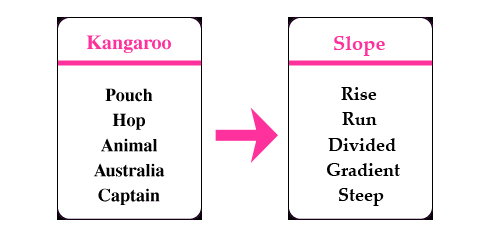
Update: Another Klingon group said we could share their unit planning (for Algebra I) which is below.
“Sticky” Notes

This past week, I attended a less-than-inspiring AP conference for AP Calc, as I am teaching the course for the first time come September. Though some parts were helpful, the presenter spent almost all of the 8 hours every day just lecturing about Calculus and going through mediocre worksheets with us. He was a perfectly warm and friendly guy, but he was also sloppy, disorganized and often slightly incorrect, not to mention not creative at all. I was pretty disappointed. [Disclaimer: People have given me far better reviews about AP conferences in the past… I think it depends on the presenter organizing].

But, while watching the Calculus curriculum being presented methodically on the board (without any distractions because my wireless wasn’t working), I was struck by how confusing it must be to stare up at a mess of disorganized mathematical notation. I decided to brainstorm ways to improve the taking-notes-from-the-board aspect of my own course – to make my notes more “sticky” in my students mind and to make them more useful for the problem solving. We can all inspire some day to have a completely student centered, inquiry based, problem solving classroom, but even in those there is certainly room for (and a need for) teacher directed instruction… and that can always get better too.

Inspired by Square Root of Negative One Teach Math’s loop to convert logs to exponents to logs and Sam’s Riemann Sum setup, I tried to think of ways to use visual ways to connect conceptual math with notation (which is probably the biggest hangup with my students), to basically create a sort of intermediate form to help make the abstraction make more sense. Here are a few ideas I had… keep in mind I haven’t tried any of these with my students.

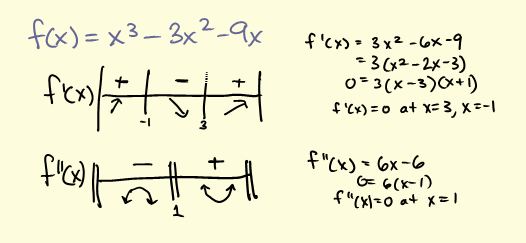
1. A Beefier Number Line for Graph Sketching

Problem: One of the things I noticed this past year is that my students would dutifully make number lines to test the derivatives but would sometimes totally forget what they were doing in the process. Also, many would mix up the first and second derivative.
Solution: Have the students immediately interpret their results with visual indications of increasing/decreasing and concave up/concave down. Make the separations on the second derivative number line be double lines instead of one to reflect the double prime part of the second derivative notation.

2. A Point-Slope Picture for Point-Slope Form

Problem: Anytime there are multi-step problems, many students either try to memorize algorithms or get completely overwhelmed calculating one thing that they lose other parts in their work.
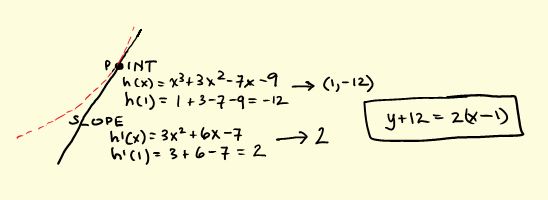
Solution: Draw a picture of a tangent line and let the point be the O in POINT and the line be part of the L in slope. Then, finding these two items gets you everything you need to find the tangent line. Maybe arranging them vertically and carrying the final part of each step out to the side might keep students more organized. The bonus is that this is a picture that fits with the math and not just a forced acronym.

3. Enhancing Volume Integrals With Pictures of Cross Sections

Problem: The hardest part of figuring out the volume of solids is setting up the integral. Students have trouble figuring out what area equation to integrate and then which variable to use when integrating (i.e. which way to go).
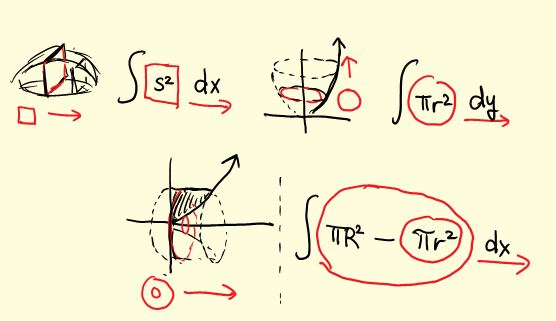
Solution: Draw the cross-section near the solid and an arrow in the direction in which you are accumulating cross sections (or on the problem words if you skip the picture). Then draw the same shape next to the integral sign and an arrow. Inside the shape of the integral write the area equation as you would see it in geometry, and above the arrow write a d-whichever-way-the-other-arrow-goes. Then replace the area equation with something else that is in terms of the whatever in d-whatever. Works for the disk and washer methods in volumes of revolution too.

Okay, so maybe those aren’t all THAT helpful, but I personally prefer thinking about small changes when I have so much on my mind about the school year. Though these are obviously not replacements for deeper understanding, maybe they could be crutches to help students go from something that might make sense to them to the abstraction of notation. Main point: I’m going to pledge to sit down and try to think about how to make notes more “sticky” before every unit.

from @bowmanimal

MV Calculus Projects 2010-2011

One class that I think I am pretty free about, and we have some fun in and get to explore and go through a lot of productive frustration, is my multivariable calculus class. I had 5 students in it last year. (*As he ducks from the rotten vegetables hurled his way, and collective groan from the crowd.*) Sadly, next year, there will be no students eligible so I won’t be teaching it.

My favorite thing from this course is the fourth quarter projects that all students do. We don’t have problem sets, we don’t have any tests or quizzes. Just this thing.

At the beginning of the year, I tell students to write down random things that pique their interests, whet their appetites, for the fourth quarter project. Whether it be higher dimensions, to the notion of curvature and what that might mean for surfaces, to the use of optimization problems in various fields, to whatever. As the class goes on, I’ll mention some interesting tidbit here or there and sometimes they’ll add it to the list in the back of their notebook. And then comes the fourth quarter, where they basically get to pick anything they want, they write their own project prospectus, they write their own rubric, and they just go at it. I give them some options, but they don’t always go that way.

I meet with them once a week or every other week (or more if they need it) and provide guidance and support, sometimes needed, sometimes not.

This year I had some excellent projects. I can’t believe I didn’t outline them for you when we finished the year, so I will outline them now. What was great is that some parents got to come to the final presentations, and so did my department head, the head up of the upper school, and some math teachers. Different days had different audiences.

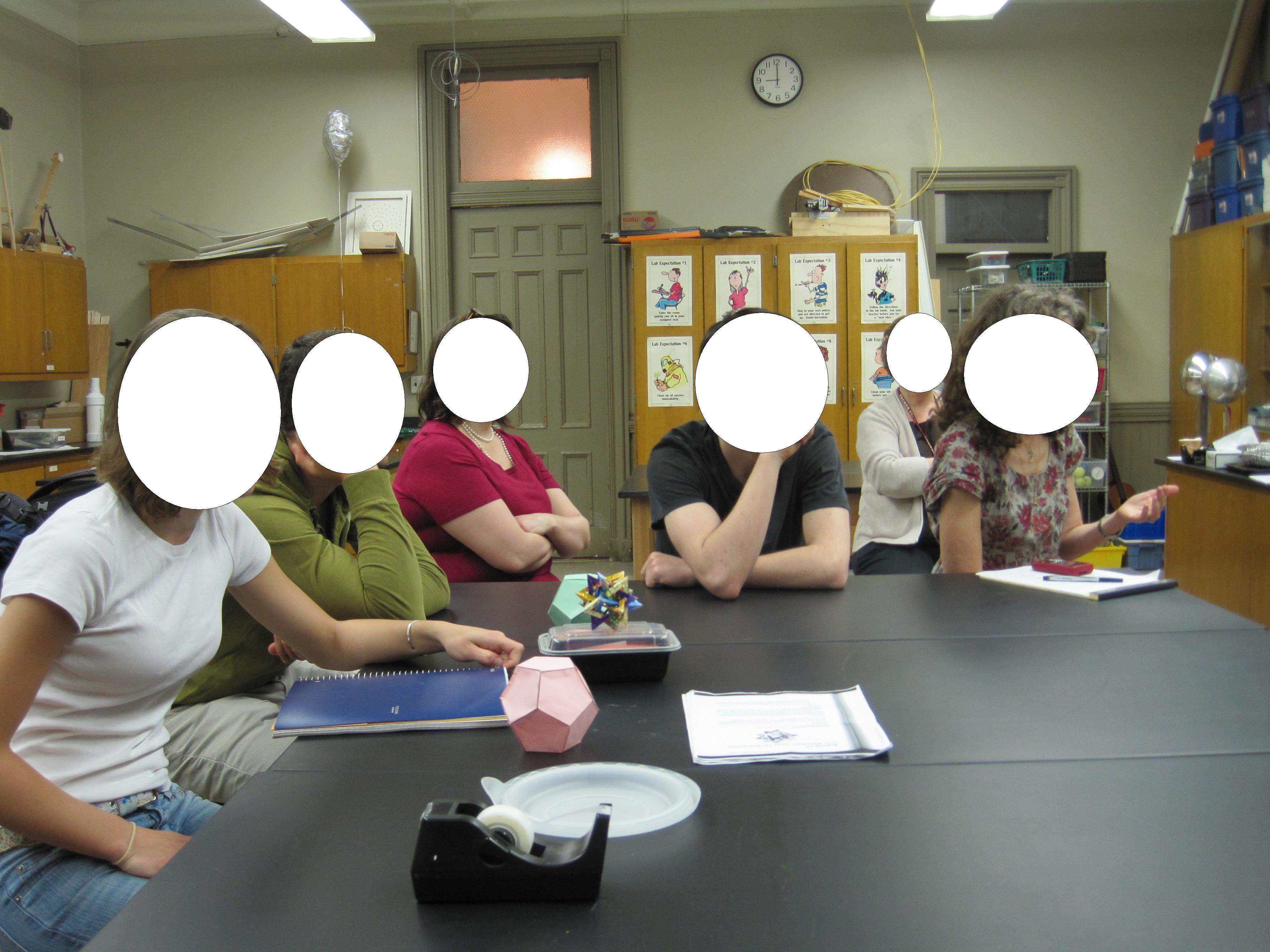
1. The first project involved constructing 5 intersecting tetrahedra out of origami and figuring out the “optimal strut width” (the width of the “beam” of each edge of the tetrahedra) so the tetrahedra just sit beautifully within each other without having them wiggle around (too small) or bend to fit together (too large).

This problem involves multivariable calculus, believe it or not, but also involved some really beautiful precalculus work meshed with 3D (basically, using roots of unity and some right triangle trigonometry) to find the vertices of a dodecahedron.  I also have to say that making the darn thing was totally hellish and the student who did it is a super rockstar. She also wrote a really comprehensive final paper explaining the calculations. Color me impressed.

2. Another student, who is a nationally recognized runner, wanted to investigate the following question: if you have a random surface with a local maximum, and you put yourself on that surface, and you wanted to get to the maximum, how would you get there? Instead of taking the shortest path (which would follow the gradient), the student conjectured that if you ran along the least steep path you will run faster, and if you run along the most steep path you will run slower. So there is a tradeoff, and there will be a path to run in between those two choices which will be optimal. So the student and I constructed a function to model the velocity of this runner. Although together we couldn’t actually get a general answer, or even a specific answer for a specific surface and point we chose, we had fun struggling through it. The student also created an accurate model of a one surface that the runner would be running on (the one that he did his calculations for).

3. Another student, for an earlier problem set where they were asked to write their own problems, studied the idea of marginal utility in economics and related that to Lagrange multipliers. This student was one of those kids who is interested in everything and he really loved studying marginal utility, and wanted to extend it and see how else multivariable calculus was used in economics. So he pretty much devoured this book on his own. Although he didn’t find too much multivariable calculus, he became enamored with the idea of the utility function, and decided to make a 50 minute class lesson on economics and calculus with an emphasis on the utility function. It was so well thought out, and so well delivered, that I think that teaching and simplifying ideas might be this kid’s calling. He also wrote an amazing paper outlining everything from the presentation (and more that he couldn’t fit in), and a problem set for students to work on after the presentation.

4. Say you have a blob drawn on graph paper, and you wanted to measure the area. What if I said: there is a mechanical device that if you drag it along the perimeter of the blob, it would calculate and tell you the area? True story, this exists, and when I described this to a student struggling to find a project… a project he was insistent he wanted to make with his hands… he was hooked. The device is called a planimeter. It sort of makes sense that something like this could exist… I mean:

(that’s Green’s theorem). So this mechanically minded student first built a trial version of a planimeter, using pencils, binder clips, and a bottle cap. And it worked fairly well. So then he built a giant and much more sturdy one. You can see this student holding his “draft” version and on the table is his professional version.

This student did almost all the work without me (which is good because I have no idea how to work with things mechanically). I basically only helped him understand some of the math behind how the mechanical device worked. The end result was that the professional device worked fairly well, but I think given another week, it could have been tenfold more accurate. Time is always the sticking point with these end of year presentations.

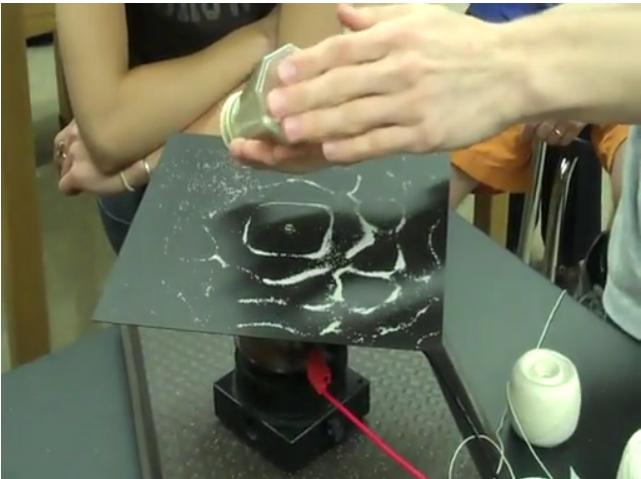
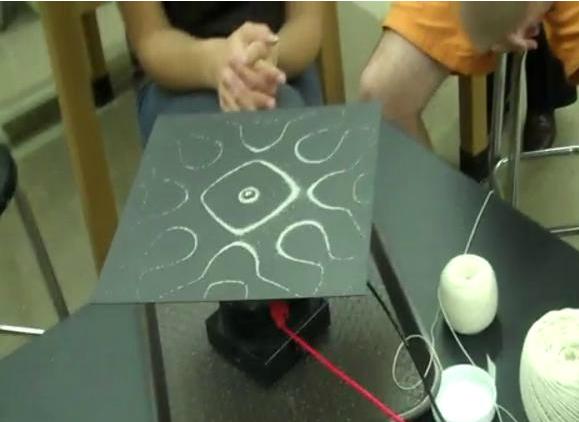
5. The final project was one of my favorites, because it involved me really going back and learning some simple partial differential equations. How this project happened involved me showing this student the following video:

Of course this video can’t but help stir the imagination. So this student wanted to build the device (called a Chaldni plate) and study the math behind it. It turned out that building the device was a bit beyond our capabilities, so we enlisted the help of the science department chair who super generously ordered a chaldni plate (he had the driver already) and helped get him set that up. I, on the other hand, did some research on what causes those beautiful patterns. Together, that student and I spent hours upon hours tearing through a paper — me doing a little lecture, him reading and asking questions, and so on and so on. And at the end, this student wrote his own paper based on our reading — explaining the math behind the designs. Although I don’t think he fully understood everything (we had not nearly enough time to make that possible), I loved that he got a touch of all these small things in higher level math. Orthogonal functions and Fourier series. 2D and 3D waves. Boundary conditions and time-dependent partial differential questions.

And his Chaldni plate worked.

PS. Apparently, I didn’t do a good job of blogging about my projects from previous years. Two years ago, here is what my kids did. And last year, I didn’t really write about it. Yikes! One student did a wonderful investigation on higher spatial dimensions, and how to extend what we’ve done into them — focusing on actually visualizing these dimensions (she really really really wanted to see them). The other extended a 2D project on center of mass that someone worked on the previous year, and I wrote about it obliquely here.

I’m alive, I’m alive

I’m alive, I’m alive // And I’m sinking in.

Acknowledgements

First off, thank you very much to Bowman for his amazing, thoughtful, well-written guest blog posts. I told you he was a tour-de-force and I can only say that I hope you’re finding his ideas as inspiring as I have. I’m stealing everything I can from him. I hope you are doing the same. I’m all about the concrete, and he gives me the concrete. Inspirational, he is.

Personal Update

So I’m now back in New York City. Home. I attended 5 weeks of professional development. Two weeks at the Klingenstein Summer Institute in Lawrenceville, New Jersey, followed almost immediately by three weeks at the Secondary School Teacher’s Program at the Park City Math Institute in Park City, Utah.

Yes, I’ve gone from this to this:

Current Status of My Thoughts

I have to say: I am burned out. Five weeks is a long time. I am also inspired, and hope to soon sort through all that I’ve taken away to make some serious changes in my classroom. And next year, I am only teaching two preps (Algebra II and Calculus, but not the AP Curriculum). So I will have the breathing room to make changes, I hope.The changes will involve intentional group work and formative assessments, coupled with much more intentional atmosphere building of a place where mathematical thinking (right or wrong) is valued and errors are celebrated and not something to be feared.

Yeah, I know. These are small changes and you think I need to be more ambitious.

JK. I know these are huge. It will take a lot of thinking to figure out how concretely to enact them. It’s easy to say these ideas, but it’s way harder to actually visualize them happening, if I close my eyes. I have some ideas, but not nearly enough.

I’m also worried about finishing the curriculum (especially in Algebra II) next year I try to go for depth and misconceptions and mathematical thinking, rather than try to go at those things but then succumb to the expediency of the moment and don’t allow time for grappling and productive struggling and discussion. But I’m less worried than in previous years, for some reason, and I’m ready to just go for it and see what happens. I suppose it’s because I’ve taken a vow to not underestimate my kids and their thinking abilities. Which I think I’ve done, unintentionally, and now I have to correct that. So if any of you have experiences of making the transition from teaching procedures to teaching thinking, any want to share any advice, puh-leese help me out here in the comments. (I don’t only teach procedures, to be fair to myself, but if I had to put myself in a camp, I would put myself more in a procedural camp than the thinking camp.)

I promise I’ll share my thoughts about changes I’m going to make in the classroom next year, as I sort through things, just like I did with my maybe-too-extensive blogging about standards based grading last summer.(That being said, I also suppose I have to talk about how I’m going to revise SBG for next year in calculus. Which means I have to figure out how I’m going to revise SBG first. Hu-uh. Feeling daunted now.)

Last year I was timid about making changes. I did Standards Based Gradings, and I felt that was “enough.” I think that was a good start. But it was like a bandaid on a bigger problem. I need to work on my craft in the classroom, and SBG didn’t change that too much. And so this year: I’m going for a sea change. No more glacial change, I’m jumping in whole hog, and mixing metaphors like similes are to analogies. Or something.

Contradictions

I praised Bowman for being specific and concrete, and look at me here, being all musing. Sorry. It almost feels like I’m trying to psyche myself up for next year, and committing myself to change by announcing it publicly. Yes, I suppose that that’s exactly what this is.

I hope to be more concrete soon. It’s just that, well, this here blog has always been for me, partly to archive what I do (the concrete) and partly for me to sort through what I’m thinking and get some ideas down… because when they slosh around in my head: 1. I can’t sleep 2. I get a headache 3. I get paralyzed with the overwhelming sense that I need to do something but I don’t know what. It’s the paralysis that I hate the most. So I’m hoping to avoid that by starting to put thoughts to page. But I know: I hate reading these kinds of posts too. So if you got to this point: sorry.