The conference is here.
The question of what’s at the rapidly beating heart of your classroom is a tough one. Let me rephrase that: for me, it’s tough, because it is totally evolving. Also whatever is at the heart of your classroom is your hidden curriculum — something that isn’t content, but just as important (if not more so) for kids to take away. So it’s pretty hard to get a handle on. It’s values.
Beginnings
In my first three years, I would have said the heart of my teaching revolved around three words:
clear
consistent
fair
Yes. Those three words drove me. The thing about having a core philosophy is that: everything revolves around it. Every assignment. Every interaction. Every expectation. And although there are hard decisions that have to be made, when I struggled through them, I found I eventually turned back to my core beliefs, and I saw the light. Do I let that kid, that sweet sweet kid, take a re-test? Do I really need to create a super involved rubric with benchmarks, or can I just outline the project? If everyone in the class bombs an assessment, what do I do? [1] When holding core beliefs, every choice has to be intentional. Because these are what you value, and you need to enact those values. If you can only “say” your values, but you can’t “see” your values… then you’ve failed. [2] [3]
This philosophy has helped me out a lot with classroom management. It has helped me gain the respect of at least a good number of students. But I have started to see that philosophy as a baseline, now, of what I am doing. I believe in more.
Current Status
In the past year, the heart of my classroom has expanded to include more than clear, consistent, and fair. Thanks to the philosophical reorientation that Standards Based Grading has given me, it now includes metacognition and proactivity. [4]
I want my kids to be aware of what they know and what they don’t know. I want them to aware of the process of learning, and strategies to help them along the way. And I want them to be able to act on that knowledge. This is my hidden curriculum.
In Calculus, I used Standards Based Grading, which is all about kids getting a handle on their own learning. It forces them to understand what they know, and what they don’t know, and really articulate it! [5]
Dismantling the course into individual skills allowed me to have a specific breakdown of what the student knows and what the student doesn’t know. A student might have mastered how to apply the product rule, but struggle with explaining in words where the formal definition of the derivative comes from. With SBG, I know this. In a school newspaper article written about my calculus class, one student was quoted: “The fact that the material is broken down into very specific skills as opposed to chapters or sections means you can focus on what you don’t know and figure out what you need to improve.” More than me knowing where my students’ strengths and weaknesses are, my students themselves can recognize them.
I talk about metacognition, but that’s only half the battle. Who cares? Kids knowing about their learning habits, that’s great. But it doesn’t help them unless they believe they can grow from it. This is something I’ve been thinking a lot about since reading Carol Dweck and her notions of growth mindset. If a student — especially my students who tend to come to class never really appreciating math — thinks they suck at math, that they aren’t a “math person,” they’ve already stabbed themselves in the eye, shot themselves in the foot, whatever. There is blood everywhere, and it sucks. My kids come in with a fixed mindset. To get them engaged, to act on the “metacognitive” work, to see that doing well in math isn’t a matter of being “born with it,” I need them to see themselves as people who can change through hard work. Because really, if they don’t believe that, they won’t be doing hard work. They’ll simply continue to try to get by in math.
The thing is, we’re human beings. We suck. It’s hard to alter our own perceptions of ourselves. It’s also hard to say “we suck” and then decide to move on from there to say “let’s do things to suck less”!
This year I’ve been trying to do some good work in getting kids to be proactive, and to build their confidence. It involves a lot of individual communication with students. It involves me showing them that I care. It involves me avoiding ever comparing a student to another. It involves me demonstrating passion which occasionally translates into passion in them. It involves me talking explicitly about how math is a process, a journey, and how anyone can do it. It involves me not falling into the trap of thinking of certain kids as “smart.”
Standards Based Grading has helped me get kids to be proactive. My favorite example of this is a student reflection I’ve blogged about before:
1. I like the way that even though I was falling rapidly into a hole, and it felt almost impossible to get out, once you talked to me I became proactive and tried my best to do better. I like to continue meeting with you. I also like to continue to participate in class and asking questions. I think asking questions in class was the biggest way for me to better understand the topics.
2. I wish I would have started from the first day of school in this attack math mentality. I was acting very passive and like ‘oh I don’t get it now, but I will later,’ which honestly was the worst thing I could have done. I also wasn’t used to the class setting and the grading system. But once you emailed me and I met with you and I know that this is a class that I have to be in it 100%, and that your method is one that helps us actually learn, it was just beneficial. I needed that scare and wake up class because I was in serious denial. I became more on top of things. However, I had to dig myself out of a huge hole that I put myself in, but eventually the rhythm has become one that I used to. And I’m almost in a weird way glad that I learned the hard way because now I truly understand Math.
But that’s just one example. For as many kids as I might have helped, I know the struggle of SBG was enough to turn some of my kids off to math. I couldn’t get them to act. I don’t think it was laziness on their part, but despair. They hadn’t fully embraced the growth mindset and realized they could do it. I failed to be able to counter this.
I value a growth mindset, and I try to promote it through my actions. That is the current central core of my classroom. I’m still working on it, but
here’s where I stand now.
[1] Of course I don’t mean “clear, consistent, and fair” to mean everyone gets the same treatment. Context matters, and what’s fair is not always “treat everyone the same way.”
[2] See Sizer and Sizer’s The Students are Watching (my review here)
[3] A grand experiment would be to have someone watch a video of your class, and try to suss out your values, and where they are expressed through your actions and words.
[4] SBG also has helped me remember the point of teaching: student learning. And now I have a razor sharp focus on that goal.
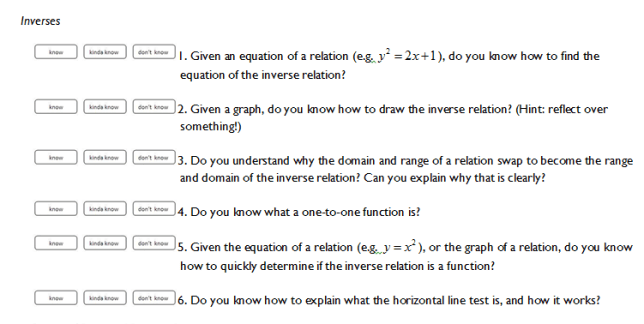
[5] In Algebra II, I deal with metacognition also, but not as well. I do this by talking to my kids explicitly about categorizing what they know and what they don’t know.
 I tried to make homework more meaningful, by creating a full feedback loop. If a student got something wrong, they were asked to re-do the work and correct it. Otherwise they would have practiced the skill incorrectly, or illuminated the concept poorly, and never fixed it. (The “ill-leave-it-to-learn-before-the-test” syndrome.) I did this using binder checks (and redux), which had the added benefit of keeping (most) students organized.









 Continuous Everywhere but Differentiable Nowhere

