This week sucks

Warning: Whining ahead. Skip this post to be spared.

I am in the middle of a hell week. In addition to my classes, I have a number of after school commitments which may lead to me frothing at the mouth, clutching my knees, and rocking back and forth, mumbling “no time, no time, never any time.”

Monday:
3:30-4: Proctor a math contest
4:00-5:15: Interview math candidates
5:15-6:15: Informally discuss candidates with hiring committee

Tuesday:
3:30-5: Math department meeting

Wednesday:
3:15-5pm: Administer the American Mathematics Competition (AMC 10/12) to 100+ students

Thursday:
3:30-4:30: Tutor
4:30-5:30(?): Interview math candidates

Friday:
3:20-4: Faculty and Staff Advisory Committee meeting
4-5:30(?): Interview math candidates

This is in addition to my regular school work. Which happens to be a lot this week. To say the least.

Do I want to be pitied? Actually, yes, please.

TWITTER T-SHIRTS

So you know those t-shirts that I was thinking of getting made? Well, tonight I thought: why the heck not?

Without further ado, the t-shirts are here!

MENS & WOMENS

Some details about them. Each tshirt has a front and back, and there are a few different color tshirts. The front says (in various colors):

While the back says:

The #needaredstamp hashtag is always printed in red. [1]

I don’t know much about women’s t-shirts, but I know they are cut differently. So I made a few of those too. The cut of them looks like this:

There were tons of choices for the type of t-shirts to be printed on, but I figured I’d just choose the cheapest. And in case you were wondering, no, I’m not making money off of these or anything. I put the commission at $0 because, well, how awful would that be to profit off of my selfless and awesome twitterfriends.

FULL DISCLOSURE: I just made these, so I haven’t ordered one yet. They are definitely not high quality shirts. So I don’t know if they suck or if they rock.

[1] It wasn’t feasible without driving up the prices to include the detailed #needaredstamp picture I wanted to include. Plus, I figured if you taught Algebra I vs. Linear Algebra, the stamps would be totally different. If you don’t know what this hashtag means, read this from the bottom up.

UPDATE: My shirt arrived today, and I’ve been asked for photos. So here’s my narcissistic photoshoot!

Some of my Algebra II class on Friday

I enter my Algebra II classroom two minutes before class, open my computer and plug it into the SmartBoard. By the time it powers up, most of my students have entered the room and are sitting down and chatting. I pull up the day’s SmartBoard and I get started. The day before was exhausting, and I was in a cranky mood then. (My Algebra II kids didn’t see this, because I gave them a test that day.) I tell my kids we all have bad days, but that when I was thinking “argh, bad day!” I started thinking of all the good that I have, and I thought of my wonderful Algebra II class. (Which they are.) So I wanted to let them know that. They liked hearing that. I liked saying that. It was a nice 30 seconds.

I then pointed to the SmartBoard

And we got started. I talked about how we’ve done so much algebraic manipulation and solving so far. Absolute value equations, exponent rules, radical equation, inequalities. And we’ve done some baby graphing (lines, crazy functions which we used our calculator to graph). But today, I said, was going to be a turning point in our course — and graphing would be the emphasis.

I introduce the discriminant, b^2-4ac and we talk about where we’ve seen that (answer: in the quadratic formula). I tell them they will soon see the use of it. But first we should get familiar with it. [1] We calculate it for a few quadratics. And then I asked them “so what? what does this thing tell you?”

(Silence.)

I move on and say, “Okay, we just calculated a discriminant of -11 for a quadratic equation. Tell me something.”

I didn’t have them talk in partners, and when I got more silence, I highlighted the discriminant in the quadratic formula:

And then I asked “what is something mathematical you can tell me about the quadratic if the discriminant is -11?”

A few hands went up, and then I should have had them talk in partners. But I didn’t. I called on one, who said “there will be i.” “What do you mean?” “The solutions will have imaginary numbers.” “Right!”

I then go on to explain it in more detail to those who still don’t see it. And then I explain how the two zeros are going to be complex (because they have a real part and an imaginary part). I see nods. I feel comfortable moving on.

I then ask “what happens if the discriminant is 10?”

I call on a random student whose hand is not raised, who answers “they will be real.” I ask for clarification, and they said “the solutions will be real.”

So I go to the next SmartBoard page and I start codifying our conclusions:
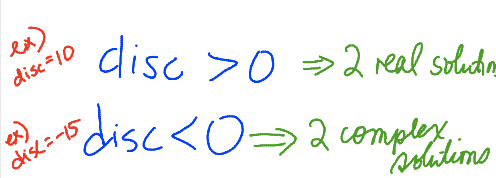
I’m hankering for someone to ask the obvious next question, and indeed, a student does. “What happens if the discriminant is 0?”

And we discuss, and realize there will only be one real solution. This gets added to the chart.

I then ask them to spend 15 seconds thinking about this — what they just learned. To see if it makes sense, or if they have any questions. Just some time.

I’m not surprised (in fact, I’m delighted) when a student asks: “Can you ever have a discriminant equal zero?”

I suddenly realized that for some of my kids, we’re now in the land of abstraction. There is this new thingamabob with a weird name, the discriminant, and the students don’t know what it’s for or why we use it. We’ve been talking about as, bs, and cs and even though we’ve done a few examples, it isn’t “there” for the kids yet.

I throw x^2+2x+1 on the board. He nods approvingly. Then I ask what the solution or solutions are for that equation, and they find the one real solution. Which gets repeated twice when we factor.
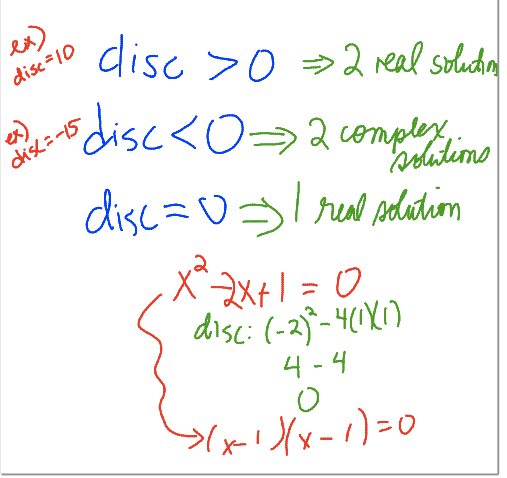
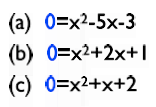
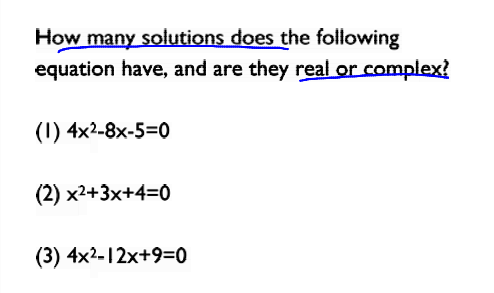
I then give them 5 minutes to check themselves by asking them to do the following 3 problems:

I walk around. Two students are actually doing the quadratic formula. So I go up to the board and underline the things in blue — and ask “do you need the full force of the quadratic formula to answer THIS question?” (Secretly I grimace, because who the heck cares if they use the QF or use the discriminant to answer the question? But if I’m teaching something, I want my kids to practice it.)

When we all come back together, I project the answers

And I get called out (rightfully so!) on improper mathematical language (imaginary vs. complex). So I fix that. I’m feeling slightly guilty about asking the two students to use the discriminant instead of the QF to answer the question, because who cares!, and so I tell the class that the discriminant is just a short way to tell the number and nature of the solutions, but don’t worry if you forget it, because you can always pull out the big guns: the quadratic formula. Which will not only tell you the number and nature of the solutions, but also what the solutions are!

I have them make a new heading in their notes

And I have them work with a desk partner to solve three quadratic equations using any method they like (they only know factoring, the quadratic formula, and completing the square).

They get the right answers, for the most part. The ones who aren’t getting it right are having trouble using their calculator to enter in their quadratic formula result. I want to move on, because of time, so I tell them that we can go over calculator questions in the next class but I want them to put those aside so we can see the bigger picture now.

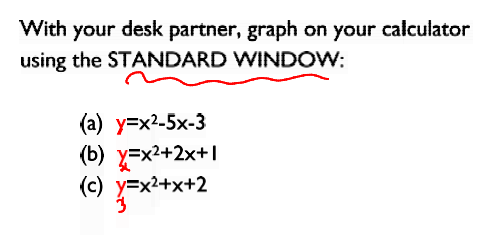
They then are asked to graph the following three equations on a standard window:

We also talk about the difference between the two things they are working with:

We then look at the graph:
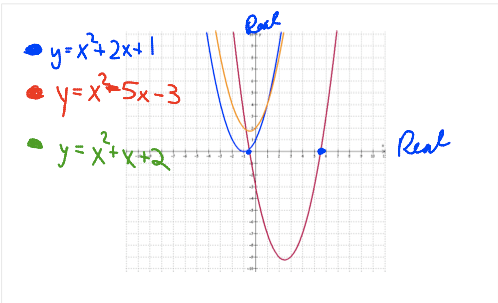
At this point, I haven’t pointed out the x-intercepts, but I asked students to see if they can relate the two questions. I grow a bit impatient, and I point to one x-intercept, and then the other, for the x^2-5x-3=y equation. Hm. They start to see it. We then look at the x^2+2x+1=y equation. Finally, the x^2+x+2=y equation. Which doesn’t have any x-intercepts. Which confused some.

Someone said “that’s because the solutions are complex.” I pointed and said something like “yeah!” and then tried to explain. Some students got confused, because we did plot complex numbers on a complex plane, so they were like “you can plot complex solutions too!” I tried to address their concerns, by saying that the x-intercepts show us the solution when y=0. But the x-axis is a REAL number line, not a complex number line. I don’t think they all got what I was saying.

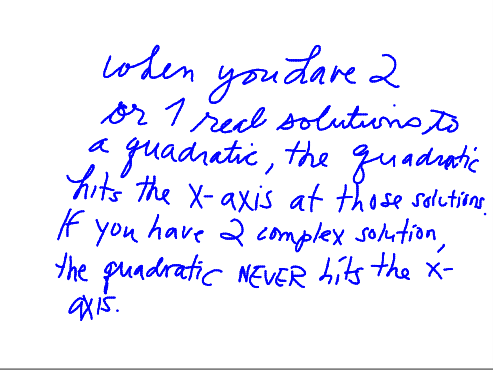
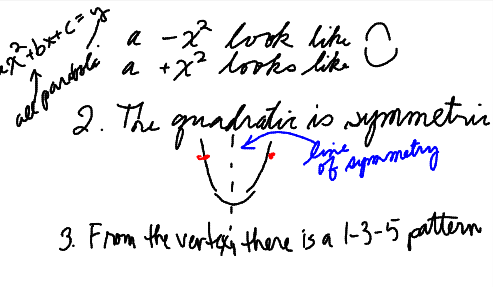
We codify what we know:

This all took about 30 or 35 minutes.

I somehow totally forgot to do something key: bring the discussion back to discriminants. I didn’t ask them “so what can a discriminant tell you about a graph of a quadratic?” It might be obvious to us, but I guarantee you that only a few kids would actually be able to answer that after our lesson.

We spend the remaining 15 or 20 minutes on graphing quadratics of the form y=x^2+bx+c and y=-x^2+bx+c by hand. The students were working in pairs. Then at the end we make some observations as a class.

Class ended, and then I had more work to do.

The point of this post is two fold:

1) I’m in a teacher funk. You can see it in this class. I didn’t work backwards. I gave them what they needed to know (the discriminant), and then motivated it second. I did lots of teacher centered things. I rarely let them discuss things with each other. Blah. Especially for something conceptual, not good. Not terrible, not good.

2) Teaching is exhausting. Anyone who teaches knows that even in a non-interesting lesson like this, a teacher has to constantly be thinking “what do my kids get?” and “do I need to say that again and reword it?” and “do I address the calculator issue of 2 kids when 15 seem to be okay?” Basically, every 10 seconds is a choice that needs to be made, a thought about how to adapt, where to go, what to do.

[1] Honestly, personally, I think the whole idea of the discriminant is stupid and I would have no problem doing away with it. It’s a term with very little meaning and almost no use. But I am asked to teach it, so I do.

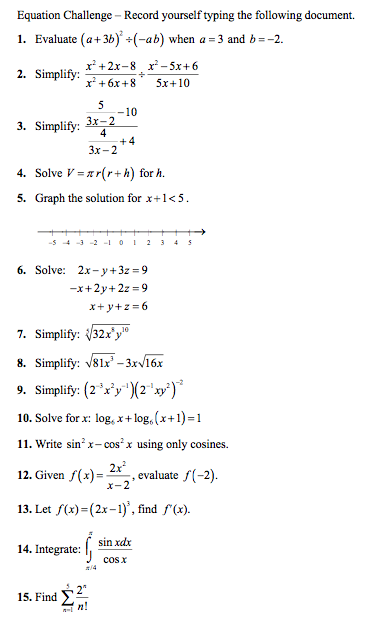
Equation Challenge!

Maria Andersen blogged and tweeted about an Equation Challenge — asking people to type out a set of 15 math questions and asking them to record it.

I know Maria is a big fan of MathType, and wants people to learn to unlock the secrets of it that make it so powerful. I use  MathType when I’m at school — I type all my worksheets and assessments up in Microsoft Word. (I type all my Multivariable Calculus problem sets out in LaTeX, however.) But when I was in high school (ahem, at… ummm… yeah, you got me… math camp), I first learned about LaTeX.

It has a slightly steep learning curve — definitely MUCH steeper than MathType — but I find that since I’ve been using it for so long, it has become really naturalized. And you know what? MathType can actually take in LaTeX (if you select that option in preferences). So I get the best of both worlds when I’m using Word.

So for the heck of it, I took Maria’s Equation challenge twice. Once, using Lyx (my LaTeX editor). Once, using Word. I was curious to see if I was faster with either of them. Of course I typed it as I normally would — using both the GUI and LaTeX.

Since Jing (which you must learn about, if you don’t know about it!) can only record for 5 minutes, I just typed as much as possible in that time frame. (If the videos won’t play full screen, just click here for LaTeX and here for Word.)

Vodpod videos no longer available.


more about “2010-02-20_1842“, posted with vodpod
Vodpod videos no longer available.

more about “2010-02-20_1852“, posted with vodpod
The documents I produced are here (LaTeX) and here (Word). The result: I’m about equivalent in both. Which isn’t so surprising, considering I use LaTeX to type both.

Topic Lists!

Central to who I am as a teacher is the notion that I have clear, consistent, and fair expectations [1]. The teacher I admire most at my school showed me that it can work, if done right. I’m sure at some point I’ll write about that when I craft my current philosophy of teaching. Which is, well, not now.

Now, I want to share with you something my department head does with her classes, and this year I’ve stolen it for my Algebra II and Calculus classes.

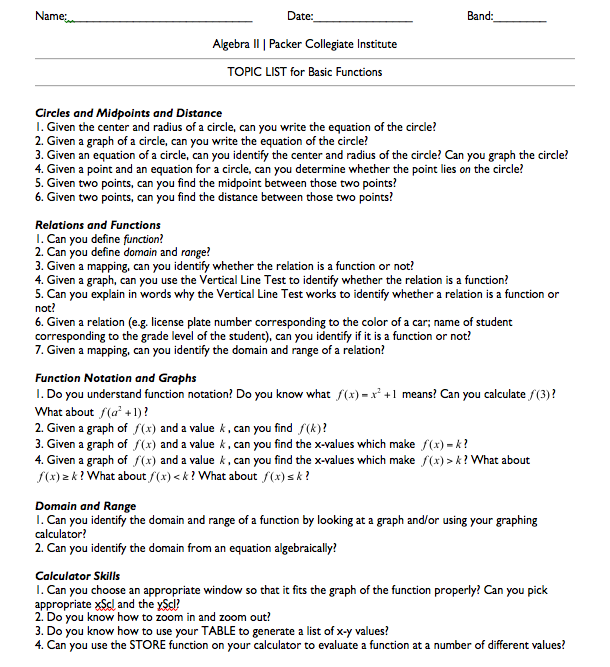
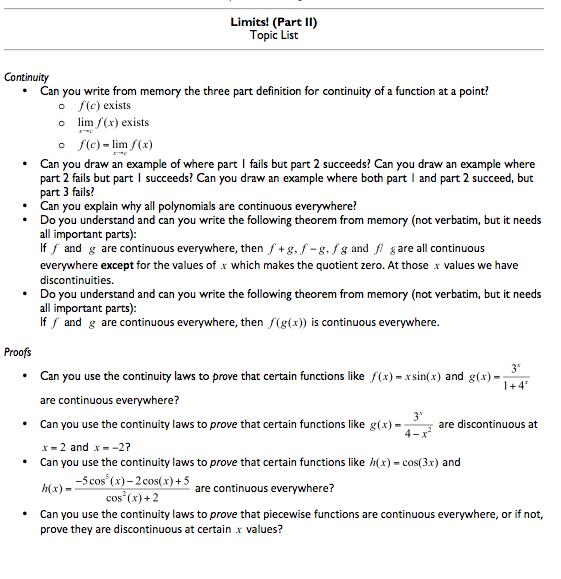
Topic Lists.

These are lists of everything students are expected to know going into an assessment. I write them up and distribute them on our review days. Here’s an example of one I handed out in Algebra II:

And here’s one from Calculus:

I will admit that at first, I was against doing this. I think it is the students’ responsibility to learn how to study in my class. To learn how to organize the information we’ve learned and create his or her own study plan. And my first thought: HANDHOLDING! CODDLING! PSHAW!

But you know what? I teach the non-accelerated classes. My kids don’t know yet how to organize all that we’ve learned. And things are much harder because I don’t teach out of the textbook. I use the book as a supplement, and (at least in Algebra II) I jump around in it a lot. A LOT. A LOT A LOT A LOT. And I use a lot of my own worksheets, and only assign textbook homework about half the time. So the course is necessarily confusing because the information isn’t all in one place.

For that reason, I feel comfortable giving them these topic lists.

What I like about them is that students know if they’re ready to take an assessment. The can just go through the list, topic by topic, and see if they know how to do that sort of problem. I always tell my kids that the assessment will have no surprises. They know what’s going to be on it. And heck, they SHOULD know what’s going to be on it. With these topic lists, I’m giving clear, consistent, and fair expectations. You know what’s remarkable about it? KID’S LOVE IT. They love organized teachers who are clear and consistent about what they want. [2]

Hey, I know, I know. It’s nothing like the “skills based assessment” that Dan Meyer and his offspring have adopted. But having a list of skills for my students to look at when preparing for my regular assessments is helpful for them. Heck, it’s going to be super useful for me because next year to see exactly what I taught this year, in some sort of codified and consistent form.

[1] The expectations have to also be reasonable and I have to provide the resources to achieve them.

[2] I don’t know if I would give topic lists to my kids if I were teaching the accelerated tracks. I feel if you’re in an accelerated track, I expect you to know how to study. Also, topic lists would probably be less useful because the problems I’d probably include on exams would be ones that force students to think a little outside of the box, and to synthesize information in a slightly different way than they’ve seen before. The topic lists couldn’t account for those kinds of questions, without giving them away.

A letter preserved: where I thought I would be

I did a summer program at Collegiate (a fancy private school in Manhattan) after my first year of teaching. Let’s see, that must have been in June 2008. On the very last day of the program we were asked to write a letter to ourselves, which would be mailed a year later. We were supposed to write some goals down.

Mine letter was mailed to me in June 2009, as promised one year later. I didn’t open it until today, on February 17, 2010. (I was scared to see if I had lived up to who I hoped to be when I wrote the letter.) What I wrote then… it’s a fascinating read.

Dear Sam-in-the-future,

These things are always pretty corny — write to your future selves. But whatever, I have 30 minutes and nothing really to do but this. I’ve just finished the Collegiate Summer Teaching Institute (“new teacher boot camp”) which came on the heels of my first year of teaching. Since it’s summer and I haven’t yet had a day to myself yet, I can say I’m exhausted and ready to return home to Brooklyn.

I can say that after this first year, I’m exhausted but not burned out. My enthusiasm about teaching is still there, as is my creativity (althought I don’t really have to time to think through or actualize my ideas). At CSTI, I got to create a lesson on Matrices, which I did using Facebook and social networks as an example. Meera R. and Antonio W. suggested I develop a unit on it and present it at NCTM. So, with that said, here are some goals I hope you’ve achieved or are on your way to achieving by the end of your next year.

*Join SFJC [Student Faculty Judiciary Committee] or FSAC [Faculty and Staff Advisory Committee]
*Successfully integrate the Algebra II video project in the classroom
*Go to the People of Color Conference (if only for networking)
*Start the non-fiction journal at Packer
*Look into attending the Exeter math teacher conference next summer
*Keep current with my teaching blog
*Talk to people and look seriously into becoming a tech integrator
*Come up with a really solid, investigation-based, computer-loving Multivariable Calculus curriculum
*Finish that damn Calculus curriculum map (ha!)

Just remember — because nobody really tells me this outright — that I am a good teacher. I work hard, I have the instincts, and I can break mathematical concepts down. Don’t let anyone sell me short, and don’t stay at Packer because of loyalty (stay because it is still an amazing place to work), and don’t leave just because I want more money.

Here’s to hoping next year is slightly less exhausing as this year was!

Heart,

Gotta love it. I haven’t achieved all my goals, but I did accomplish a lot on the list. I am a member of both the SFJC and FSAC. I seriously investigated starting the non-fiction journal at my school, but the English and History departments weren’t really gung ho about it, so I had to give it up. I did go to the Exeter conference the following summer (which was amazing, by the way). Heck, I am still writing this dang blog! And I have come up with a pretty dang solid Multivariable Calculus curriculum, which is based on problem sets, but it is definitely not “computer-loving” yet.

One thing that still holds true: My enthusiasm about teaching is still there, as is my creativity (althought I don’t really have to time to think through or actualize my ideas).

We’ll see where my career goes in the future. It’s fun to see where I hoped I’d be when I wrote this a year and a half ago, versus where I am now.

PS. If you want to get a flavor of the Matrices thing that I created, I blogged about it ages ago, but I think this was a much more rough form than what I crafted at the summer program. I think I have a much better and more updated version, if anyone who is teaching matrices wants to see it. Just put something in the comments and I’ll see if I can’t dig it up.

The Unfolding of a Non-Intuitive Problem

Below is a problem that one of my calculus classes tried solving (unsuccessfully) so we banded together and walked through a solution. The problem is this (from here):

If you have two flies on a deflated spherical balloon — one on the equator and one on the north pole — and the balloon inflating at a rate of 5 cubic centimeters a second, how fast are they moving apart from each other at some time t_o?

What I like about the problem is that it is looks as simple as all the other related rates problems they’ve done, but it actually gets pretty complex. And it gets tricky figuring out what you’re trying to solve for, unless you keep yourself organized. What I love most is that you’re given almost nothing, but you end up with an answer I’d call beautiful because it is so ugly. You start out with practically nothing and can get something so ugly out as answer? Awesome. Welcome to math, neophyes!

So we walked through the solution together — after they had a good amount of time a couple weeks ago to try to solve it. I gently asked a few questions prodding them and kept the information organized. What you see below is how the problem unfolded on the whiteboard.

Vodpod videos no longer available.

more about “The Unfolding of a Non-Intuitive Problem“, posted with vodpod