Teachers Say (and do) the Darndest Things

We all have catch phrases. Things we say, purposefully or accidentally, enough times that the kids have taken note. You know, these are things kids probably mimic when doing impressions of us. Which I know they do. I mean, don’t they?

I bet someone doing an impression of me teaching any of my classes would say “ooooh, CRUST!” as an expletive a lot. That’s my curseword in class, whenever I lose track of time or make a mistake. I also often deny mistakes, jokingly. A brave student will note “you forgot the negative sign there.” I’ll carefully add it in and say “Um, hell-O, no, I DIDN’T. I have no idea what you’re talking about.”

We also have catch phrases related to math. In calculus, you all know my motto, which gets said at least once a week if not two or three or four times a week:

turn what you don’t know into what you do know

And in Algebra 2, I have one class rule for safety. Which I pull out of my pocket a lot:

don’t divide by zero! if you do, the world BURSTS INTO FLAMES!

[And then I take the red smartboard marker and draw flames around the thing that would have a zero in the denominator.]

Kate Nowak’s recent post talked about the changing of traditional teaching phrases in her class[1]:

Today in Algebra 2 we reviewed negative exponents and the children acted like they had never seen it before. I told them about the phrase “move it, lose it” for dealing with a negative exponent, as in, move the term to the other side of the fraction, and lose the negative sign. A student who moved here from another state (where, you know, they get to spend enough time on things to actually learn them) told us about the phrase she learned “cross the line, change the sign.” Which the kids liked better. “You know, because it actually rhymes, Miss Nowak. Unlike yours.” Um, last I checked “it” rhymes with “it.” I’m not an English teacher! You can tell because I’m not wearing cool shoes and I don’t give hugs.

Okay, a big giant *grin* for the best two lines I’ve ever read on a blog (the last tines, obvi). But it got me thinking more about these techniques we use to teach kids to remember things. Yes, I think kids should know the reason why particular algebraic manipulations / formulas work. But once they show me that they “get” it I have no problem with them using phrases and shortcuts to help them remember things.

I mean, how many of you always rederive the quotient rule when taking a derivative of a rational function in calculus? Or do you sing a little sea shanty like:

low de-high less high de-low
and down below
denominator squared goes

Or for the quadratic formula? In your mind you’re definitely saying the formula in a very specific way each time. Think about it.

THINK, I said.

Yup, I thought so. So inspired by Kate, I thought it would be a neat exercise to chronicle three of the ways I get kids to remember things or do hard things.

(1)

The “pop it out” rule for logarithms. When we are learning how to expand \log(x^3) to get 3\log(x), I always say “POP IT OUT!” and do a raise the roof hand gesture. I don’t know why I do that. I don’t know how it started. Maybe the raising of the roof is popping out of the exponent. Then when students are working and get stuck, I sometimes help ’em out by quickly doing a mini raise the roof. Then they always exclaim “Oh! Pop!”

(2)

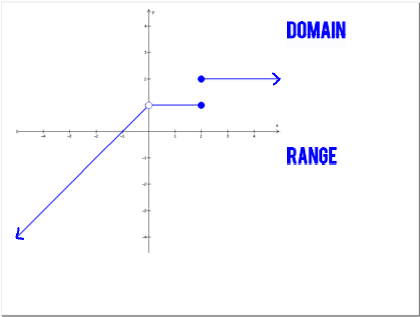
[Note: I am pretty sure I stole this from someone from a couple of years ago.] When teaching how to visually find the domain and range of a function, I tell students: “Guess what? You don’t know this but besides your calculators you have another a highly sensitive and powerful mathematical instrument. It’s kind of awesome. It’s called a domain meter.” I throw a relation on the board:

I tell them to hold out their index finger way to the left of the graph. Then slowly move it rightward across the graph. As they do it, I do it with them, and as soon as my finger hits x=-2 I start annoyingly sounding “BEEEEEEEEEEEP” while continuing to move my finger. Finally when my finger reaches x=2, I stop beeping and I silently continue to move my finger. I tell them: “my domain meter only beeps when it hits the graph. What’s the domain?” (They get it.)

Then I say “Believe it or not, you have another amazing mathematical instrument. You guessed it, a range meter.” I then hold up my vertical index finger (“domain meter!” I exclaim) and turn it horizontal (“range meter!” I exclaim). Then I take my horizontal finger and start at the bottom of the graph and move it upwards. I only start beeping at y=0 and continue until y=2. They all can state the range at this point.

I’ll end up finally throwing something more complicated on the board:
and they’ll get it, first try.

(3)

In calculus, I want my kids to be able to see derivatives quickly. My first year teaching it, I focused a lot on u-substitution to take the derivative of \cos^4(x). Why? Because my kids just couldn’t get the hang of “seeing” the answer. So I came up with the “box method” of teaching the chain rule, which works great. (And yes, of course, I always teach u-substitution first and we talk about why this “box method” works.)

I have my kids first rewrite the function so that they can see “inner” and “outer” functions. So for example, they have to rewrite \cos^4(x) as (\cos(x))^4. That way they can see the “inner function” easily. Similarly, they need to rewrite \sqrt{\cos(x)} for the same reason. I then ask them to put a box around the inner and outer functions respectively. If there are more than two (functions within functions), they should make all the boxes.

So let me show you with a simple example from class today:
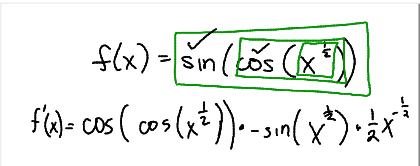
I have students write the functions in terms of “outer,” “inner,” “more inner,” etc. until they get to the gooey center of a composition of functions. Then I tell them to look at the outermost function, ignoring everything from the boxes inside (in our example above, they’d say “sine of blah”). I asked them “what’s the derivative of sine of blah?” and they all say “COSINE!” So I write

\cos(stuff)

and ask “what do I put in here?” They say “don’t touch the innards!” So I fill it in:

\cos(\cos(x^{1/2})).

Then I put a check next to the outermost function and say “we’ve dealt with you, so we’re done with you.” I then go to the middle function and say: “What’s the derivative of cosine of blah?” and they all say “NEGATIVE SINE!” So I go to the board and add

\cos(\cos(x^{1/2}))*-\sin(stuff)

and ask “what do I put in here?” They say “don’t touch the innards!” So I fill it in:

\cos(\cos(x^{1/2}))*-\sin(x^{1/2})

Then I put a check next to the cosine function and say “we’ve dealt with you, so we’re done with you.” I then go to the middle function and say: “What’s the derivative of x^{1/2}?” and they all say “\frac{1}{2}x^{-1/2}. So I stick that on at the end.

\cos(\cos(x^{1/2}))*-\sin(x^{1/2})*\frac{1}{2}x^{-1/2}.

And fin, we’re done. It goes pretty fast once they get the hang of it. And they actually secretly love having equations that are scrawled across a whole page.

[1] Kate, forgive me for cribbing so much wholesale. But I needed to have the last sentence in there!

2009 Edublog Nominations

My nominations for the 2009 Edublog awards

Best new blog
David Cox’s Questions? [http://coxmathblog.wordpress.com/]
(Anyone who has read this blog won’t question why it is top of my list.)

Best resource sharing blog
Kate Nowak’s f(t) [http://function-of-time.blogspot.com/]
(Her resources are more than nice lessons, but also interesting activities that can be used to group kids and differentiate instruction.)

Most influential blog post

Dan Meyer’s What I Would Do With This: Pocket Change [http://blog.mrmeyer.com/?p=4905]
(This was one of the best blog posts I read all year. It was inspirational. It didn’t get a lot of comments, so maybe not a lot of press, but it — and Dan’s whole What Can You Do With This series — is an exciting framework for how math can be taught.)

Best teacher blog

Dan Meyer’s dy/dan [http://blog.mrmeyer.com/]
(If you’re reading this, chances are slim to nil that you’ve not been to his blog. If you are in that slim to nil category, shame on you.)

Best elearning / corporate education blog

Maria Andersen’s Teaching College Math [http://teachingcollegemath.com/]
(I look up to her. I always find ideas and thoughts, and get exposed to some resources out there in the edutechnoblatespheroid, waiting for me at her blog.)

Best educational use of video / visual
Rhett Allain’s Dot Physics [just moved to http://scienceblogs.com/dotphysics/; originally at http://blog.dotphys.net/ ]
(Sweet design aesthetic and, oh yeah, he does some pretty sweet physics too.)

Evolution of my narrative comments

In my school, we write narrative comments for all our students twice a year. In order to prepare for my first quarter comments, I looked back at my comments of years past. Although I don’t think my comments are exactly where they should be, I was pretty proud of the long way I’ve come when writing them. [note: information has been changed in all of these.]

They’re not amazing yet, and I know what I need to work on, but I’m happy to see how far I’ve come.

1st year teaching
Stu is a pleasure to have in class. This quarter we have had 4 major assessments: three quizzes and one test. Stu’s grades on these were 13.5/15, 18/25, 59/100, and 43/50. Stu’s homework grade is 95%. Clearly – from her homework grade – Stu spends quality time on her work, which is really important for understanding. On the chapter 1 test, Stu scored a 59% which I know must have upset her. Instead of being frustrated and angry, Stu made an appointment to see me and talk through it. Her improvement was clearly evidenced on the next quiz where she garnered an 86% (43/50). She should be proud of this accomplishment. I continue to encourage Stu to ask questions in class when she’s confused and also to continue to make appointments to individually go over some of the material she finds challenging. Let’s hope this upswing continues into next quarter.

2st year teaching

Stu is a joy to have in class. The earnestness with which he engages with the material in class, working through problems or asking questions, is a boon to any teacher.  I asked students to write a reflection at the end of the quarter, and his was incredibly thoughtful. He wrote “The awareness of my understanding helps me to ask informed questions in class and is crucial to my classroom involvement.” The entire class benefits from these questions.

We have had four major assessments this quarter: a quiz on functions (47/52: A-), a quiz on exponents, logarithms, and trigonometry (35/42: B), a quiz on limits (42/51: B-), and a quiz on limits and continuity (27/33: B-). He has also completed all his homework assignments assiduously. On the first quiz on limits, Stu seemed to have some difficulty understanding the difference between “zeros” and “asymptotes” when doing sign analyses of rational functions. On the second quiz on limits, Stu’s difficulties revolved around proving a function was continuous everywhere (using the fact that it was a composition of two continuous everywhere functions). I encourage Stu to review these quizzes. If he has any questions about how to do these problems, he should meet with me!

His final quarter grade is an 86% (B+).

3st year teaching

Delightfully funny and always striving to do better, Stu is a student who focuses intensely in class to ensure that he understands the material daily. From what I’ve seen so far, it appears that Stu has a strong command of mathematical ideas and abstraction, and he picks up on ideas fairly quickly. When given problems that check student understanding in class, Stu endeavors to get an answer — and is always willing to help those around him also. The questions he raises are good, and I encourage Stu to keep up the volunteerism. The questions he asks benefits the class as a whole.

In a reflection I had students write near the end of the quarter, Stu noted that his way of approaching homework wasn’t working. He said “Initially, I didn’t realize I had to show all my steps and write neatly, but I now know what I need to do, which shows improvement on my part. I’m working hard to be more thorough.” Not only is this important in Algebra 2, but learning to correct mistakes in any class is important because it encourages students to be active learners, not passive learners. Stu certainly is an active learner.

We have had three major assessments and two pop quizzes this quarter. On the major assessments—on sets, inequalities, and absolute value equations; on absolute value inequalities, factoring, and exponents; and on polynomials, domain, and rational expressions—Stu earned 54/60 (A-), 59/70 (B), and 48/50 (A) respectively. On the two pop quizzes, Stu earned 11/12 and 6/7.

Clearly his performance this year has been consistently strong, and I encourage Stu to continue working at this level at the very least. However, I always try to push my students to achieve more than what they think they are capable of achieving, and I know that Stu can do even better.  I am happy to meet with Stu to talk with him about how to achieve this.

In Algebra 2, homework is divided into two parts: daily check for completion, and our binder check for correctness, neatness, and organization. Stu has done all the daily homework, and earned a 25/40 (D) and 45/45 (A+) for the two binder checks.  The binder check is done to encourage organized, active learners, who are expected to correct mistakes. Stu clearly has learned how to do so as the quarter progressed, and I encourage him to continue checking his work for the rest of the year.

Stu gave himself 4/5 for his classroom engagement grade.

Circles, circles everywhere

So we’re off for Thanksgiving today (phew!) and after a few really great days, this two-day week was pretty much a bummer. The one fun mathematical thing I’ve worked on is a problem involving geometry. Ew, I know. But I got really into it, and it got me thinking of about a million other extensions, questions, methods of attack, etc. I was thinking in so many different ways — about symmetry and about limiting and degenerate cases and about angles and such.

(1) You have two circles, radius 3 and radius 5, tangent to each other. You want to draw a third circle tangent to the given two circles. In fact, you realize there are an infinite number of these circles. So the first question is: what is the locus of all points which is comprised of the centers of these infinite circles?

If you want a small hint, go after the jump for a picture. (In case it wasn’t clear, we are taking about circles which are externally tangent to each other.)

(2) Generalize the problem to being given two circles with radius a and radius b (instead of radius 3 and radius 5).

(3) Can you find a third circle tangent to the given two circles such that the centers of the three circles forms a right triangle (if possible).

(4) What if we ask a similar question about spheres? If you are given two spheres of radius a and radius b, what is the locus of all points which is comprised of the centers of spheres tangent to the given two spheres?

So if you are bored over your Thanksgiving holiday, you might want to have some fun with this. I’ve solved the first two. I haven’t had time to think about the third yet, though I know the solution won’t be (too) hard. The fourth one? Eh, I anticipate it to be pretty tough. But having solved the first two will definitely help! [update 5 minutes after posting: Eh, nevermind, I think I know the answer to the fourth one… not really hard!]

(more…)

Genesis

I am exhilarated. The past two days in my calculus classes have taught me more about teaching (and more about student learning) than any other days this year. I am so engrossed in what’s going on that I feel like I might be at the brink of something big for my teaching… Maybe not, maybe this is just a passing thought, and I might grow bored of this, but right now it feels big. It could be a genesis for me-as-teacher.

As you know, I’m interested in the questions of how to teach problem solving, how to hone intuition, and how to build independence and tolerance for frustration for students. But on a whim, last week, I decided to temporarily throw all those huge questions out the window and just do something, anything, to get students to problem solve. My kids had just had a test on basic derivatives, so it was the perfect time to digress before Thanksgiving break.

So you know where we are… my calculus students had learned how to find derivatives of basic functions, they had learned the product and quotient rules, and they had a bunch of the conceptual ideas down. (For example, they could explain why the power rule works and where the formal definition of the derivative comes from.) But that was it. We focused on finding the derivatives of function after function after function.

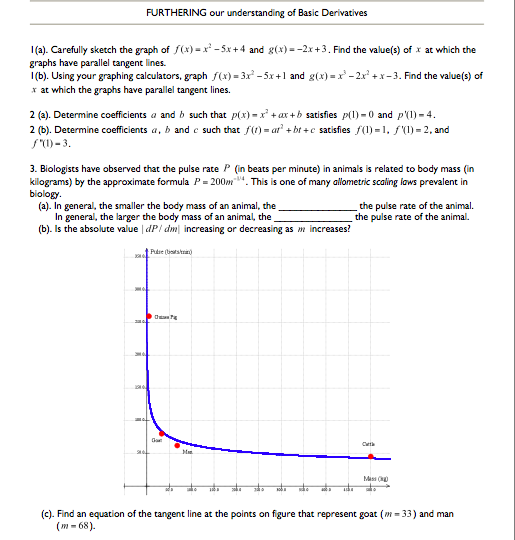
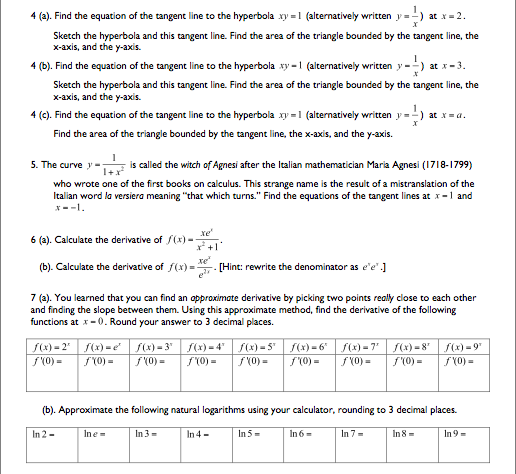
So I gave myself 3 days to do something. I crafted a worksheet with 7 questions. Many just taken wholesale from our textbook, or slightly modified/scaffolded. I didn’t try to find hard problems. I have no interest in throwing my kids into the deep end of the pool [1]. Instead of “hard,” I tried to find problems that were different than any problems they had seen before.

You might look at this sheet and say “yeah, any calculus student who knows how to do derivatives ought to be able to do these questions.” But the first thing I learned in these two days is that that would be a huge mistake. In fact, it was a mistake I made for the past two years. I would assign one of these sorts of problems for homework, and the next day students would come in asking questions, and we would go over how to solve it in class. And by “we” I mean “I” would explain the solution asking students questions along the way. Then my kids would ostensibly know how to solve the problems. And I would move on, knowing they had “learned more calculus” and mastered “one more type of problem they might confront.” And although it may be true, my kids never really had to flex any of their intellectual muscles. They learned another algorithm. They didn’t ever have to struggle, minus a few minutes (seconds?) at home before giving up.

Here’s how these days went.

DAY ONE

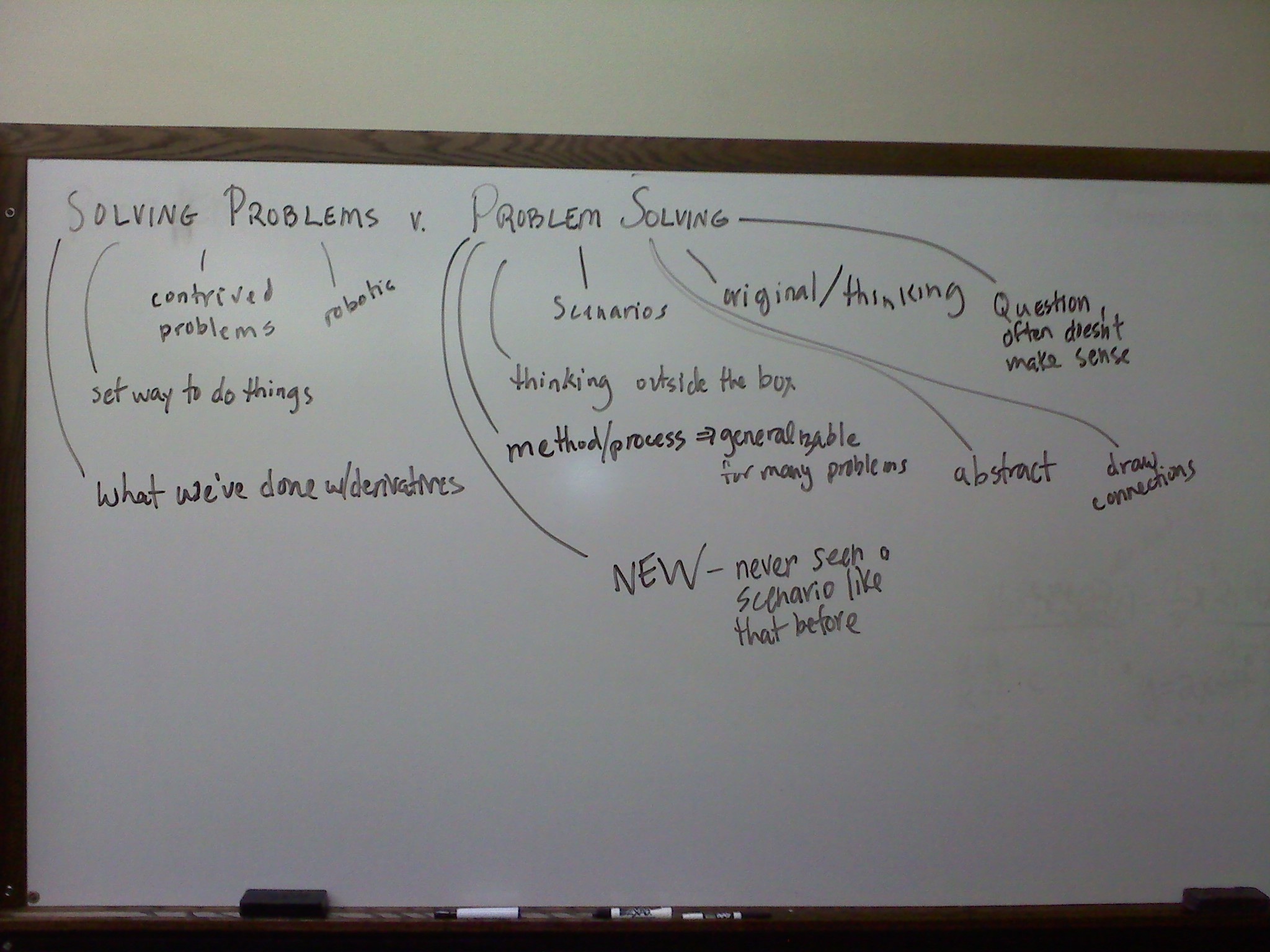
I start out with “SOLVING PROBLEMS v. PROBLEM SOLVING” on the board. I tell students what we’ve been doing in this unit is solving problems. I ask them what they think the difference between the two things are. This is what we come up with:

I put them in pairs. I tell some of the groups to work on problems 1, 3, 5, and 7, and the other groups to work on 2, 4, 6, and 7 — starting with whichever question strikes their fancy. I tell them that I won’t be of much use to them. That they are going to have to use their wit and wiles to do these problems. That they should ask their partners their questions, that if they really get stuck they should go to another group, and if they really, really get stuck, they can talk to me. Although I won’t be of much use to them.

They start working. For the remaining 40 minutes. They are totally on task. They are struggling to understand the questions, and they are trying to explain their ideas to each other. For example, for question 1, some groups just couldn’t understand what the question was asking.

Me: “Did you graph the two functions like the problem said?”
Them: “No.”
Me: “Maybe that will help you understand the question.”
[I come back later]
Me: “Do you understand the question now?”

Or sometimes I would get some student needing affirmation:

Them: “Mr. Shah, for this problem I first took the derivatives of the functions and set them equal to each other and then I solved and got this quadratic and then since I couldn’t factor it I used the quadratic formula.”
Me: “That sounds like a statement. Do you have a question?”
Them: “Well, I guess I’m asking you if I’m on the right track.”
Me: “You know I won’t answer that. Do you think you’re on the right track?”
Them: “I think so.”
Me: “So go with it. Stop worrying about being right at every step. Have confidence. Talk things out. Make mistakes. Whatever. Now stop bothering me.”

I have to encourage a couple of people to work as a team instead of independently, but other than that, my students are killing it. It is amazing. I can’t understand what it is, but my kids are really into this!

One of the groups which is working on problem 4 says “Mr. Shah, now that we’ve done part (a) and part (b) for this question, we’re not problem solving anymore. We’re just solving problems when we’re doing part (c).” I almost cry. My kids are starting to recognize on their own that once they problem solve and get a technique down, they are then only solving problems. They have another tool in their toolbelt with which to problem solve.

At the end of the class, I say “Stop.” Most have only solved 2 or 2.5 questions. I smile and tell them that’s alright, and that they are doing so amazingly that I am not going to assign any homework.

Lessons from DAY ONE:

  • The “easy” questions I chose aren’t so easy, since my kids have never seen questions of that particular form before. As I suspected, this is problem solving for them.
  • The kids who are afflicted by “learned helplessness” (read: who always raise their hand at the first sign of trouble) can think for themselves. In other words, my kids can be independent thinkers if forced to.
  • Kids need time to struggle and grapple and do basic things like draw parabolas and hyperbolas. I assume they can do these things quickly. They can’t.
  • My kids are not to be underestimated. I realized that I regularly underestimate the ability of my kids to think for themselves. Which is one of the biggest reasons it has been hard for me to let go of my teacher-centered class, and lead more of a student-directed class.
  • Many of my kids actually found math fun/interesting! Without the stress of grades and time pressure, they got to enjoy the puzzle aspect of math!

I sent out a survey to my students asking them about this first day of problem solving.

Some of their positive responses (and see this teaser post for my favorite response):

It’s exciting to think that we are finally able to combine a lot of the formulas and other material we learned previously to solve a single problem.

I think it went well. It was tough, but rewarding to get an answer, even though we still weren’t sure if it was correct.

I found the class really interesting because I often find myself neglecting my brain and just accepting what teachers tell me. It’s a nice change of pace to think for myself for once and truly try to understand it.What makes me excited about doing more of this is that I feel the more we do, the more comfortable we will be with doing them.

I think it went really well, actually. I liked the problem solving.

I liked doing problem solving because it was different from what we’re usually doing. It’s also a good way to work on a different way of thinking about things, which I’m always appreciative of.

I think it went well. It’s hard to start out a problem, but then at a certain point things start to click.

It wasn’t bad, it was good working in groups so that we can bounce ideas off of each other. It was good applying the things we learned previously.

Im excited to be able to do harder problems, and it makes the easier problems look and feel alot easier.

It’s really interesting and challenging. Solving these problems is like solving puzzles because you already have the pieces, but you need to find a way to piece them together so they form a whole.

I like working with a partner on problems. i think that these problems feel very comprehensive which is fun.

There were no negative responses. There were anxieties though. All of their anxieties about problem solving boiled down to two things: grades and their ability to actually do the problems since there is no set method to solving them.

DAY TWO

I start out the class reminding the kids about problem solving. I talk about their survey responses, and the anxiety about grades. I tell them to mitigate their fears, whenever we problem solve I will always give them a choice of problems to work on, I will let them work in pairs (at least for now) so they can bounce around ideas, and that I will grade them on more than just answers. I will grade them on their formal writeups and the clarity with which they explain their approaches to the problems, even if none of their approaches succeeded. My kids seemed to feel those addressed their concerns.

I set them off to work with their same partners. If they worked on the even problems, they should work on the odd problems (regardless of whether they solved all their even problems). If they worked on the odd problems, they should work on the even problems (regardless of whether they solved all their odd problems). The students work. I wasn’t sure if they’d still be into it, but they are.

Five minutes before class ends, I stop everyone. Most groups had gotten 3 more problems done. I tell everyone their homework. Each student must pick two problems and do a formal writeup for those two problems. No one in the group can do a formal writeup of the same problems, though. I ask them  how day two went. They agreed that it was (on the whole) much easier the second day, now that they knew what they were doing and how to work with their partners.

Lessons from Day Two

  • I suspect that two days of problem solving is enough. I think more time will make what we’re doing into a chore instead of something new and exciting.
  • My kids really, really want to know if their answers are right. I refuse to tell them. That bothers them. I tell them that’s part of problem solving. And then I asked them if they have a way to check their answers themselves?

Where am I going from here?

1. Tomorrow, I’m going to have each student exchange their writeups with their partners. They are going to read through the writeups, and come up with comments and suggestions for clarity. Diagram here? Explanation there?  After 15 minutes of discussion, I’m going to tell them that the remainder of their classtime will be spent writing up a better version of their partner’s solutions. Their final draft. Which will be graded.

2. Now that my kids have struggled with some easier problems, and know they are capable of working them, I created a bunch of harder problems. I am going to distribute these problems to my classes, partner them up, and give them one week and two weekends to solve 2 of the problems. I will give them 20 minutes to work together in class in the middle of the week. The problems are here, if you want to see them.

3. I’m going to photocopy each classes’ writeups and distribute them. We’ll talk about what makes a good writeup and what makes a bad writeup.

4. I think I might spend two days after each unit doing this.

And with that, I’m out.

[1] One thing I want to avoid at all costs is being one of those teachers who says “I teach problem solving” while actually just giving hard problems to kids and then watching them struggle. I want to teach problem solving. That’s tough.

People have been telling us what we need to do

Student quotation from an online survey I gave about class today:

I think it went really good. Although many of us struggled, that feeling of struggling felt good. Teachers always give us equations to use or tell us what we need to know, but during class today that wasn’t the case. We had to pull together what we knew in order to solve problems. You didn’t give us specific equations to use or anything.  I feel like this connects to life, and especially now for us seniors. Throughout most of our life people have been telling us what we need to do, but soon we will be the adults who need to know how to resolve problems when we are approached by them. People won’t be giving us what we need to solve our problems any more, we need to learn to struggle and figure out our own ways to succeed.

I am aglow with how thoughtful, reflective, and mature my kids can be. I also was reminded how capable my kids are. And yes, probably more to come on what prompted this.

One teacher’s advice for dealing with cheaters

A first year teacher on twitter asked me how to deal with cheaters. My immediately response was: find out your school policies and procedures. Dealing with cheating is emotionally fraught, for the students, for parents, for the teacher, and for administrators. My school has something called the Student-Faculty Judiciary Committee, which I serve on, which provides a way for students to reflect on their actions, as well as distances the teacher from the situation. More than anything, you need to know what others in your school do, because it can all backfire on you if dealt with improperly.

So I tweeted that school culture and policies — and knowing you have support in what decisions you make — are important. And then I typed up my advice, if a teacher has carte blanche and no SFJC or disciplinary board.

Knowing nothing about your school policies and culture, and assuming you have the support of your administrators to deal with it in your own way, and assuming you’re pretty darn sure your two students cheated, here’s what I would do.

First approach the students individually, and to each, say you noticed something odd about their latest exam, and if they have anything they want to tell you, to let you know by the end of the day.

If one (or both) do come to you and admit to cheating, skip to the paragraph beginning “If they admit to cheating…”

Most likely neither will come see you, so the next day sit them down individually, state the facts, and let them talk. I wouldn’t even mention the other student’s name in that meeting – and if you pull out the other exam, be sure to cover the name up. This meeting is about the kid in front of you. Not the other kid. And be sure to make sure the student knows that.

Start off by admitting you don’t know the whole situation, but it looks too suspicious to let it go, and that you wanted to have a conversation about it. Lay out the facts. Keep pressing the student on the improbability/impossibility of the similarities being a coincidence, and how you really need them to help you see their side. Don’t get attacking, don’t get put on the defensive, don’t accuse, just keep to the facts. You aren’t putting them on trial. You are their teacher, and you want to keep that relationship first and foremost. So stay cool and firm. And if it gets too emotional, take a 5 minute break and come back.

If they admit to cheating in that meeting, GREAT! Then have a conversation about what was going on, have them reflect on why they cheated (pressures, panic, etc.) and ask them about things they can do to prevent it from happening in the future. Then ask them what YOU can do to help them to prevent it from happening in the future. THEN talk about your consequence (0 for exam? 50% for exam? whatever). I’d give the consequence last, and it is NOT up for negotiation. Finally thank them for their honesty, and remind them that above all else, you’re there for them. That you care, and that you’re their teacher.

If they don’t admit anything in that meeting, and after hearing what both students had to say you are still convinced that it was cheating, then tell the students you are still skeptical and their explanations, but you are going to sleep on it and get back to them.

The next day I would talk to them again (individually, as before) and say that you are sorry about the situation, but as a teacher, you can’t just sit on it.  Then tell the student that they are going to get a 0 (or 50%, or whatever your consequence is) for the exam. Remember, sometimes as a first year teacher, students feel can convince you that everything is up to negotiation. That’s not true, and don’t let them negotiate with you. However, you need to emphasize that even though the situation isn’t ideal, YOU ARE THEIR TEACHER and YOU ARE ALWAYS THERE FOR THEM. Say you know things will probably feel very awkward for them, and they might really be angry at you or the situation for a while, but they need to get past that quickly because you are there, always, to help them succeed.  And you don’t want anything preventing them from coming to you for extra help or support, or to feel like they can’t speak up in class.

Cheating is hard for me. I have gone through a cheating situation (sometimes more than one) each year. And I get really emotional, angry, frustrated, and sad. Maybe it’s just me, I don’t know. But what gets me through it is even though I feel like the student violated my trust (which he or she did), they did not cheat to violate my trust. It is not personal, though it feels personal. It usually arises out of panic and pressure. And that’s the opening where I find a place to start a conversation with a student.

[1] To me, anyway, it is really important that the student-teacher relationship doesn’t get totally broken as a result of a cheating incident. Teachers have to be the adult in these situations and recognize that our students are just kids. It may seem like a huge breach of trust to us, but we still have a responsibility to them.