Shadowing a Student

It all stemmed from one of the weekly meetings that we 10th grade homeroom advisers have. We were talking about how little we actually knew about what it was like to be a 10th grader — and the ups and downs of going to school everyday as a 10th grader. One idea we had was inviting a panel of students to come in to talk to us frankly about their experiences. We did that. Listening to these kids — it was incredible. They were kids from all across the personality and academic spectrum, but they all were so articulate and honest and thoughtful. Their maturity, the way they think about teachers and about school and about learning, the way they handle their frustrations… let’s just say that although I usually think our student population is great overall, I don’t always get to see or remember how great they are.

I said it all got started with this 10th grade meeting. Well someone, I don’t think it was me, came up with the idea of shadowing a 10th grade student for a day. To see what it was like to run from class to class, to experience all the daily things that a 10th grader might go through.

If you know me, and probably by now you’re getting a sense of me, I jumped at the chance. I asked to be paired with a student I had never met and knew nothing about. And last Wednesday, I became her shadow. We did separate once. My student had to change for gym in the girl’s locker room.

What I expected:

  • The day would be hectic, and I would end the day at 3:10 exhausted.
  • I would be jolted as I bounced from class to class with different teachers with different expectations.
  • I would enjoy learning.

That’s it. I didn’t go in with a ton of preconceptions.

What I discovered:

  • The day was strenuous, but not overly so. Even though the student I shadowed didn’t have a lunch period on the day I shadowed her, I wasn’t dead at the end of the day.
  • It was easy to go from classroom to classroom, teacher to teacher, and deal with the changing expectations.
  • Doing any strenuous thinking (reading, answering tricky multiple choice questions, etc.) before 9:30am was tough. I had to read and re-read the passages assigned in the AP US History course multiple times.
  • I need to be given instructions twice. Because even though I try to listen, focus, and take everything in, I sometimes missed what I was supposed to be doing. Having instructions written on the board, or repeated, would have helped me out in those cases.
  • It is not a good feeling to be answering multiple choice questions and think that the rest of the class is ahead of you and that you don’t have enough time to finish them all. I resented it when I was told “Even if you aren’t done, stop. We’re going to go over these.” [1]
  • It is hard to take good notes in most teachers’ classrooms. Many don’t design their classes with notetaking in mind, or give students the time to write down notes.
  • Dodgeball isn’t as scary as when I was in high school. They don’t use the tough rubber red balls anymore.
  • Students do a lot of running around, and don’t have a lot of down time. (At least not on this day, where my student had no free periods.)
  • Taking tests is scary. I took the last-period chemistry exam on the Ideal Gas Law. Finishing it in time was scary, as well as that moment of panic when I was still on question 7 of the multiple choice and a student raised his hand and asked the teacher about the 5th short answer question. (In case you were wondering, I got a 67% on this test, which highly impressed the teacher. I would have definitely broken into the C range if I had remembered the conversion from Celsius to Kelvin.)
  • Teachers in general aren’t good at handling class discussions, or synthesizing the information from these discussions into a digestible format useful for everyone.
  • I like being lectured to. I learn a lot in a short amount of time.
  • Some classes (e.g. chorus) are like vacations from the stresses of the day. Not that work doesn’t happen there, but chorus was really enjoyable and relaxing to be an environment where everyone loved what they were doing.
  • At least on this day, there wasn’t a lot of group work. Actually, in none of the academic classes except math were students asked to talk with anyone but the teacher. Conversations were mainly between teacher and student.

It was worth doing. If you can convince your school to get you a sub so you can do this, I highly recommend it. Plus, the other kids in my shadow’s classes thought I was so cool for trying to learn what it was like to be in their shoes. Okay, not so cool. But they definitely respected me for it.

(And the best part: my shadowee and I got to invent our own special handshake.)

[1] That was especially painful, because I know as a math teacher I do that a lot. I’ll put up 3 problems for students to work on — the last one being the hardest. When I’m sure everyone has gotten the first two, and I’m running low on time, I’ll stop everyone and we’ll go over all the problems together.


 

Silent Teaching

A few weeks ago or so, the GSA (Gender and Sexuality Alliance; formerly GBSA) club at my school held a day of silence to highlight the experience of being silenced, and to show support for gay, transgendered, and questioning students. Students who wanted to participate could wear a sticker saying they were participating, and for those teens who couldn’t keep their mouths shut, there was even a sticker for “vocal supporters!”

It was great. I had a few students come to the front of the classroom and write their ideas on the whiteboard, and I made an effort to keet everyone engaged.

It made me think that next year, I would plan a class where I wouldn’t talk at all. Some classes naturally lend themselves to have the teacher fade into the background: group work/investigative activity, student presentations, etc. But I was thinking: what an interesting exercise to think what a class would look like if I was teaching something routine (e.g. logarithms, completing the square) but I couldn’t speak. Can one teach as effectively without a voice? How important is our voice to the teaching process? What are alternatives to talking? What other means of communication do we use without knowing it?

No good ideas yet, but I’ll keep on thinking. Just a gedanken experiment (thought experiment). Could be fun for a us to all try this out on the same day next year. You know, as a lark. It’s not like we have anything better to do with our time other than baffle our students with even more nonsensical actions.

Why Twitter?

Picture 11

On November 18th, I decided to give Twitter a try. I wrote:

So I’ve decided there is possibly a vibrant teaching community that I’m not familiar with, because I had decided to ignore Twitter while getting the year in order. So here I am, going to take the plunge. […] I found a whole bunch of blogs by math teachers that I follow regularly. Let’s see if I can find the same on Twitter. 

It is now May 10th. I have made 741 tweets. I follow 71 people. And I check twitter multiple times a day. 

On November 18th, I didn’t “get” it. No one could explain to me why twitter was worth trying. But people on the blogs I read were talking about it. Before writing it off as inane… I mean, why do I care what a math teacher in Northern California had for lunch?… I gave it a shot. My goal for this post is to share with you how I use twitter, and why I continue to use twitter. 

One: I joined twitter to be involved with the math teacher blogger community. Turns out, most of the people writing the blogs I follow regularly have twitter accounts. I didn’t know that so many people were on twitter before joining. So these people, who I sporadically communicated with by commenting on a post here or there, have become people I communicate more regularly with. I solicit ideas from them and I share my ideas with them. The dialogue, short and sweet, is continuous. Like a bird chirping in the electronic zeitgeist.

Two: I get to solicit advice and share frustrations. And I get to give advice. 

Picture 3Picture 4Picture 6

Three: I don’t know much about the people I follow, but I do know we share a set of values about teaching math. We love what we do. Why else would we want to talk with others who are the same. Not that I don’t have great colleagues in my school, but I am the only teacher for three of my four classes. I like to have someone to hash out ideas with. These people on Twitter are those people.

Picture 9

Four: Links, links, links! I post links relevant to the post I’m writing on my blog. But I tweet lots of random math links that don’t seem to fit in what I’m doing now. Cool things that I think other math teachers might find useful. And others do the same. When I first started twittering, this was hands down my favorite benefit. Plus I get links about non-math related things too. Like when someone linked to the entire 5 seasons of Angel which were on sale for $57 at Amazon for one day.

Picture 5

Five: I actually like hearing about the ordinary, math and non-math related things that my twitter friends post. Ummm. Okay, I know that these people aren’t my friends. And that I’m not ever going to meet them in real life, for the most part. But I’ve actually come to care when someone’s kid is angry at them or when someone’s husband was in the hospital. It brings the people behind the blog posts to life. Picture 7Picture 8

Six: I didn’t used to do this, but I have started doing this: when I write a blogpost, I tweet about it for other people to learn about it.

Picture 10

Seven: I have discovered new math teacher blogs out there by looking at the followers of some of the people I follow.

Eight: This doesn’t apply only to Twitter, but also the blogs I read. I’ve noticed that having other people care about what they do makes me care about what I do. I want to do well that much more because of them. I honestly can’t say that I would have the drive for continual improvement and spend the time thinking through things as much if it weren’t for this little community.

And that’s my story with Twitter. I can see how someone wouldn’t find it useful. But to the nay-sayers out there, I will say this: I went in thinking I probably wouldn’t find Twitter useful/interesting/fun. It was only after I was following math teachers and joining in the conversations did I actually say “hey, this is actually pretty rad.”

To visit my Twitter Page, click here.

Bright Student Doesn’t Do Homework

Wow, my post title reads like an Onion headline. But in fact, I didn’t read it in the Onion. I read it on Twitter.

Jackie Ballarini asked:

Picture 2

The question is worth thinking about, because it gets to the heart of some pretty deep issues. What is a grade, what is homework, and what is our role as teachers? I’m afraid my opinion will be in the minority and I’m okay with that. Just don’t be too harsh in the comments.

I personally am a fan of homework. I assign it. This year, in my second year, I’m assigning less of it than last year. But it allows me to focus on concepts in class, and has students practice more skills at home. We spend about 1/2 the class learning concepts and building up to being able to solve problems. The other half is solving these problems. Then I assign homework to have students try things on their own, individually, away from their desk partners and with some time between when they first saw the material and when they see it again. Why homework?

1. It forces students to naturalize the skills they’ve learned in class. I think there is something valuable about doing the same problem, but with different numbers, five times over. It drills home basic procedures. Some of my students can’t see something once and remember it. They need time to work through it on their own. And doing it again and again actually does help them.

2. It allows me to have students grapple with slightly newer situations, that we don’t always cover in class. I do this more with my Calculus class than my Algebra II class. Homework has been, at times, an extension of class. (Just to be clear, this isn’t me saying “oops I ran out of time, so you have to learn this new material on your own.” I actually choose a preliminary list of problems, and then revise the list based on where we got to in class.)

3. It is an easy way for me to make sure that all students are learning. If homework were optional, I know that the students who most need to do it to practice their skills won’t do it; and for the most part, students who don’t need it as much will do it. (Note to self: definitely an important point that I should think about.) But yeah, homework is a way for me to easily make sure that students who don’t always get things immediately have time to practice them — and a consequence is that students who do get things quickly have to do some extra work which might be unnecessary.

Clearly though, there are problems with homework. The most apparent being that it is not individualized and not all students need to spend the time on it to be successful. And certainly I agree that coming up with alternative ways to assign homework might be fruitful and worth trying [1]. However that won’t be my concern here, today, in this post.

Back to Jackie’s question. Most of the responses I saw on Twitter were of the “give the kid an A!” variety. And I totally get and respect that point of view. How can one argue against the fact that the student knows the material? And if the student can get straight As without working, and can even teach the material to other students, why would we demand that this student spend the unnecessary time to do what they already understand? Why force busy work upon the student? It doesn’t seem legit.

I see all that.

And yet, I actually believe that the student should be penalized for not doing the homework.

If a grade is merely about the ability of a student to solve problems well, I say okay, give the kid an A. But I don’t see my role as a teacher as only teaching students to work problems. (That is my primary goal, though.) Even though they are in high school, my students are kids. Think to you in your classroom everyday. These kids are learning what is acceptable behavior and what isn’t. They are learning what expectations are and how to meet them (or what the consequences are of not meeting them). They are learning how to act with maturity and handle responsibility.

I mean, holding a trashcan in front of a kid so they can spit out their gum, or encouraging them to come to you for extra help, or congratulating them on doing a fantastic job at the basketball game or the school dance concert — these actions affirm implicit values that you are trying to instill in your kids. Yeah, and one of the values is accepting responsibility for your actions.

The students knows that they should be doing their homework. Even if is the most mundane, boring, piece of busy work ever assigned. But the teacher has set up the expectation. And in my opinion, even if the student gets an A+ on every exam and the most perfect angel, the student should then be asked to face the consequences. (And in my class, since homework is factored into the grade, the consequence is that the student’s homework grade would greatly suffer.)

My question is: if we don’t penalize the student, what message are we sending? And if the consequence of not doing the homework is that the student gets an F for all the homeworks that weren’t completed, so be it. The expectations were there, the consequences were laid out, so I say: follow through.

I guess by following through with the grading system that I had been using all year, I am pretty much saying to the bright kid who can’t be bothered to do homework: “Hey, sometimes in life, we all have to do things we don’t like. Things we don’t think we need. But we have to do them anyway.” And guess what? I’m really okay with promoting that value. Welcome to the larger world.

Now I have to end this with a small note. This post isn’t about Jackie’s student. I don’t know her classroom, her student, or her policies/expectations. It’s all highly individual. But if this happened in my classroom, with any of my students, and with my policies/expectations, this would be the consequence.

[1] There is something really great about Dan Meyer’s class setup, where if you know the skills, you get the grade. If you don’t know the skills, you don’t get the grade. Most notably, it allows students to be active agents in their own learning process. And if a student drops the ball and doesn’t learn something, he or she has the opportunity to pick the ball up again. In Dan’s classroom, grades aren’t punitive but encouragements and sites for individual improvement. However that isn’t my classroom (yet) and I doubt there are many around like it.

I was thinking of trying something next year more along the lines of Jonathan’s comment at the end of Dan’s post:

I assign 3 pieces: practice, regular, and challenge. Everyone does regular, and one of the others. So the stronger kids get a couple of challenge problems, and the weaker kids get a fistful of easier exercises to build up some proficiency. And since it is easier, they are more likely to do it.

Dan himself this year has started assigning homework, but just a little. It seems like he spends a lot of time in class working problems for the drilling aspect I think is so important.

Just some good books about Math, for those who like Math

The math department, every year, gives awards to four students (some with some monetary compensation for college, some not). I was put in charge of thinking of some books to give with these awards. I sent my initial thoughts to my department head:

For the Math/Science award, I suggest:

*D’Arcy Thompson’s On Growth and Form is full of beautiful prose, and relates the sciences to mathematics. The actual science is wrong, but it is considered a classic piece of literature.
*Anthony Zee’s Fearful Symmetry about the important — crucial — role that mathematical symmetry plays in modern physics. A super-well written book for the layman.

For all other awards, I put out there:

*Silvanus P. Thompson’s Calculus Made Easy has a deceptive title. And it was written in 1910. But almost all accounts agree it is one of the best textbooks around. Even for those who might have thought they understood the conceptual undergirdings of calculus, this book will illuminate them further, without any obtuseness.
*Douglas Hofstadter’s Godel, Escher, Bach is standard reading for all math lovers everywhere.
*Calvin C. Clawson’s Mathematical Mysteries is one of the best and most accessible popular math books I’ve read.
*G.H. Hardy’s A Mathematician’s Apology is quite good at explaining what a mathematician actually does philosophically when he works, written by one of the most important mathematicians of modern times.

My final recommendation differed slightly:

Award 1: Timothy Gowers’ The Princeton Companion to Mathematics

Award 2: Douglas Hofstadter’s Godel, Escher, Bach; Thomas Kuhn’s The Structure of Scientific Revolutions; Bruce Hunt’s The Maxwellians; Silvanus P. Thompson’s Calculus Made Easy

Award 3 & 4: G.H. Hardy’s A Mathematician’s Apology

I really enjoyed thinking through which books might be appropriate. Also I didn’t want to give something I hadn’t read. But this process reminded me of all those books about math out there that I haven’t read (yet), but have really want to. Like Polya’s How to Solve It and David Foster Wallace’s Everything and More.

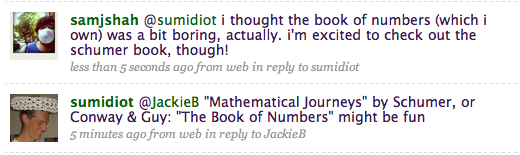
I posted this book award stuff on twitter, and got some great reactions. (Read from the bottom upwards.)

picture-4

picture-1

And then I thought: hey, you all must have a favorite math or math-y book that you’d want to have your favorite students read. I’d love to know your favorites! (Plus this list could help inspire me to do some quality reading this summer!)

My Exponential Function Unit

My Exponential Function Unit for Algebra II

Basic Context: This unit is coming right on the heels of function transformations. Students are familiar with translating functions up, down, left, and right; reflecting functions over the x- and y-axes; and vertically and horizontally stretching and shrinking functions.

Structure: The work on exponential functions is broken into four parts.

Part 0: Preliminary Diversion into Inverse Functions
Part I: Graphing exponential functions
Part II: Solving basic exponential function equations
Part III: Applications of exponential functions (carbon dating and compound interest)

Time: This took a total of 13 days — including an introductory activity day, a review day, a day where we did an exponential decay simulation as an entre to carbon dating, and two assessment days.

Nature of Class: I teach 15 students in a non-accelerated Algebra II class. The ability level of the students range the gamut. Many have a hard time thinking abstractly. All have graphing calculators and know how to use them at the basic to intermediate level. We meet 4 days a week for 50 minutes each day.

Broad Goal: The goal for this unit was to really drive home the concept of exponential functions.

Major Failures: I see two major failures. One is not seriously talking about how fast exponential functions grow. This would have been a really fun day, working on a problem like: “Would you rather have (A) $1,000,000 a day for the month of May, or (B) $1 on the first day, $2 on the second day, $4 on the third day, $8 on the fourth day, etc.” The second is just not having a lot of fun with this. The exponential decay simulation we did could have been so much more powerful, and changed in so many fun and really great ways. We could also have done an activity for exponential growth, using real data — population growth, Moore’s Law, or something to do with the Supreme Court. It would have been nice to finish off with a nice 2 day research activity. If for nothing else, to let my students produce something they could be proud of.

Major Strengths: In terms of getting students to understand exponential functions conceptually, I think I’ve done a pretty good job. My students can relate tables, graphs, and equations. They understand why the functions look the way they look. By the time we finished the exponential application days, students were coming up with the formula for the depreciated value of an object without any help.

Materials [NOTE: If you are opening these docs on a Mac, “Select All” and change the font to “Gill Sans.”]

Part 0: Preliminary Excursion into Inverse Functions
PDFs of My Smartboards before class: 1, 2, 3.

Part I: Graphing Exponential Functions
1. Introductory exercise introducing students to exponential growth and decay (.doc)
2. Introduction to exponential functions, and graphing basic exponential functions (.doc); HW (.doc)

Part II: Solving Basic Exponential Equations
1. PDF of My Smartboard before class: 1

Review Sheet on Part 0, Part I, and Part II to prepare students for the assessment (.doc)

Part III: Applications of Exponential Functions
1. Coin Drop Simulation for Exponential Decay (.doc); HW (.doc)
2. Carbon Dating (.doc); HW (.doc)
3. Compound Interest (.doc)

What I Want You To Know: Looking at just the stark documents, this whole unit seems like it might be a bit formulaic. However, particular moments of the guided notes, or the SmartBoards, or during the activities, were actually designed to be places where we have classroom discussions. For example, when one of the worksheets reads:

exponentialdefinition
we actually had a great 5-7 minutes talking about the answers! So I’m afraid these resources make it seem like we might not have really interrogated exponential functions. But we did.

You can really see what I mean because… during this unit, my friend came to observe my class. (It was an assignment for a class she was taking for her Masters.) It happened to be the class where we first talked about exponential decay. While I was teaching, she decided to make a (partial) transcript of the entire class. The transcript is very rough and partial, and you can’t really tell what’s going on exactly, but you can get a sense of what the class was like:

Transcription (with student names redacted) after the Jump

(more…)