Quick question

When I introduce an idea and have students practice a few problems in class to see if they are getting it, I walk around and individually help students. Neighboring students other also help each other out.

What do you do, however, when a few students who “get” things right away finish before the others? The rest of the class seems to get it, but it just is taking them a while to work out the problems. What do you do with these kids? Do you just have them sit quietly?

Sometimes I’ve had them: (1) make up their own problems for me to possibly use on a future assessment, or (2) walk around and ask if anyone else needs help. Most of the time I let them sit. I feel like I should have a good way to deal with this. But I can’t always ask them to make up their own problems or walk around. It’s a temporary solution.

Ideas? Strategies? Do we all struggle with this?

Currently, I’m thinking that each time I put problems up, I should put a couple up, and then put one “challenge problem” too — and then have the expectation that students finish the standard problems, and say that if you don’t have time to get to the challenge problem, that’s totally okay.

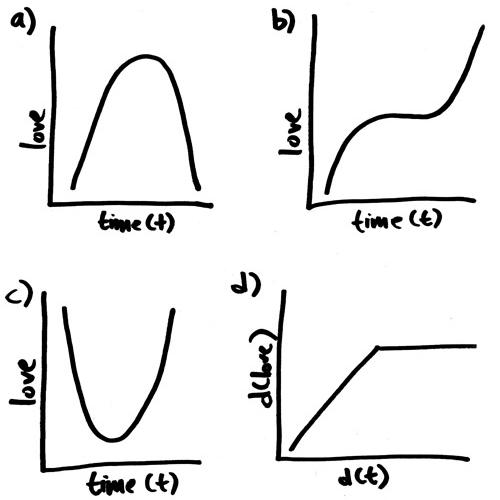
The Calculus of Saying I LOVE YOU!

I found — when searching for something else — this page on the calculus of love. It’s actually really cute, and totally accurate mathematically. Both big plusses in my book.

phpthumbphp

The article analyzing these graphs is here. Definitely something to check out if you’re teaching precalculus or calculus.

Okay, it is 6:54 and I have to run to school for a 7:30 meeting! Yikes!

Lates.

Topological Maps, Google, and Multivariable Calculus

Right now, I’m about to start teaching Partial Derivatives in my multivariable calculus class. I’m going to teach them in a traditional way, to build a sense of what they are. However, I really want to create a project that has students take actual data and find something useful with it.

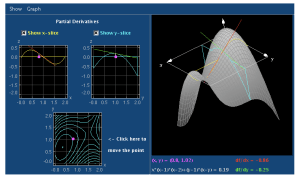
To take you down my train of thought, look at this applet:

picture-1

So of course we will soon relate partial derivatives to the gradient which will get us to exploring topological maps. Pretty standard stuff.

However, wouldn’t it be neat if each student could pick a place on the globe and create a topological map for it? (And then, using some simple computer tools or a protractor and ruler, come up with estimations about the steepness or flatness of the terrain at various points?) Well, I can easily make this happen! Because now GoogleMaps has a Terrain feature, and if you zoom in enough, you get to see the level curves with the height of the land marked. And you can use sites like this to calculate the distance between two points!

Here’s some random place in Alaska.

picture-2

I’m thinking that having my students actually work to calculate some of these values by hand might really hammer home what these strange calculus concepts are. It’s easy to take the derivative with respect of x of f(x,y)=3x^3y^2. It’s less easy to understand what that means, or what the gradient means, or how they are calculated.

I don’t know if I’ll have time to whip this up, but I think it could be a really great activity.

Related Rates in Calculus

ladder

I’m about to teach Related Rates in my Calculus class. And the book and the Internets aren’t helping me. Supposedly, related rates are so important because there are so many “real world” applications of it.

Like a  snowball melting, a ladder falling, a balloon being blown up, a stone creating a circular ripple in a lake, or two people/boats/planes/animals moving away from each other at a right angle.

Weird exemplars — I wonder where they got started and why they still hold so much water in every textbook? Because seriously?!, a ladder sliding down a wall — when is anyone truly going to need to know the rate of change of the angle over time? Same with the melting snowball.

I’m not someone who needs a real world application to justify everything I teach. In fact, I rarely do. But when we’re teaching something and hold it up as “calculus in the real world,” I refuse to believe that this is the best we can come up with.

I am searching high and low for one true real world problem. No contrivances, but something where I can point to and say: “this calculation needed to get done and because it was, we now have ____.”

I am thinking that maybe figuring out how a radar gun calculates the speed of a car, especially if it is being used from a moving car, might have something good there.

So far, though, the closest I can get is here:

Rockets: A camera is mounted at a point so many feet from a rocket launching pad. The rocket rises vertically and the elevation of the camera needs to change at just the right rate to keep it in sight. In addition, the camera-to-rocket distance is changing constantly, which means the focusing mechanism will also have to change at just the right rate to keep the picture sharp. Related rates applications can be used to answer the focusing problem as well as the elevation problem.

A number of AP Calculus classes have their students make videos with related rates problems. But those problems are just like the others: contrived. It’s like using integration to do simple addition. This video is the exception; I love it.

Anyway, holla below in the comments if you got anything.

Kepler’s Laws, reprise

You might recall that in my multivariable calculus class (four students), we’ve been turning a really badly written section in our textbook on Kepler’s Laws into a great learning experience. The section was really unclear, the authors didn’t motivate any algebraic work, nor did they relate the equations to any conceptual understanding of what was going on.

We decided — well I decided, but my students agreed to play along — to rewrite the textbook to make it clearer. We wanted to focus on motivating each step of the derivation, we wanted to organize the derivation in a more sensible way, we wanted to be explicit with each of our calculations so the reader isn’t left wondering “where the heck did that come from?”

My students got into the project. Heck, I got into the project. We spent about 5 class days working on it. Most nights I didn’t assign homework. One night, I asked students to each individually outline how they thought the rest of the paper should go. Another night, I asked students to proofread what we had written for stylistic and conceptual inconsistencies. We finally came up with a formula describing all conic sections — which describes how the earth moves around the sun. We didn’t get to actually derive Kepler’s Laws (see below for why).

The students are really proud of this paper. They want to send it to the math department head who left last year, the publisher of the textbook, and their calculus teacher who retired last year. (We will send it to all three!) We embarked on this together (I didn’t know anything about this section; I was going to skip it but the students really wanted to cover it), and I let them do a lot of the thought work themselves. It’s hard to let go as a teacher, because I have this drive to explain and clarify everything when someone doesn’t “get it.” But these kids are advanced enough that they can grapple with the material, ask each other questions, and be okay with getting stuck. And I suspect it is precisely because of this, because they did it, that they feel ownership of the paper.

Two of my favorite parts of the paper:

picture-3

picture-4

Our current draft is here.

Their next “problem set” isn’t like the others. I pretty much said: “we learned how to read the book, and make sense of that which we thought we could never figure out. Now your task is to each individually finish his paper off. We’ve gone 2/3 of the way to the end together. Go try to do the last 1/3 yourself. With this formula we came up with, your textbook, the Internet, and your wits, write the final part of this paper. That’s right: you derive Kepler’s Laws.”

Their problem set it due on Friday. I’m excited to see what they do with this!

If you’re wondering what our class looked like when we were working together on this paper:

Imagine four students, sitting at a square table. Each has photocopies of the relevant textbook section in front of them. I am sitting at the front of them, laptop on, with Lyx (my LaTeX editor) open. The screen is being projected so the students can read what I’m typing. I prompt: “so what do we want to write?” and we’re off. The students talk with each other about the section — not only asking questions and answering each other on the mathematical content, but about how the section should be presented. One might say “I think we should say something about how vector b will actually be crucial to understanding everything. The book introduces b and then forgets about it and never really explains it.” Another might respond, “Yeah, we should devote a whole section of our paper to explaining b.” And they’re off. I sometimes interject to ask questions, or to get them on the right track, but it’s rare that I’m directing. Finally, when I see they’re coming to some sort of consensus, I say “so what am I going to type — what’s my heading? The introductory paragraph explaining what you’re planning on doing?” And then one of them will say “In this section, we will introduce a new vector, b, which will end up being unchanging over time. This constraint on the motion will …” And then another student might say “maybe after ‘unchanging over time’, we should say “no matter where the earth is or what speed it is moving at.”

And we’re off to the races. This goes on for 50 minutes. Which always seemed too short. Each day we got about 1 to 1 1/2 pages (single spaced) written. At the very end I scanned in the images that one student drew as we worked our way through the material.

This project was hands down the best thing I’ve done in any of my classes all year, in terms of student learning.

Random Acts of Kindness

Ms. Cookie at Math Teacher Mambo recently posted about random acts of kindness that she promotes at her school:

I ask my students to write a thank you note (on paper I provide, with markers I provide) to a teacher in school which I then put in the appropriate mailboxes.

I fell in love with this idea. It really struck me, especially after having an especially rough week emotionally. On Thursday I talked with students, trying to gauge if this week was hard for everyone — not just me. If teachers were piling on the assessments, if there was some sort of Zeitgeisty stressful crunch that was driving everyone crazy. Almost every student said this week was the hardest since the beginning of the year. (I don’t know what about this week is so exceptional; we’re mid-quarter… maybe it is just coming off of Thanksgiving break that made this jolt especially traumatic for everyone.) Teachers agreed too.

So thinking we all needed a bit of a pick me up, and just being excited about thinking positively again, on Friday morning I stopped off at the Duane Reade and bought thank you cards. In 3 of my 4 classes, my lesson plans included doing “lecturing” work for 25 minutes, and then individual/partner work for the remaining 25 minutes. When setting the kids free to work on the chain rule (calculus) or max-min-increasing-decreasing/how-do-you-use-your-calculator work (algebra II), I gave a 2 minute talk about Ms. Cookies post, and about how we often forget to think of all the good that people do for us.

I then said that I would love it if they took 5 minutes out of their work time to write these cards, but that it was optional. And that they can go to teachers, or to fellow students, or maintenance staff, or to college counselors, or anyone. I also said that if they thought someone might find a random “thank you” to be creepy or sycophantic, they could preface their card with “Mr. Shah is doing this thing with random acts of kindness…”

Most kids took the cards (some two or three!) and wrote them for teachers. I delivered them to the mailboxes later in the day. Some took the cards and wanted to hand deliver it. Two students in the same class wrote cards for each other!

Honestly, I did feel a bit uncomfortable about doing this during class time. I’m really particular about spending class time focused on learning, and in general, I don’t like to do “fluffy” things — especially things that don’t directly relate to math content. I’m very particular about being that teacher that focuses on content at all times — every minute. However, I think that in this case — for both me and my students — it was worth the trade-off. It rejuvinated me, because it reminded me all the good I have around me. I really saw the students get into it.

One thoughtful student who was working hard on his card sent me an email saying:

Today you prompted your classes to do good deeds and make someone else’s day a bit better, but I wanted to make sure that you recieved thanks as well. I really appreciated the gesture–not only did you give us a much needed break from work, but you allowed us to feel good about making someone else feel important. I hope you feel great about what you did…

Just wanted to let you know that you made a positive impact on me and on someone that is very important to me.

That email justified it for me. Not that I will be doing things like this frequently, but I see so much value in it. Not only does it promote random acts of kindness, but things like this can help shape a school culture. It can make people appreciate those around them.

It also reminds me of the immense value that I find in blogging, and reading blogs. My bad week was turned around by reading this one post. Something great that Ms. Cookie does at her school now affects — positively — what’s going on at my school. The blogs I read are informative, primarily, but they inspire me, start me thinking, lead me to question what I do, and keep me interested in blogging myself. The extent to which we bloggers — and our stories and ideas — affect each other often goes unmentioned.

In the vein of doing random acts of kindness, Mr. K at Math Stories recently wrote about “underrecognized blogs” — in light of the recent nominations for Edublog Awards — “some that aren’t nominated, but that will stay in my reader even if they go dead and cold, just on the off chance that they may have one last post left in them.” And, with his own random act of kindness, he wrote of my blog: “Infectious love of math, and an earnest quest for self improvement. Not the same level of math that I teach at all, but somehow I end up caring anyway.” I don’t have a lot of readers. It seems that most of the hits to my blog are Harvard students looking for information on Math 55 or someone looking for some information on the Richter Scale — I’ve written posts on both. But I’m okay with not having a large readership and being unrecognized. I blog for me. An archive of my journey, a repository of ideas, random neat math things that I get obsessed with. But with that one line for Mr. K, I swelled up. Even though I’m okay being unrecognized, it’s nice to be pointed out.

I’m now all about the small, sincere acts.
Teachers Shadowing Students

I am a tenth grade adviser. All the tenth grade advisers get together every week to discuss various tenth grade students, our tenth grade community service project, general trends we’ve noticed with the class, and so on and so forth.

In our meeting today, our dean said that she was going to shadow a tenth grade student soon. To see what that student goes through on a daily basis. We’ve been talking a lot about the stress that tenth graders feel — the increased expectations placed on them by their teachers and the increased responsibility they’re expected to take for their own learning. This idea was in response to that. So we can see at least a partial perspective.

The dean asked if any of us advisers wanted to follow a student, saying our school would pay for a sub. I of course volunteered.

This is possibly the best idea ever. For me, it’s less about understanding the stress of students. It’s more about experiencing what sitting in classroom after classroom, being asked to do thing after thing, by person after person, feels like. I’m going to relive what it’s like to be a student again. It’s been long enough that I don’t remember how exhausting (or not exhausting, who knows) the day is. But I’m curious to see my emotional reaction to being a student in various teachers’ classes. I’m also curious to see if I see myself in any of the other teachers — both in a good way and a bad way. (I can see me going “oh my god, this is annoying, and I do that all the time!”)

Anyway it was such a good idea that I thought I’d pass it along to y’all, in case it appeals to you too.

I’ll of course report back when I do it, with my findings.