Pre-Calculus

Guest Post: Conics Project

This is a guest post from my friend Liz Wolf.

***

“The conics section comes at a tough time in our curriculum.  It’s a few weeks after Spring Break, and kids are always antsy in class and have major spring fever.  I wanted a way to make conics less abstract and show the kids how often they come up in every day life.  I came up with a project that not only got them outside, but also got them looking at things in a different way.  The photo of the water droplet on the swing set was my favorite.  The students really embraced this and I was impressed with how well they embraced GeoGebra having never used it before.”

***

Below are some examples of final products from her class, and the instruction sheet she used.

Image

Image

Image

Image

Update: Liz sent me her Geogebra instruction sheet!

Families of Curves #2

So today I started the Family of Curves project in Precalculus. Students are going to be given three in class days to work on this, and about a week or two of out-of-class to finish it on their own.

I started class showing around 4 or 5 minutes of this Vi Hart video with no introduction:

Then I showed a whole bunch of pictures… of tessellations, Escher prints, one of the things they were going to be creating on geogebra [but without telling them it was not a famous artist], and a few beautiful prints and the website for Geometry Daily.

Then I had them take out their laptops, and just get started working on Geogebra. The packet below takes them through the sequence command, and then shows them how the sequence command can create a family of curves…

Here’s the instructions getting kids started on Geogebra and what’s expected of them…

[.docx]

Note: My kids are getting more and more fluent with Geogebra… We have been using it on-and-off all year at various times.

They were silently working the entire class. I put on some music, and they started talking a bit. But since it’s an individual project, I suppose I can’t expect a lot of talking. Some kids have been asking me “how do you make circles?” and one student asked me how to fill in circles…

It took them pretty much the whole day today to do the geogebra introductory stuffs, so they didn’t all get to play around with their own functions. I expect tomorrow will be pretty awesome to watch them tinker and explore, and get cool things.

I don’t know if they are “into” this yet. I’ll see if I get any anecdotal evidence tomorrow.

Families of Curves

When I put out my call for help with Project Based Learning, I got a wonderful email from @gelada (a.k.a. Edmund Harriss of the blog Maxwell’s Demon) with a few things he’s done in his classes. And he — I am crossing my fingers tight — is going to put those online at some point for everyone. To just give you a taste of how awesome he is, I will just say that he was in NYC a few years ago and agreed to talk to my classes about what it’s like to be a real mathematician (“like, does a mathematician just like sit in a like room all day and like solve problems?”), and have kids think about and build aperiodic tilings of the plane.

Anyway, he sent me something about families of curves, and that got my brain thinking about how I could incorporate this in my precalculus class. Students studied function transformations last year in Algebra II, and we reviewed them and applied them to trig functions. But I kinda want to have kids have some fun and make some mathematical art.

First off, I should say what a family of curves is.

family

That’s from Wikipedia. A simple family of curves might be y=kx which generates all the lines that go through the origin except for the vertical line.

lines

I made this in Geogebra with one command:

Sequence[k*x, k, -10, 10, 0.5]

This tells geogebra to graph y=kx for all values of k from -10 to 10, increasing each time by 0.5.

Okay, pretty, but not stunning. Let’s mix things up a bit.
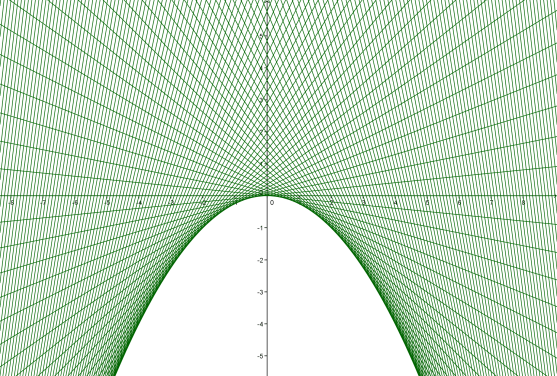
lines 2

Sequence[k*x+k^2, k, -10, 10, 0.1]

Much prettier! And it came about by a simple modification of the geogebra command. Now for lines with a steep slope, they are also shifted upwards by k^2. This picture is beautiful, and gives rise to the question: is that whitespace at the bottom a parabola?

Another one?

sin

Sequence[1/k*sin(k*x),k,-10,10,0.2]

And finally, just one more…

tan

Sequence[1/k*tan(x)+k,k,-10,10,0.1]

Just kidding! I can’t stop! One more!

sec

Sequence[k sec(x)+(1/k)*x,k,-10,10,0.25]

What I like about these pictures is…

THEY ARE PRETTY

THEY ARE FUN TO MAKE

THEY ARE SUPER EASY TO MAKE & TINKER WITH

THEY MAKE ME WANT TO MAKE MOAR AND MOAR AND MOAR

And then, if you’re me, they raise some questions… Why do they look like they do? What is common to all the curves (if anything)? Does something special happen when k switches from negative to positive? What if I expanded the range of k values? What if I plotted the family of curves but with an infinite number of k values? Do the edges form a curve I can find? Can I make a prettier one? Can I change the coloring so that I have more than one color? What would happen if I added a second parameter into the mix? What if I didn’t vary k by a fixed amount, but I created a sequence of values for k instead? Why do some of them look three-dimensional? On a scale of 1 to awesomesauce, how amazingly fun is this?

You know what else is cool? You can just plot individual curves instead of the family of curves, and vary the parameter using a slider. Geogebra is awesome. Look at this .gif I created which shows the curves for the graph of the tangent function above… It really makes plain what’s going on… (click the image to see the .gif animate!)

sec animation

Okay, so I’m not exactly sure what I’m going to do with this… but here’s what I’ve been mulling over. My kids know how to use geogebra. They are fairly independent. And I don’t want to “ruin” this by putting too much structure on it. So here’s where I’m at.

We’re going to make a mathematical art gallery involving families of curves.

1. Each student submits three pieces to the gallery.

2. Each piece must be a family of curves with a parameter being varied — but causing at least two transformations (so y=kx^2 won’t count because it just involves a vertical stretch, but y=k(x-k)^2 would be allowed because there is a vertical stretch and horizontal shift).

3. At least one of the three pieces must involve the trig function(s) we’ve learned this year.

4. The art pieces must be beautiful… colors, number of curves in the family of curves, range for the parameter, etc., must be carefully chosen.

Additionally, accompanying each piece must be a little artists statement, which:

0. Has the title of the piece

1. States what is going on with each curve which allows the whole family of curves to look the way they do, making specific reference to function transformations.

2. Has some plots of some of individual curves in the family of curves to illustrate the writing they’ll be doing.

3. Has a list of things they notice about the graph and things they wonder about the graph.

At the end, I’ll photocopy the pieces onto cardstock and make a gallery in the room — but without the artist’s names displayed. I’ll give each student 5 stickers and they’ll put their stickers next to the pieces they like the most (that are not their own). I’ll invite the math department, the head of the upper school, and other faculty to do the same. The family of curves with the most stickers will win something — like a small prize, and for me to blow their artwork into a real poster that we display at the school somewhere. And hopefully the creme de la creme of these pieces can be submitted to the math-science journal that I’m starting this year.

Right now, I have a really good feeling about this. It’s low key. I can introduce it to them in half a class, and give them the rest of that class to continue working on it. I can give them a couple weeks of their own time to work on it (not using class time). And by trying to suss out the family of curves and why it looks the way it does, it forces them to think about function transformations (along with a bunch of reflections!) in a slightly deeper way. It’s not intense, and I’ll make it simple to grade and to do well on, but I think that’s the way to do it.

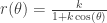
What’s also nice is when we get to conic sections, I can wow them by sharing that all conics are generated by r(\theta)=\frac{k}{1+k\cos(\theta)}. In other words, conic sections all can be generated by a single equation, and just varying the parameter k. Nice, huh?
PS. Since I am not going to do this for a few weeks, let me know if you have any additional ideas/thoughts to improve things!

Venturing into the Unit Circle and Graphs

One of the super fun things about teaching a new course is that I get to think through what you teach from scratch. It’s also one of the hardest and most frustrating things. Because it’s new, I have nothing to fall back on! But because it’s new, I have fresh new vistas open. The world is my oyster.

Recently I’ve been introducing trigonometry to my precalculus students. They had been exposed to right triangle trigonometry, but other than a two days beyond that last year in a rushed unit that they don’t remember, nothing else.

So for a short while I’ve been creating new materials to teach trigonometry. I’m going to post them below and explain the intention of each of them. For almost all of them, I had students work in groups, and I would circulate. We would come together and talk as a class, but they were doing most of the heavy lifting. My favorites are Sheet 1, Sheet 6, and Sheet 7… so if you’re just looking for a few good things… I have embedded .pdfs of each of the sheets, but if you want to download the .doc files so you can edit, they are waaaay at the bottom.

My Trigonometry Unit (so far)

Sheet 1: This sheet is the introduction to trigononometry. I didn’t call it that. I wanted students to start seeing circles, angles, and draw the connections themselves. As they did this, they naturally had to build triangles and review their right triangle trigonometry (SOH-CAH-TOA) to answer the questions. They also were forced to start thinking of angles in relation to circles, instead of just angles in relation to triangles. As we progressed through the unit, I very explicitly started talking about moving away from the triangle to understand angles and towards the circle…. But for this sheet, I didn’t say anything of the sort.

Sheet 2: This is a sheet that is our first official foray into trigonometry. It is intended to remind students their basic right triangle trigonometry, and how to use that to find both sides and angles. It also has students derive the formula for arc length and the area of a sector. If I wasn’t teaching the advanced class, I don’t think I could have expected students to have derived the formula on their own — but for my kids, this was easy. We haven’t yet talked about relating trigonometry to the unit circle yet. But we are looking at angles in relation to circles. (Sorry about the scanned images… I hand drew stuff in this.)

Between the previous work and the next work, I gave an impassioned diatribe called “WHY DEGREES?” where I argued with brio that radians are the most natural and beautiful way to measure angles. I think I got students to at least recognize that there is something elegant in them. At the same time, I got to introduce the unit circle — because the unit circle is the thing we use to define radians! At this point, I start emphasizing the use of the unit circle to all our angle work.

Click to see the rest (there are a lot of Scribd documents embedded)…

(more…)

Unit Circle Plates

I take no credit for this. I’m teaching Precalculus for the first time, and the other teacher also teaching it has been doing this for years. We introduced the unit circle and then had students make these precious unit circle plates.

It took about 10 minutes at the end of one day, and another 15 minutes at the start of the next.

In order to make them, I gave students a sheet of paper with the unit circle on it, and dots at the relevant points on the edge. I had students draw the angles in, write down the angles in radians and degrees, and calculate the points in the first quadrant. Then I had them use symmetry arguments to get the points in the other quadrants. Then they cut the circle out, glued it to a paper plate, and stuck a pipe cleaner in the center to become the terminal angle.

Because I was rushing through the curriculum faster than I hope, I had studentsuse the unit circle plates to find the sine, cosine, and tangent of some special angles, and then I had them put the plates aside. That’s all the use we got out of them thus far. So right now, I’m not sure if the time was worth it to build them. However, I think when we get back from Thanksgiving, when we start solving trigonometric questions, I’m going to have students pull these out and use them at the very beginning… Keep things concrete. And as we progress through the lesson, ween them off.

With the plates, I can see starting simple, with questions like:

\sin(\theta)=-\frac{\sqrt{2}}{2}

They’ll see there are a couple of solutions. I’ll give some questions with one solution, with two solutions, and no solutions!

Then a little harder:

2\sqrt{3}\tan(\theta)+4=6

And then finally maybe something like:

Approximate, as best you can, the solutions to:

\frac{1}{3}\cos(\theta))=\frac{2}{15}

(Which will take some critical thinking skills, and some guesstimation.)

And then we’ll figure out how to solve these without the unit circle plates… and look at the graphs… and all that good stuff.

Just a thought. And, of course, we can use the plates to construct the basic shape of the graphs of \sin(\theta) and \cos(\theta) and \tan(\theta). If you can think of any other good uses for the plates, lemme know!

Will the fish bite?

Today at the end of Precalculus today I asked if any kids had any questions/topics they wanted a quick review on for an assessment we’re having tomorrow. (We lost a week due to Hurricane Sandy, so it’s been a while since they’ve worked on some of the topics.) One of the topics was inverse functions, so I gave a quick 3 minute lecture on them, and then we solved a simple “Here is a function. Find the inverse function.” question. They then wanted an example of a more challenging one, so I made up a function:

And then we went through and solved for y. And we found that …

… the function is it’s own inverse. Yup, when you go through and solve it, you’ll find that is true. (Do it!)

I said: “WAIT! Don’t think this always happens! This is just random! Really! This is random!”

But I just had the thought that this might be good to capitalize on. So I sent my kids the following email:

I don’t know if anyone will bite, but I hope that someone decides to take me up on it. I already have a few ideas on how to have them explore this! (Namely, first exploring \frac{x-b}{x-d} and then exploring \frac{ax-b}{cx-d}.)

We’ll see… I’m trying to capitalize on something random from class. I hope it pans out.

A biology question that is actually a probability question

Now that the hurricane issues are slowly dissipating, I made it back to Brooklyn today, back to the place I spend most of my time… my school… I suppose you could call it home.

I’m doing some work here before turning to my apartment, and I ran into a science teacher who asked me a question:

Let’s say you have a sequence of 3 billion nucleotides. What is the probability that there is a sequence of 20 nucleotides that repeats somewhere in the sequence? You may assume that there are 4 nucleotides (A, C, T, G) and when coming up with the 3 billion nucleotide sequence, they are all equally likely to appear.

I liked the question, but I haaaave to work on my own work and not this problem at this moment. So I thought I’d throw it to you.

A. What’s the answer to this question?

B. How would you explain it to this biology teacher (who knows basic math stuffs)?

and for the bonus…

C. How would you design a lesson that would make a student understand the process and your answer. You can assume that the student understands combinations and permutations.

If I get some work done today, I may think through this problem as a treat. If none of you beat me to the punch. But I’d rather you beat me to the punch.

PS. I might as well throw in the additional question of: “how long does the length of the sequence have to be before you are guaranteed a repetition of a sequence of 20 nucleotides?”

UPDATE: My friend Jason Lang sent me his solution, which is amazingly written and cogent.