As I mentioned before, I often see neat stuff on Twitter and want to remember it, but I just “favorite it” and then forget it. Sometimes I remember to go back and look for it, but it’s arduous. So I decided if I get the time, I’ll blog about some of my favorite things which will help me remember them better.
At the very end, you’ll see a problem that nerdsniped me for a good while. It hit a sweet spot for me.
***
First off, though, something about me! Kara Newhouse contacted me and Joel Bezaire about how we use reading in our math classes, and then she wrote an article about it for KQED Mind/Shift. I didn’t quite know what it was, but I figured why not answer a few questions!
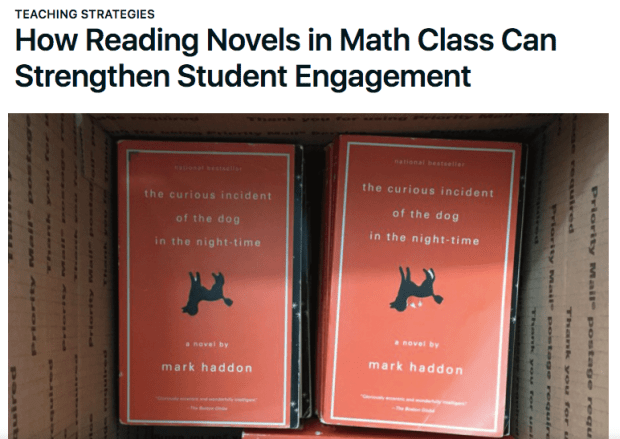
Even though I hadn’t heard of Mind/Shift before, it apparently is something that gets around. Because my friend Julie told me someone sent it to her, and my sister saw it in the NAIS newsletter. And even Steve Strogatz tweeted it out (with some links to my blog). So that’s random and awesome. If you want more information about how I organized the book club, here is my post-mortem after the first year of doing it. Now I am not teaching the course I had the book club in, but what’s awesome is that I have a few kids who wanted to read math books with me… so informally I meet with them for 40 minutes each 7 school days, and over donuts, we talk. First we read Flatland, and now we’re reading The Man Who Knew Infinity. And I’m loving it! So don’t think you need to do it in a class. I’ve read books and discussed them with kids one-on-one!
Okay, now that’s over! Onto the other less self-aggrandizing things!
***
I love Richard Feynman. I don’t think it would be too strong a statement to say that I would be a different person today if I hadn’t had been introduced to him when I was young, when my father gave me a copy of What Do You Care What Other People Think? And I saw this, and I immediately wanted to get it printed on a business card to hand to kids at the start of the year.

***
Now that we’re talking about Feynman, James Propp wrote a powerful piece about “genius” which problematizes Feynman. I already knew Feynman was self-fashioning himself in the way he presented himself to the public-at-large (and his contemporaries). But this article goes further, in a reflection connecting to a powerful piece by Moon Duchin about the sexual politics of genius. He notes:
But Duchin makes me ask, for whom does Feynman’s advice work well? Who in our culture is forgiven for putting aside personal relationships in the name of single-minded pursuit of truth? Who is permitted to be a joker? And who in our culture is steered, from an early age, toward an excruciating attunement to what other people think?
I highly recommend reading James Propp’s piece.
***
Steve Phelps (@giohio) shared this desmos applet which plots lines normal to a curve. You can change the curve!
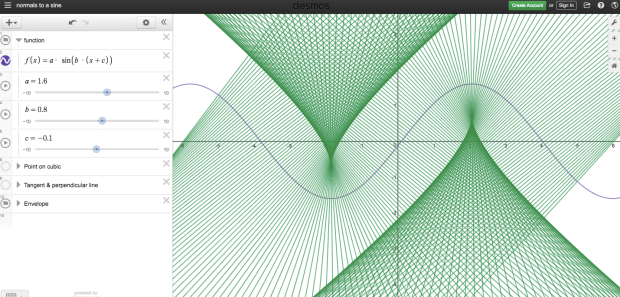
It reminds me of my family of curves project (post 1, post 2, post 3). I wonder if I couldn’t have kids come up with a way to get any perpedicular line to a curve in calculus, and then have them play around with this applet to generate beautiful designs!
***
Nanette Johnson tweeted out a powerful slide from a talk she was at given by @danluevanos. I don’t need the rest of the talk. I get it.
 I often feel like a crappy teacher. Right now, I’m on day 3 of Spring Break, and since it started, I’ve been contemplating how crappy I feel about my teaching. I know I’m not a bad teacher, but … maybe I am? I don’t know. But yes, these two questions screamed at me. Because they are part of something I need to recommit myself to: focus on the positive and take the positive and multiply it. Because I always focus on questions #3 and #4, and rarely give myself time to think about #1 and #2.
***
Mark Kaercher is using Desmos to do warmups.

Here’s the first link in his tweet: https://www.desmos.com/calculator/xxxmahtp91
Here’s the second link in his tweet: https://teacher.desmos.com/activitybuilder/custom/5a770219c1b9e208ca83895c
I love this idea of doing warmups using Activity Builder. Must remember for next year!
***
Patrick Honner wrote a great article in Quanta magazine: “How Math (And Vaccines) Keep You Safe From The Flu”. I’m just mad I didn’t send this article to my calculus kids after we did our point of inf(l)ection activity (adapted lightly from Bowman Dickson @bowmanimal).
***
This tweet from Kara Imm just made me so happy. I always believe that formalism and stuff should come after something has been explored (whenever possibe). And second graders were absolutely doing that! Sixogon! Navada! So awesome!

***
So Anna Blinstein asked about higher level mathematics and this happened. I learned that arithmetic with complex numbers is akin to arithmetic with polynomials mod x^2+1. WHAAA?!

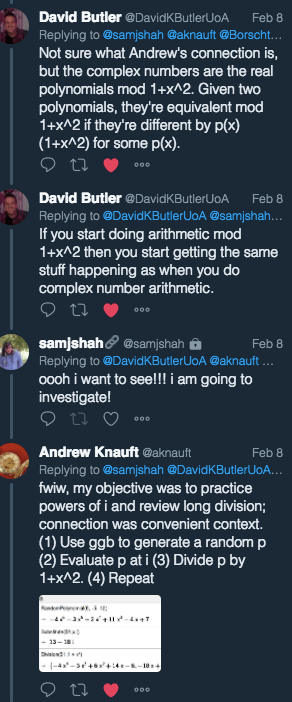
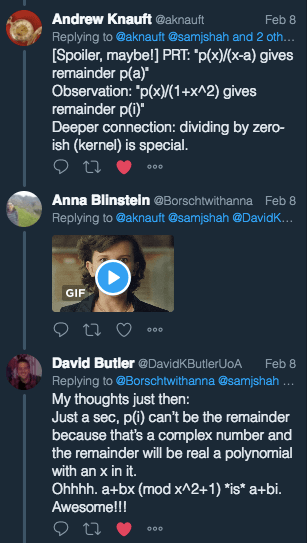

Of course I took out pencil and paper and had some fun with this. Blows my mind.
***
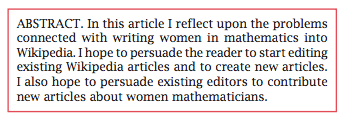
Steve Strogatz tweeted out this interesting article by Maria A. Vitulli about Writing Women in Mathematics in Wikipedia. The abstract is here:
***
When it comes to polynomial division, I’ve seen the connection to standard division (where x=10). But I think I need to exploit this more in my teaching, especially to make the polynomial remainder theorem seem obvious to kids (and not like magic, which they often feel, even when we’ve figured it out). Erick Lee tweeted a perfect reminder:

***
Joe Cossette tweeted out a neat idea — a stop motion photography race between two figures. (Click here for original tweet so you can watch the video.) I wonder if this can be adapted to calculus when we talk about rectilinear motion. Regardless, I could see it be interesting to give a physical understanding to various functions. Especially when comparing them (like exponential versus quadratic). “Which will eventually win?” Plotting 


***
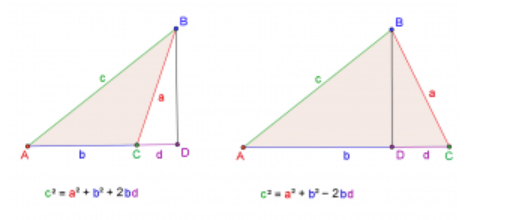
David Butler read my recent post about The Law of Cosines and shared his own post which talks about how the Law of Cosines doesn’t actually need cosine in it. Worth seeing! Trig without trig!
***
I leave you with a problem from Abram Jopp that nerdsniped me!

More constraints: You can’t use domain restrictions. You can use compound inequalities, but desmos only allows simple ones (e.g. 2<x<3 or x<y<x+2) and not complicated ones. A good number of tweeps got obsessed. There were many different proposed solutions, but I am proud of mine. I don’t think anyone else’s was quite like it.
In the process of working on this problem, David Butler and Suzanne Von Oy reminded me of this beautiful relationship: min(A,B)=1/2(A+B)-1/2|A-B| and max(A,B)=1/2(A+B)+1/2(A-B). And so I wanted to illustrate that with this Desmos graph. I definitely want to remember this gem when I teach Advanced Algebra II at some point when we’re exploring the power of absolute value. It’s so awesome.

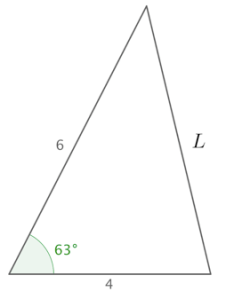


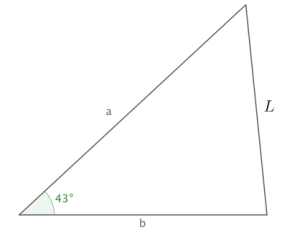

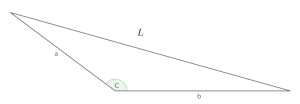

 . They get to
  but then don’t go any further. But since I know I want them to get to the law of cosines, I tell them to expand and look for something nice. Sometimes I’ll give them the answer (
 ) and then say: work your work until it looks like this, with one trig function in it. From that point on, kids are in the zone.

 anyone? You see the
  and the
  and
and  , but what you also see is that you’re taking out some area (the green bits). [1]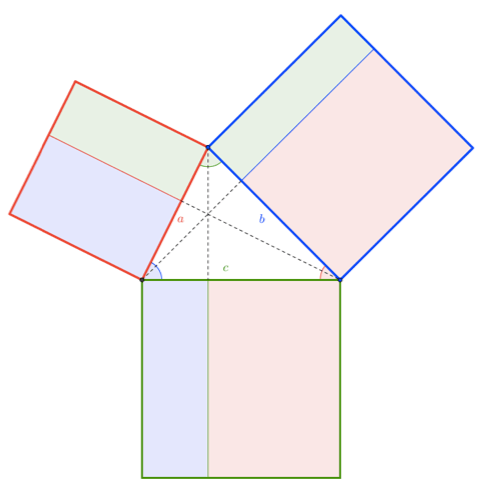


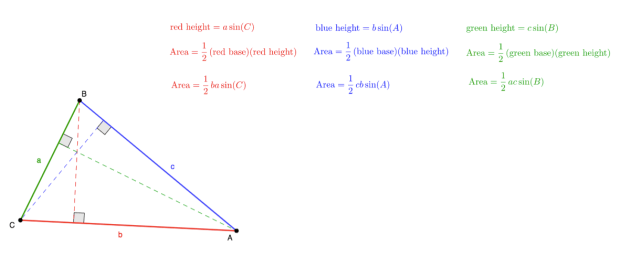
 to get the Law of Sines:



 .)
.)
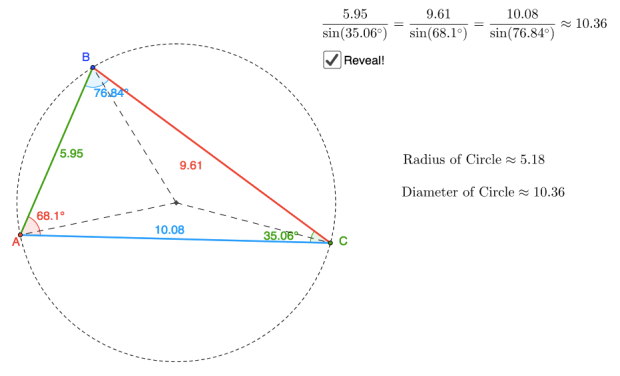
 . And I sent ’em up to the whiteboards and asked them to prove it. I gave some hints. Like, for example, the inscribed angle theorem. But eventually kids got it!
 , where
  is the radius of the circumscribed circle. I asked them to prove it algebraically, and they did:
 . But we know that
  . So let’s manipulate the rea equation to get an
  .
. .
. Continuous Everywhere but Differentiable Nowhere