My Algebra II Video Project

So did I mention the “big” Algebra II project I did this year? I suspect that I said something in passing, and then flew on, waiting until the day that I could do a final analysis of whether it was a success or not (it was a low to moderate success) and how I’m envisioning it for next year now that I’ve had one crack at it.

For those who want to jump right to the finished product: http://mistershah.wordpress.com

Details, documents, and analysis are after the fold.

(more…)

MMM7 Solutions

Interestingly, this week’s Monday Math Madness (7) question can be answered with a direct application of generating functions, which I recently used to derive the Fibonacci numbers a few weeks ago! (See here for Part I and here for Part II.)

Let me be clear. You don’t actually have to make a generating function out of this, like I do below. I recognize that it adds one more “layer of complication” that isn’t really needed. I did it because it helps me keep my terms straight. Plus I wanted to connect it to the Fibonacci posts that I did easily. You can easily do it without.

The short answer:

Create a function g(x) by letting each of the terms in the sum being a coefficient. Eventually, we want to find g(1).

Let’s begin the extended answer!

g(x)=(\frac{3}{5})^0F_0+(\frac{3}{5})^1F_1x^1+(\frac{3}{5})^2F_2x^2+...
\frac{3}{5}xg(x)=(\frac{3}{5})^1F_0x^1+(\frac{3}{5})^2F_1x^2+(\frac{3}{5})^3F_2x^3+...

Note that g(1) is exactly the sum we want to find! Add the two together and combine like terms to get:

g(x)+\frac{3}{5}xg(x)=(\frac{3}{5})^0F_0+(\frac{3}{5})^1(F_0+F_1)x^1+(\frac{3}{5})^2(F_1+F_2)x^2+...

Remembering the Fibonacci recurrence relation (e.g. F_1+F_2=F_3 and such), and using it to simplify the coefficients above, we get:

g(x)+\frac{3}{5}xg(x)=(\frac{3}{5})^0F_0+(\frac{3}{5})^1F_2x^1+(\frac{3}{5})^2F_3x^2+...

We want to get “g(x)” on the right hand side (RHS), and we see that multiplying the RHS by \frac{3}{5}x will help. Because at least then we’ll have the same number for the exponents and the Fibonacci number!
\frac{3}{5}xg(x)+(\frac{3}{5})^2x^2g(x)=(\frac{3}{5})^1F_0x^1+(\frac{3}{5})^2F_2x^2+(\frac{3}{5})^3F_3x^3+...
Noting that F_0=F_1, we see that the RHS is really g(x)-F_0. (It has all the terms in g(x) except for F_0.)
Finally, we get \frac{3}{5}xg(x)+(\frac{3}{5})^2x^2g(x)=g(x)-F_0.
Rearranging this equation, we get g(x)=\frac{-F_0}{\frac{3}{5}x+(\frac{3}{5})^2x^2-1}
Now for the easiest part… plugging 1 in for x, we get g(1)=25. Since g(1) was the infinite sum we were trying to find, we are done!

There are two things to note.

  1. Because our method of solution wasn’t really dependent on the 3/5 at all, we can solve the problem for any other fraction (well… technically… it has to be within the radius of convergence…).
  2. It might seem unintuitive that the original infinite sum will converge. Because you’d think that either the (3/5)^n would decay at a different rate than F_n increases. But it turns out that they both grow exponentially! (You can see that by looking at my previous post on the Fibonacci numbers and how to come up with a general equation for the nth term!). And so having one decay exponentially fast and the other grow exponentially fast end up “cancelingl” each other out. Which is a wishy-washy explanation as to why we can get such a beautiful convergence!

Magnetic Movie Brings Me Grad School Nostalgia

Magnetic Movie

I just watched this short film (4’56”) with scientists describing different types of magnetic interactions (e.g. on the sun, on Mars, in a regular situation). The filmmaker CGI-ed in visualizations of the various types of magnetic fields that come up. The still above is from the short.

My first reaction: hmmmm, applying this in the classroom somehow? naaaaah.

My second reaction:

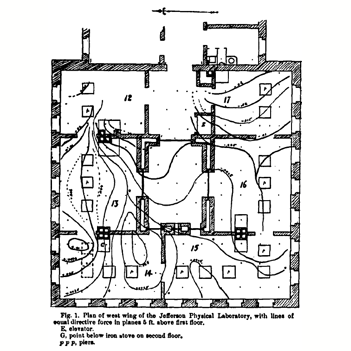
It reminded me of working on my dissertation topic in grad school — on the rise of laboratory physics in American universities at the turn of the century. One of the things that happened was that American universities built teaching laboratories for students to actually do experiments in, as part of their undergraduate and graduate training. And building plans had to be quite elaborate because of the sensitive magnetic work that needed to be done — no ferromagnetic materials were allowed in the building of certain sections of the laboratories (research sections). Harvard’s Jefferson Physical Laboratory was one of the first built. And one of my favorite images from my in depth dissertation research was the following [1]:

This picture represents part of the JPL and the strength of the magnetic fields within it.  Clearly you see why the movie brought back this image to me.

And for those who are interested, my favorite quotation from this era dealing with laboratory teaching was:

The multiplication and enlargement of laboratories depended chiefly upon the growing recognition of the truth that firsthand knowledge is the only real knowledge. The student must see, and not rest satisfied with being told. Translated into a pedagogic law, it reads, ‘To teach science, have a laboratory; to learn a science, go to a laboratory.’ (1884) [2]

I love that an argument had to be made for laboratory teaching (not everyone agreed), and then there were battles over what kind of teaching should happen in the laboratory itself.

Sometimes looking back on this project makes me think: wow, that’s such an interesting dissertation you abandoned.

[1] Picture taken from R.W. Willson, “The magnetic field in the Jefferson Physical Laboratory,” The American journal of science 39 (February 1890): 87-93.

[2] On 174 in “The laboratory in modern science,” Science 3 (15 February 1884): 172-174.

Superstring Theory? Hogwash!

I recently re-stumbled upon The Science Creative Quarterly. I find it every so often, read through a few articles in the archives, and then forget about it until some link or another drags me back there, where I repeat this process. Indefinitely.

This time, I (re?) discovered a great article on superstring theory. An excerpt to get you interested:

The idea is that all the particles and forces in the universe are different notes on appallingly tiny strings. A key tenet of this theory is that there are at least ten dimensions, that’s six more than the four we can access, but that the others can’t be measured or in any way observed because they’re too small. Seriously, that’s the entire argument. And an invisible and untouchable dog ate their homework. Also, the dog cannot be smelled.

The rest of the article is here, hilarious and full of things we’ve all thought but we’d never say, because we have that much faith in physicists.

mix cd club

This year, my first year of teaching, has left me little time for a social life. Let’s just say: I’ve pretty much resigned myself to having one day a week to myself — Saturday– and on principle, I refuse to do work on it. (Confession: I’ve been known to break that rule…)

Because of this weird life of mine, I decided to be proactive and create a “mix cd club.” Every two or three months, a bunch of us get together with some awesome mix cds we crafted on some theme (chosen by yours truly) and exchange them at a local watering hole.

This round’s theme was: Time Travel
(In honor of a recent watching of Bill and Ted’s Excellent Adventure.)

And I decided to do the somewhat morbid:

“songs that I wouldn’t mind being played at my funeral.”

  1. scream and shout (polyphonic spree)
  2. breathe me (sia)
  3. round here (counting crows)
  4. i will follow you into the dark (death cab for cutie)
  5. 1234 [feist cover] (jack penate)
  6. somewhere over the rainbow (israel kamakawiwo’ole)
  7. what a wonderful world (louis armstrong)
  8. suddenly everything has changed [flaming lips cover] (the postal service)
  9. apologize [ft. one republic] (timbaland)
  10. neighborhood #1 (the arcade fire)
  11. the funeral (band of horses)
  12. a fond farewell (elliott smith)
  13. the world at large (modest mouse)
  14. i hear the bells (mike doughty)
  15. we’re from barcelona (i’m from barcelona)
  16. girls (death in vegas)
  17. light and day (the polyphonic spree)
  18. pink trash dream (the polyphonic spree) [only 31 seconds]
  19. introitus: requieum aeternam (mozart)
We’re meeting up in 4 hours. I can’t wait. I love delicious beverages and good music. (And for those of you who haven’t discovered muxtape: samjshah.muxtape.com)
UPDATE: So at the first mix cd club meet up, we all gave the bartender an extra copy of our cds. At the second meet up, I swore that my mix cd was being played — I heard like 7 of my songs (some popular, some obscure) played in a row. This time, again, I heard a few of the songs from my cd. Guess what? I got confirmation that my cd is on constant rotation in the bar. When we offered the bartender copies of our cds, he thanked us and asked “who made the ‘listen me’ cd? because I put that on all the time.” That was at least 6-8 months ago. I grinned.UPDATE 2: Tracklistings of all cds here.

Matrices, Social Networking, and Algebra II

At the tail end of the fourth quarter, my students and I grew tired, weak, and weary from trigonometry overload, so we did a short one week lesson on matrices and systems of equations. I taught them how to add, subtract, and multiply matrices — by hand, and on their calculators. Then, I decided I wanted to bring some “real world” stuff to them.

So I decided to do a lesson on matrices and food webs [click here to view the assignment]. I pretty much stole it wholesale from some website or another (my motto: beg, borrow, and steal!), made a few changes, and let them go at it. And even though I don’t know how interested all of them were with the assignment, I was actually extraordinarily pleased at how well they did on it and how engaged they were in the classroom [1]. They talked, debated, and came to some pretty solid conclusions. My role in the classroom was relegated to going around and asking them questions like “so you answered the fourth question… can you tell me what the 2 in that matrix represents?”

You know, just to make sure they were getting it.

And they were.

One of my favorite moments was when a group asked me “do you add or multiply the matrices?” and I asked them “what do you think?” and then they got to arguing about it for 3 minutes before they came to the right conclusion.

Literally five minutes after finishing this activity in my first class, I realized that all the social networking sites (MySpace, Facebook, and the like) can be analyzed in the same way as food webs. Hello six degrees of separation!

So at the beginning of my next class where we were going to do food webs, I first drew a bi-directional network on the whiteboard with three teachers and one student. The student I chose is one who I felt I could poke fun at because he pokes fun at me. Of course I made up funny relationships between all my characters. So, for example, I said that the student liked teacher A, but teacher A didn’t like the student one bit — she told me that she thinks he is too rambunctious. And so forth. It was a tiny, fun little network, with all these fun little stories behind each relationship, and we made a tiny, fun little matrix from it. Then we moved on to the food web activity.

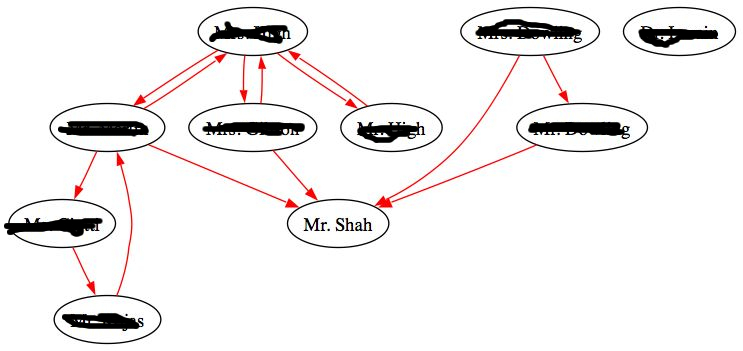
After class, I thought: why not do this whole social network thing next year? So last night I made up a fake set of relationships among teachers at my school and then created a network:

It’s pretty funny actually. I have one husband who likes his wife, but the wife doesn’t like her husband, and other strange relationships. And to accompany it, I made a draft of a worksheet to use next year [click here for draft]. And you know what: I think it’s pretty good. [2]

Besides food networks, and friend networks, I had two more ideas:

  1. Actually make a small celebrity network using IMDB, connecting them only if they’ve been in the same movie. A la Kevin Bacon. Then using that matrix to calculate the degrees of separation.
  2. Have students pick an airline and a bunch of cities it serves. Look at all the flights of an airline on a particular day — and make a matrix representing the number of flights that are made between all cities that one day. Some cities won’t have direct flights between each other — but that’s when you use the square of the matrix, to find which cities are accessible to one-another via one stop over. And you can take the cube of the matrix to find out which cities are accessible via two stop overs. And so forth.
Actually, I really like the second idea for some sort of take-home student project, where we also learn and use some basic Excel. Hmmmm….
And you were wondering what my last post was all about! Ah, gentle reader, I would not leave you hanging for too long.
[1] What was interesting to me about this assignment was although I saw them all working and thinking and grappling, showing true engagement unlike other times when I’ve failed, they didn’t show a true *interest* in the topic. Which makes me question the whole equality that teachers and administrators often believe in implicitly: student interest = student engagement.
[2] Although I might make two changes: (a) not make the network bi-directional (if person A is friends with person B, then person B is friends with person A), and (b) focus more on how to figure out how many degrees of separation someone is from someone else.

Social Networks

I promise I’ll bring this back to teaching and math, but not in this post. In this post, I wanted to show you something I made a few summers ago with one of my friends. It’s a graphical representation of a social network she’s embedded in.

(Click picture to make bigger.)

Each node is a person.

Each different color/style of line represents a different relationship.

  • best friends
  • friends
  • crush (one person with a crush on another)
  • crush (both people have crushes on each other)
  • relationships
  • hookups
  • questionable hookups (meaning: my friend is pretty sure there has been a hookup, but there has been no confirmation)
  • kiss
  • for sure enemy (this is often only in one direction)
  • questionable enemies (meaning: my friend is pretty sure that at least one person secretly hates another, but there is no confirmation)
  • broken relationships
  • labmates
  • roommates
  • former roomates
  • has a crush but won’t admit it to themselves or others
Admit it. It’s pretty awesome.
This is a prologue to a soon-to-be-written post, but also to let you know of this great piece of software (for macs only — sorry!) that I found to create these kinds of charts, all those summers ago:
It’s pretty fantastic, free, and can do a lot of different types of graphs! So math teachers out there, add this to your exponentially-growing list of “cool internet stuff that maybe I’ll use one day.”