Merblions

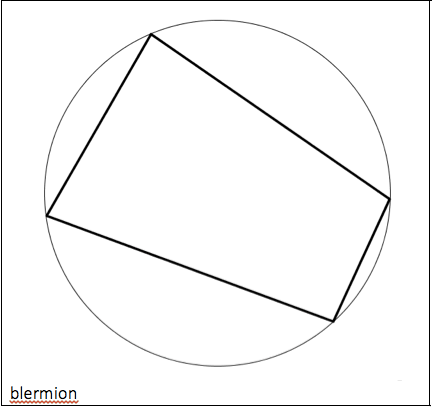
Earlier this year in Advanced Geometry, my kids were introduced to Blermions (original post from when I created the lesson; new post after I tweaked and taught the lesson). That lesson gets kids to understand a bit about cyclic quadrilaterals and some of their properties.

blerm.png

Now we are at the end of the year, and one of my Advanced Geometry sections had three classes that the other section didn’t have. So I had to come up with something supplemental. Thank goodness for twitter. You see, @jacehan was using my blermion activity, and some of his kids asked him “what if the circle was inside the quadrilateral?”

Of course, genius that @jacehan is [his blog is here], he named these creatures merblions.

merb.png

With this one question, I had the makings of an amazing three days ready for me. You see, in Geoemtry, we had just finished studying angle bisectors (and how they related to pouring salt on polygons). We had also just finished studying triangle congruency. (I know that is usually taught earlier in the year, but when I rearranged the course, it fit best near the end of the year.) So those were two powerful tools to analyze merblions.

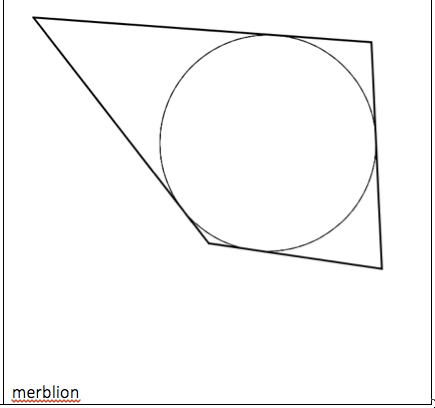
So I told students to pair up. And they were given the above picture and told that: “A merblion has an inscribed circle which is tangent to all four sides of the quadrilateral.”

That is all.

Then I told students that in some ways, this is a culmination of everything they’ve done all year. They have everything they’ve learned at their disposal. Geogebra. Paper. Rulers. Compasses. Protractors. But mostly, they need to make conjectures and see if they are true — either getting a lot of inductive evidence or by using deductive logic. Anything they wanted to figure out about merblions were fair game.

I also highlighted that the other geometry teacher and I started investigating these, realized they were very rich and there was a lot to discover, but we purposefully stopped investigating them. We wanted our students to make the discoveries, without us accidentally guiding them

We also told them that they needed to persevere, and be okay trying lots of things. But if they ever felt their wheels were turning and still nothing was happening, they could call us over for a nudge. (I created a list of things I could say to kids to help nudge them along if they got stuck… I didn’t have to use it more than once! Kids were into it.) They knew at the third day, they would be presenting (informally) their findings to the class. So they had to keep track of things, take screenshots, etc.

While they worked (with music!), I saw kids make conjectures, find they weren’t true, and then move on. I then realized kids weren’t recording their “failed” conjectures. But that data is important! So I told kids to keep track of all of their ideas, and even if their idea didn’t turn out to be true, it is totally worthy of putting into their presentation! It helps us see their avenues of inquiry. Similarly, I told students to record their conjecture, even if they couldn’t prove them deductively.

The kids were doing so many interesting things — including things I hadn’t thought of. (Two pairs tried finding the smallest merblion, by area, that could fit around a circle of a given size! Three pairs tried to do an “always/sometimes/never” with “A _____ is A/S/N a merblion” where the blank were all the quadrilaterals we’ve studied [kites, rhombuses, trapezoids, etc.]. One pair noted that to use Geogebra to draw a merblion, you only need a circle and two points, but the two points couldn’t be any two points — so they wondered where those two points could be located.) It was great.

They continued on the next day, and spend the last 20 minutes of the second class throwing some slides up in our google presentation [posted here, with identifying information of students removed].

What they ended up discovering was awesome.

some big results (some proved, some unproved) found

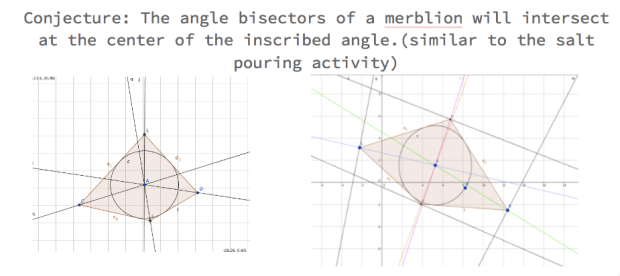
1. The center of the circle inscribed in the merblion is the intersection of the four angle bisectors. And if we cut a merblion out of cardstock and did the “salt pouring activity,” we would see the salt form a pyramid with a merblion base and a single peak (where the peak would exist at the center of the inscribed circle).

result1.png


2. Kites, squares, and rhombuses are all merblions. However rectangles are only merblions if they are squares, and parallelograms are merblions only if they are rhombuses. Some trapezoids are merblions and some aren’t.

3. No concave quadrilateral can be a merblion.

4. A merblion has two pairs of opposite angles which are acute, and two pairs of opposite angles which are obtuse (unless you have a square).

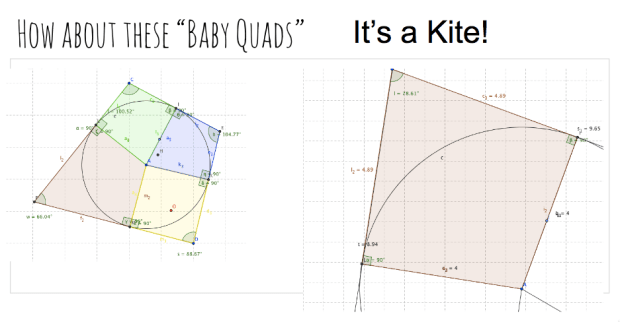
5. A merblion is secretly composed of four kites. And the four kites have two opposite right angles. (Which means that the non-right angles are supplementary in these kites.)

result2

6. In a merblion, the sum of the lengths of opposite sides are equal. result3.png

7. The area of a merblion can be computed by finding the perimeter, halving it, and multiplying it by the radius of the inscribed circle.

number4

8. For all merblions that can be drawn around a given circle, the merblion with the least area is a square.

9. In the other class (not in my class) students found this result… The two angles here are always supplementary.

result5.png

Why I loved this

The kids were totally engaged. They didn’t feel pressure to produce “the right answer” because there was no right answer. (And no grade associated with this work.) I emphasized that all conjectures (even if they don’t work out) were valid, so kids felt okay writing anything and anything down. I didn’t have a specific outcome they had to come up with, so I wasn’t leading. Kids could do anything! They got to work together.

And when some results were presented that explained things that people were wondering about — there were noticeable ooohing and aaahing (for example, result #6!).

And after the presentation happened, it became clear to everyone that by crowdsourcing this problem, we were able to see lots of results and then start examining how the different results related to each other (so for example, result #6 explains #2).

This was very fun. Very very fun.

Reading? For math class?

This year, our school adopted this weird rotating schedule where we see our classes 5 times out of every 7 days. And four of those times are 50 minute classes and one of those times is a 90 minute class.

I didn’t have a clear idea of what to do in multivariable calculus for the block. I still had to cover content, but I wanted it to be “different” also. After many hours of brainstorming, I came up with a solution that has worked out pretty well this year.

We had a book club.

The 90 minute block was divided into 50 minutes of traditional class, and 40 minutes of book club. (Or 60 minutes of class, and 30 minutes of book club.)

Now, to be clear, this is a class of seven seniors who are highly motivated and interested in mathematics. I can see ways to adapt it in a more limited way to other courses, with more students, but this post is about my class this year.

BOOKS

We started out reading Edwin Abbott’s Flatland.

Flatland

Why? Because after they read this, they understand why I can’t help them visualize the fourth (spatial) dimension! But it convinces them that they can still understand what it is (by analogy) and makes them agree: if we can believe in the first, second, and third spatial dimensions, why wouldn’t we believe in higher spatial dimensions too? It’s more ludicrous not to believe they exist than to believe they don’t exist! A perfect entree into multivariable calculus, wouldn’t you say?

After reading this, we read the article “The Paradox of Proof” by Caroline Chen on the proposed solution to the ABC conjecture.

paradox

This led us to the notion of “modern mathematics” (mathematics is not just done by dead white guys) and raised interesting questions of fairness, and what it means to be part of a profession. Does being a mathematician come with responsibilities? What does clear writing have to do with mathematics? (Which helps me justify all the writing I ask for on their problem sets!) It also started to raise deep philosophical questions about mathematical Truth and whether it exists external to the human mind. (If someone claims a proof but no one verifies it, is it True? If someone claims a proof and fifty people verify it, is it True? When do we get Truth? Is it ever attainable? Are we certain that 2+2=4?)

At this point, I wanted us to read a book that continued on with the themes of the course – implicitly, if not explicitly. So we read Steve Strogatz’s The Calculus of Friendship:

Strogatz

What was extra cool is that Steve agreed to sign and inscribe the book to my kids! The book involves a decades long correspondence between Steve and one of his high school math teachers. There are wonderful calculus tricks and beautiful problems with explanations intertwined with a very human story about a young man who was finding his way. Struggling with choosing a major in college. Feelings of pride and inadequacy. The kids found a lot to latch onto both emotionally and mathematically. Two things: we learned and practiced “differentiating under the integral sign” (a Feynman trick) and talked about the complex relationship that exists between teachers and students.

After students finished this book, I had each student write a letter to the author. I gave very little guidelines, but I figured the book is all about letters, so it would be fitting to have my kids write letters to Steve! (And I mailed the letters to Steve, of course, who graciously wrote the class a letter back in return.)

Our penultimate reading was G.H. Hardy’s A Mathematician’s Apology:

hardy

I went back and forth about this reading, but I figured it is such a classic, why not? It turned out to be a perfect foil to Strogatz’s book — especially in terms of the authorial voice. (Hardy often sounds like a pompous jerk.)  It even brought up some of the ideas in the “Paradox of Proof” article. What is a mathematician’s purpose? What are the responsibilities of a mathematician? Why does one do mathematics? And for kids, it really raised questions about how math can be “beautiful.” How can we talk about something that is seen as Objective and Distant to be “beautiful”? What does beauty even mean? Every section in this essay raises points of discussion, whether it be clarification or points that students are ready to debate.

What is perfect about this reading is at the same time we were doing it, the movie about G.H. Hardy and S. Ramanujan was released: The Man Who Knew Infinity (based on the book of the same name).

Finally, we read half of Edward Frenkel’s Love and Math:

frenkel.PNG

Why? Because I wanted my students to see what a modern mathematician does. That the landscape of modern mathematics isn’t what they have seen in high school, but so much bigger, with grand questions. And through Frenkel’s engaging telling of his life starting in the oppressive Russia and ending up in the United States, and his desire to describe the Langland’s program understandably to the reader, I figured we’d get doses of both what modern mathematics looks like, and simultaneously, how the pursuit of mathematics is a fully human endeavor, constrained by social circumstances, with ups and downs. Theorems do not come out of nowhere.Mathematicians aren’t the blurbs we read in the textbooks. They are so much more. (Sadly, we didn’t read the whole thing because the year came to a close too quickly.)

STRUCTURE OF THE BOOK CLUBS

I broke the books into smaller chunks and assigned only them. For Flatland, it might have been 20-30 pages. For Love and Math or A Mathematician’s Apology, it might have been 30-50 pages. We have our long block every 7 school days, so that’s how much time they had to read the text.

At the start, with Flatland, students were simply asked to do the reading. Two students were assigned to be “leaders” who were to come in with a set of discussions ready, maybe an activity based on something they read. And they led, while I intervened as necessary.

For every book club, students who weren’t leading were asked to bring food and drink for the class, and we had a nice and relaxing time. On that note,  never did I mention anything about grades. Or that they were being graded during book club. (And they weren’t.) It was done purely for fun.

Later in the year, I had students each come to class with 3-4 discussion questions prepared, and one person was asked to lead after everyone read their questions aloud.

The discussions were usually moderated by students, but I — depending on how the moderation was going — would jump in. There were numerous times I had to hold back sharing my thoughts even though I desperately wanted to concur or disagree with a statement a student had made. And to be fair, there were numerous times when I should have held back before throwing my two cents in. But my main intervention was getting kids to go back to the texts. If they made a claim that was textually based, I would have them find where and we’d all turn there.

Sometimes the conversations veered away from the texts. Often. But it was because students were wondering about something, or had a larger philosophical point to make (“Is math created or discovered?”) which was prompted by something they read. And most of the times, to keep the relaxed atmosphere and let student interest to guide the conversation, I allowed it. But every so often I would jump in because we had strayed so far that I felt we weren’t doing the text we had read justice (and we needed to honor that) or we were just getting to vague/general/abstract to say anything useful.

EXAMPLES OF DISCUSSION QUESTIONS

I mentioned students generated discussion questions on their own. Here are some, randomly chosen, to share:

  •  Strogatz talks about how math is a very social activity. We see this exemplified in the letters between Steve and Mr. Joffray, but where else do we see this exemplified in math? (papers, etc.) How do you think Strogatz might have felt about Shinichi Mochizuki’s unwillingness to explain his paper and proof to the math community?
  • What do you think about Strogatz and Joff using computer programs to give answers to their problems? Are computers props, and their answers unsatisfying? Or are they just another method, like Feynman’s differentiating under the integral?
  • Do you like A Square? In what ways is he a product of his society? Does he earn any redeeming qualities by the end of the book?
  • Can you draw any connections between things in Flatland and religion? Do you think Abbott is religious? Why/why not?
  • When we first read about Mochizuki’s ABC Conjecture, we debated whether or not math is a “social” subject. Perhaps many mathematicians do much of the “grind” work on their own, however, throughout everything we’ve read this year, there has been one common link when it comes to the social aspects of math: mentorship. It appears to me that all of the great mathematicians we know about have been mentored by, or were mentors others. In what ways have Frenkel’s mentors – he’s had a few – had an influence on the path of his mathematical career? Do you think he would/could be where he is today without all of those people along the way? Can you think of any mentors that have had a profound influence on your life? (The last one can just be a thought, not a share.)
  • Frenkel talks about the way in which math, particularly interpretations of space and higher dimensions, began to influence other sectors of society, specifically the cubist movement in modern art. This movement was certainly not the first time math and science influenced art and culture – think about the advent of perspective in the Renaissance and the use of technology on modern art now – however math and art are often thought as opposites and highly incompatible. Why do you think that people rarely associate the two subjects? Would you agree that the two are incompatible? Can you think of other examples of math/science influence art/culture/society?

REFLECTIONS

In many ways, I felt like this was a perfect way to use 30 minutes of the long block. After doing it for the year, there are a few things that stood out to me, that I want to record before summer hits and I forget:

(a) I think students really enjoyed. It isn’t only a vague impression, but when I gave a written survey to the class to take the temperature of things, quite a few kids noted how much they are enjoying the book clubs.

(b) For the post-Flatland book club meetings, I need to come up with multiple “structures” to vary what the meetings look like. Right now they are: everyone reads their discussion questions, the leader looks for where to start the discussion, the discussion happens. But I wonder if there aren’t other ways to go about things.

One example  I was thinking was students write (beforehand) their discussion questions beforehand on posterpaper and bring it to class. We hang them up, and students silently walk around the room writing responses and thoughts on the whiteboard. Then we start having a discussion.

Or we break into smaller groups and have specific discussions (that I or students have preplanned) and then present the main points of the discussion to the entire class.

Clearly, I need to get some ideas from English teachers. :)

(c) I love close readings of texts. I think it shows focus, and calls on tough critical thinking skills. At the same time, I need to remember that this is not what the book clubs are fundamentally about. They are — at the heart, for me — inspiration for kids. So although for Flatland I need to keep the critical thinking skills and close readings happening, I need to remember (like I did this year) to keep things informal.

(d) Fairly frequently, I will know something that is relevant to the conversation. For example, I might talk about of the math ideas that were going over their heads, or about fin de siecle Vienna, or branches of math that might show how the line between “theoretical” and “applied” math is blurry at best. I have to remember to be judicious about what I talk about, when, and why. We only have limited time in book club, so a five minute tangent is significant. And one thing I could try out is jot down notes each time I want to talk about something, and then at the end of the book club (or the beginning of the next class), I could say them all at once.

(e) I usually reserve 30 minutes for book club. But truthfully, for most, 40 minutes turned out to be necessary. So I have to keep that in mind next year when planning class.

(f) Should we come up with collaborative book club norms? Should I have formal training on how to be a book club leader? Should we give feedback to the leaders after each book club? Can we get the space to feel “safe” where feedback could actually work?

And… that’s all!
Partitions

Yesterday in my geometry class, I deviated from my plan. (We had finished trigonometry, so when I told kids I was going to go off on a tangent, the groans were hearty and multitudinous.) I liked it so much that I did it in my other geometry class and my precalculus class.

You see, I have kids in five groups, and the groups sit at different tables each class. I have folders for each group prepared, and I throw the folders down randomly on the tables. Sometimes I let kids put the folders down — so they are dictating where everyone sits. THE POWER!

So yesterday, I had five folders and I wanted kids to put them down. How could I have done it?

Give all five folders to one student to place on the table.
Give one folder each to five students to place on the tables.
Give two folders to one student and three folders to another. Etc.

In other words:

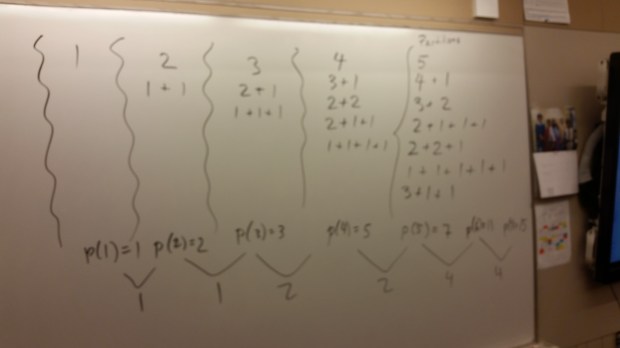
5, 4+1, 3+2, 3+1+1, 2+2+1, 2+1+1+1, 1+1+1+1+1

There were seven ways to divide up the folders to give kids.

(I then said this was like factoring numbers, but with addition. So for example: 20 could be written as: 10*2, 5*2*2, 4*5, etc. But they had never been asked to think about this with addition! That’s what this folder problem was in disguise.)

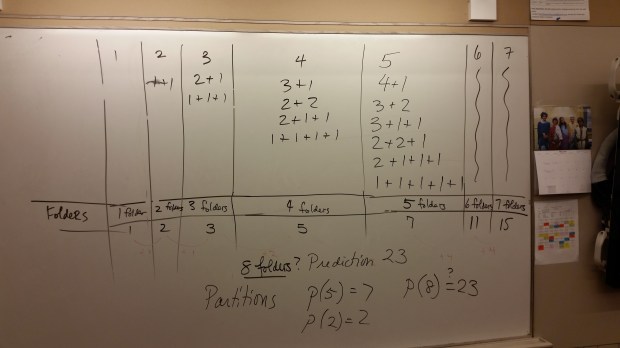
I asked kids to calculate how we could do this with four folders… and then how we could do this with six folders. When they were done, we created this chart on the board:

1 folder: 1 way
2 folders: 2 ways
3 folders: 3 ways
4 folders: 5 ways
5 folders: 7 ways
6 folders: 11 ways

And then I told them that before class, I calculated 7 folders (lie… I looked it up!) and got:

7 folders: 15 ways

At the end, I asked each group to try to estimate (with reason, but without counting) what the answer for 8 folders would be.

While they were estimating, I pulled up a trailer to The Man Who Knew Infinity (a movie about Ramanujan and Hardy which was just released last Friday and was still in theaters…) When I asked each group to share their answer, but without giving any rationale, every group predicted 23.  Do you see why?

Let me show you what the board looked like after they explained their reasoning… (one image is from one class, one is from the other)…20160506_110311.jpg

20160506_092112

The second image shows the differences between these numbers. The differences were 1, 1, 2, 2, 4, 4… so they naturally added 8 to the last value… so 15+8=23.

Then I had kids watch the trailer to The Man Who Knew Infinity:

When it finished, I told them it was still in theaters and it made me cry! And then I said the mathematicians in this movie were very famous — any math major or mathematician will have heard about them… And what were they working on in this film? Our folder problem! (At this point, I had given them the name of the function we were working with: the partition function.) The question was: given any positive integer, could they figure out exactly how many partitions it has without listing them all out?

Then I pulled up the Wikipedia page on partitions and we looked at some more values:

partitions

ARGH! It’s at this point the kids see their prediction for 8 folders (23) wasn’t correct (the value is 22!). And we note that the numbers start growing slowly, but then they seem to be growing faster and faster!

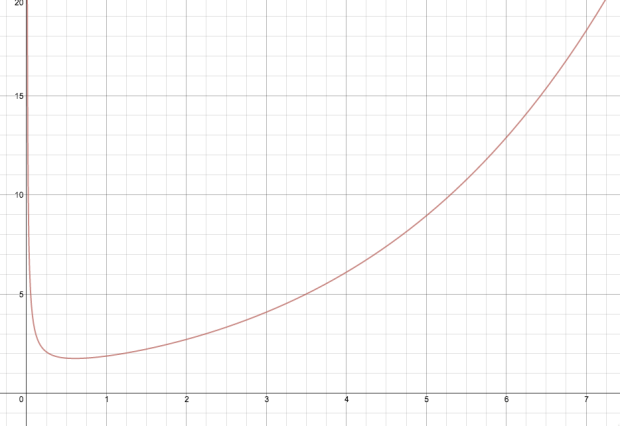
I then pull up desmos and type in:

partition2.png

and say that part of the film involves the mathematicians discovering this formula is a pretty good approximation for the number of ways to distribute n folders… if n is large. And we start looking at the graph to see how it compares to the values we find.

partition3

It’s actually pretty bad for small n values, but as we try getting to higher n values, we see how high we have to change the window to see the output! Also: weird! Pi is involved?!? And a square root of 3? Whaaaa? (And when I did this in precalculus, kids knew what e was so it was even weirder… but in geometry, kids didn’t so I merely mentioned it was a number like pi but with a value of about 2.71.) [1]


All of this came out of me giving myself permission to go on a tangent… We spent probably 15-20 minutes doing this in each class (I had to do it in my others after I did it on the fly in the first class). But in this 15-20 minutes, I felt like I was alive, and that I was bringing to my kids something I am not able to give them in a traditional curriculum. (It felt like it dovetailed a lot into what I wrote in this post about inspiration and mathematics a few weeks ago.)

Kids were asking great questions, and were talking about other random neat math things. I let that happen briefly… but the ticking clock was getting at me. So then we went back to our regularly scheduled program.

[If I had planned this as an actual lesson, I would have done a lot differently (probably more predicting)… but I’m guessing if I had planned this as an actual lesson, I would have killed it. Part of what I think made this successful was the spontaneity and lack of overthinking/formalism]


[1] In precalculus, we had just finished working with hyperbolas. So after I told kids that this function was good for huuuuge values of n but bad for small values of n, and asked kids what that reminded them of. Two students immediately saw that the equations we came up with for the end behavior of they hyperbola was exactly this… It is terrible for small values of x but great for large value of x!

hyperbola

Parabolas: Focus and Directrix

I am teaching conics now. I usually skip teaching anything about parabolas in depth because… well, they do so much with quadratics in Algebra II… and I would rather devote my time to something new. However this year I’m teaching with another teacher who did cover parabolas. So I had to learn what a focus and directrix is. I mean, I knew ages ago, but who needs to keep that kind of information in your head?!

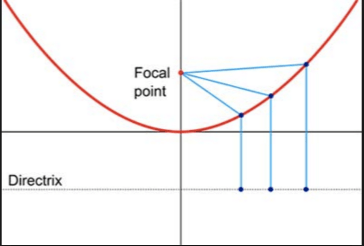
parabola.png

For those who aren’t in the know, for me the big idea is that we can conceptualize a parabola as the result of graphing the algebraic equation y=ax^2+bx+c. But there is a second way to concieve of the same mathematical object: with a geometric argument.
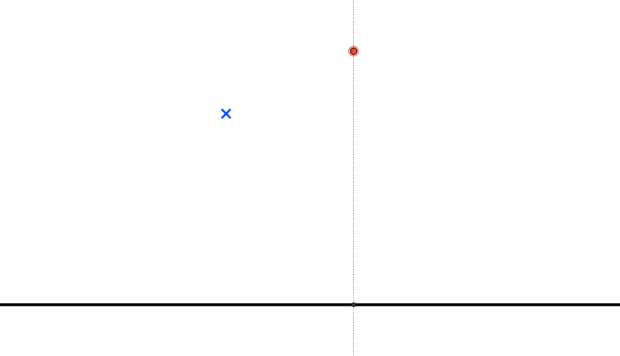
If you have a piece of paper with single point drawn, and a single line (that doesn’t contain the point) drawn, those two objects uniquely define a parabola.

That’s a pretty awesome thing, once I started thinking about it. An alternative way to view something that I only ever think about in the standard “graph a quadratic” way!

The Forwards Question

So given a point and a line, how can we draw this parabola? Here is how…

img1

The point is the blue X. The line is the black line. We want to drag the red point along this vertical line so that the distance from the blue point to the red point is equal to the distance between the red point and the black line. So we use a ruler, some trial and error, and find that red point belongs somewhere here… [1]

img3.png

And then we leave that red dot there, and start again with another vertical line. And find another point on that vertical line which has the same property!

img4.png

And again and again and again. Until you have created a whole bunch of red points. Those form a parabola.

parabolacreate

I’m still not 100% sure how I’m going to introduce this notion to my kids. I’m pretty sure I’m going to give each kid a printed paper that looks like

img1

And ask them where to place the red dot… And then see if they can find a more efficient way than using a ruler and guessing a checking. (Paper fold! See it? If not, read the footnote.) I will probably do this as a warmup one day — and then have kids go “whaaaaat is this for?” and I’ll shrug and say “Wish I knew, kids…” and then move on not referencing this.

And then the next day for the warmup, I’ll find a way to have the whole class collect points for the same blue point and black line… We’ll generate the locus of all these points which are equidistant from the blue point and perpendicular distance to the black line… and lo and behold… the parabola. And then we’ll do the patty paper folding thing down in the footnote video.

So… Yeah. Now we have an obvious place to go…

The Backwards Question

Here it is: Given a parabola, can you find the defining point and line? (The fancy mathematical words for these defining objects are “the focus” and “the directrix.”)

And so I created a sheet to have my kids figure out how to find these objects given a parabola. [Note: I haven’t used the sheet. I haven’t even worked out the sheet and made a key. I just whipped it up now! So apologies for any errors, if any.]

2016-04-25 Parabolas [docx form]

Now to be perfectly perfectly honest, there are two things about this sheet I hate.

(1) I give footnote 1.

(2) I give 3c. In fact, partly I think giving 3a is a bit much as is.

Both give away too much. So why didn’t I change it? Do I not have confidence in my kids?

No. It’s because I wasn’t even planning on introducing parabolas. And now I got sucked into them — learning all about them — and I am excited to share some of this stuff with my kids. But I don’t have the time for this. The fact that I’m going to give about a day for parabolas is more than I was planning… so I have to keep things a bit on the crisper side.

What else would I change if I had more time? I would have kids think about if this works for an “upsidedown” parabola. And also have them use what they know about inverse functions to apply this to “sideways” parabolas.

I honestly don’t know if I’m going to use this in class. I probably will because I took the time to make it, and I kinda got excited when I was figuring out for myself all this focus/directrix stuff. I pretty much took this definition of a parabola and figured all this out myself — and I hope kids get the same joy. But have I convinced myself that kids need to learn about a parabola other than there is this other way to “create” them that isn’t algebraic? Is there a “big idea” hidden in this worksheet? I don’t think so. This may be a one-time use worksheet.


[1] Now in actually, there is an easy geometric way to find that red point. It involves a simple paper fold. Fold the blue point to the point on the directrix below the red point. What that crease intersects the vertical line is where the red dot should be. Perpendicular bisectors FTW! And you can do a quick patty paper demonstration of this to create a parabola! (We did this in my class last year, for parabolas, hyperbolas, and ellipses, thanks to Tina C.)


A New Insight on the Famous Painted Block Problem

There is a famous, well-known problem in the world of “rich math tasks” that involves taking an nnn cube and painting the outside of it. Then you break apart the large cube into unit cubes (see image below cribbed from here for n=2 and n=3):

cubes

Notice that some of the unit cubes have 3 painted faces, some have 2 painted faces, some have 1 painted face, and some have 0 painted faces.

The standard question is: For an nnn cube, how many of the unit cubes have 3 painted faces, 2 painted faces, 1 painted face, and 0 painted faces.

[In case you aren’t sure what I mean, for a 3 x 3 x 3 cube, there are 8 unit cubes with 3 painted faces, 12 unit cubes with 2 painted faces, 6 unit cubes with 1 painted face, and 1 unit cube with 0 painted faces.]

Earlier this year, I worked with a middle school student on this question. It was great fun, and so many insights were had. This problem comes highly recommended!

Today we had some in house professional development, and a colleague/teacher shared the problem with us, but he presented an insight I had never seen before that was lovely and mindblowing.

Spoiler alert: I’m about to give some of the fun away. So only jump below / keep reading if you’re okay with some some spoilers.

(more…)

Inspiration and Mathematics

In my multivariable calculus class this year, we’ve been holding a regular “book club” during our long blocks. (Don’t ask… we have a rotating schedule and every seven school days we have a 90 minute class.) Right now we’re reading Edward Frenkel’s Love and Math: The Heart of Hidden Reality.

LoveAndMath.png

In the introduction, Frenkel criticizes the teaching of math:

What if at school you had to take an ‘art class’ in which you were only taught how to paint a fence? What if you were never shown the paintings of Leonardo da Vinci and Picasso? Would that make you appreciate art? Would you want to learn more about it? I doubt it. [1] … There is a common fallacy that one has to study mathematics for years to appreciate it… I disagree: most of us have heard of and have at least some rudimentary understanding of such concepts as the solar system, atoms and elementary particles, the double helix of DNA, and much more without taking courses in physics and biology. And nobody is surprised that these sophisticated ideas are part of our culture, our collective consciousness.

So many whirling thoughts came up while I was reading these passages. One thought led to another to another to another. Writing this post is an attempt to start recording them and to get them a little more codified in my mind! It is still going to be a hot discombobulated stream-of-consciousness mess. #sorrynotsorry

I wonder if I asked my kids “what is mathematics?” right now, what they would say. I am doubtful that their answers will include the adjectives and verbs that I personally would say.

I wonder if I asked my kids “what is is going on in the field of mathematics?” right now, what they would say. I’m guessing a lot of blank stares.

I wonder what my kids would say if I asked ’em “what courses exist in college for mathematics?”

I wonder what my kids would say if I asked them to name a mathematician who is alive?

I wonder if the word “mathematics” was changed to “astronomy” or “physics” or “biology” if their answers would be different.

There are ideas that my kids learn about modern physics (in popular culture, in classes) which spark their imagination, blow their minds, make them curious and full of wonderment at the weirdness and strangeness of the world. Special relativity. Quantum mechanics. Quarks and the structure of atoms. They are exposed to these ideas, even if they don’t have the mathematical capabilities or abstraction to attack them rigorously. And these ideas have a powerful effect on some kids. (I know I wanted to be a physicist when I first learned about these ideas!)

But what do my kids learn about modern mathematics — from school or popular culture? Are there any weirdnesses or strangenesses that can capture their imagination? Yes! Godel’s incompleteness theorem. Space filling curves. Chaos theory. The fact that quintic and higher degree polynomials don’t have a general “simple” formula always works like the quadratic formula. Fractals. Higher dimensions. Non-euclidean space. Fermat’s Last Theorem. Levels of infinity. Heck, infinity itself! Mobius strips. The four color theorem. The Banach-Tarski paradox. Collatz conjecture (or any simply stated but unproven thing). Anything to do with number theory! Anything to do with the distribution of primes! But do they capture students’ imaginations? No… because they aren’t exposed to these things.

Where in our curriculum do kids get inspired? Where does awe and beauty fit into things? When do we ever explicitly talk about beauty in mathematics? When a kid has a rush of insight and makes a visible gasp, what do we do in that moment? What has to already be in place for a kid to make that gasp?

We need to expand how we frame mathematics in high school so it isn’t seen as “Algebra I, Geometry, Algebra II, Precalculus, and Calculus.” These course names aren’t mathematics.

We need to consciously and regularly introduce a bigger and more modern world of mathematics to our kids. How? Having kids read when the New York Times publishes an article about a mathematician or mathematical result! Using resources like Numberphile and Math Munch and Vi Hart videos. And… I don’t know.

We need to provide space and time for kids to explore an expanded vision of what math is, and have choice in having fun and playing with this expanded vision of math. (My explore math project is an attempt to do that — website here, and posts one, two, and three here.)

We need to have mathematical lore, stories we can tell students. Galois duel! Ramanujan’s inexplicable genius! What are mathematical stories that can be passed down from generation to generation? (Does a good resource exist for this? Tell me!) [Update: The internet went down when I was going to edit this post by mentioning we need stories and people who aren’t just white men!]

Do we have Feynman or degrasse Tyson-esque figures we can point to? Dynamic popularizers of the subject that have entered the public consciousness?

***

Maybe what I’m trying to say, if I had to distill everything down to the core, is:

(1) Can we find a way — in our existing schools with our set curricula and limited time — to expand kids notions of what mathematics is by exposing them to notions external to the Alg-Geometry-Alg II-Calc sequence. And if we can do this well, will it help inspire more kids to be interested in mathematics? 

(2) Are there ways for us to keep an focus on beauty, the unexpected, awe, and wonderment in our classes? And find ways to record, highlight, and amplify those moments for kids when they happen? Why I love mathematics is because of all of these moments! Maybe focusing on them would help kids love mathematics?

UPDATE: Annie Perkins has a great blogpost which captures some of the exact same ideas and feelings here. But she’s more eloquent about it. So read itUpdating it here so it is archived for my own thinking on this.


[1] This notion has so many resonances with Paul Lockhart’s A Mathematician’s LamentWhich I highly recommend.


The key turn, and noticing with a trig table

In Geometry, we’re in the middle of our introduction to trigonometry. (If you want to hear more about that gentle, conceptual introduction, read up here.)  Up until now, kids have been using this right triangle book to figure out missing angles and side lengths. The big idea is that every triangle in the world is similar to one of the triangles in this book… so we can use that similarity to find side lengths and angles.

And finally we did the magic transition where kids saw how ratios could be used to find the labeled angle… This is the key turn, from sides of triangles to ratios of sides.

triangle

Initially all students used the pythagorean theorem to find the hypotenuse and then they “scaled the triangle down” to find the similar triangle in the book with hypotenuse one. From there, they could find the angle.

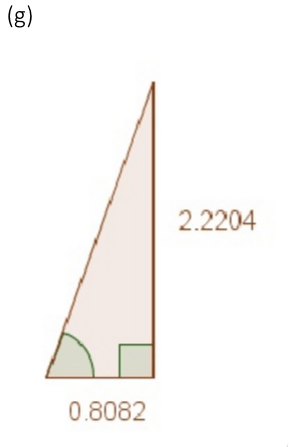
But then I asked: How could you find the angle without using the Pythagorean theorem? They could still use the triangle book, and the basic functions on their calculators (kids obviously at this point don’t know about sine/cosine/tangent). Some were stuck, some saw it right away. But eventually everyone recognized that they were looking in the triangle book for a triangle which was similar to the triangle given. And we know that proportions of corresponding sides in similar triangles stay constant… so they used guess and check to find triangles in the book with a vertical/horizontal ratio that matched 2.2204/0.8082.

Okay, great. They hated thatThey had to divide the side lengths on a bunch of different triangles in the triangle book. So annoying. It was much worse than just using Pythagorean theorem and scaling down. 

So here’s where we paused. I said: “okay, fine, agreed. This is annoying and horrible, and the Pythag approach is much nicer. Let me ask you this… What if I put the ratio of the vertical/horizontal leg on every page in the book. So you had the ratio. Which way would be more efficient to use then?”

Everyone said the ratio. Why? Given a triangle, you simply take the ratio of two sides, and then flip in the book until you see the same ratio. Then you can immediately read off the missing angle. One division, that’s all. (With Pythag, you have to first calculate the hypotenuse without any error, and then scale that triangle so the hypotenuse is one, and only then flip in the book! And that might lead to more error.)

So I showed them trig tables. Of course they don’t have sine/cosine/tangent yet on them. And I let them use it on a few problems.

And then… FUN! I asked kids to just look at the table and just “notice” patterns.

They came up with some great things, which I then started playing with on the fly. I told them to call the three columns “Ratio 1,” “Ratio 2,” and “Ratio 3”:

  • As the angle increases, Ratio 1 starts close to 0 and goes close to 1.
  • As the angle increases, Ratio 2 starts close to 1 and goes close to 0.
  • Whoa, wait, the numbers in Ratio 1 and Ratio 2 are “reversed”! Reading Ratio 1 from the top-down, and Ratio 2 from the bottom-up is exactly the same.
  • As the angle increases, Ratio 3 starts close to 0 and gets higher… dramatically higher at higher angles!
  • The numbers in the Ratios didn’t seem to be going up “proportionally”


While they were looking for patterns, I noticed no one had taken out their calculators, so I told ’em to see if their calculators could help them figure out any additional patterns.

  • Ratio 1 divided by Ratio 2 is the same as Ratio 3.

They will be exploring some of these ideas later,  and class was coming near to a close, so we didn’t explore everything we could have. But we did talk about a few things.

(1) We briefly discussed why Ratio 1 will never equal 1. (The hypotenuse of a triangle can’t ever equal a leg of a triangle! You wouldn’t have a triangle, but a segment.)

(2) We saw in a triangle why Ratio 1 divided by Ratio 2 yields Ratio 3.

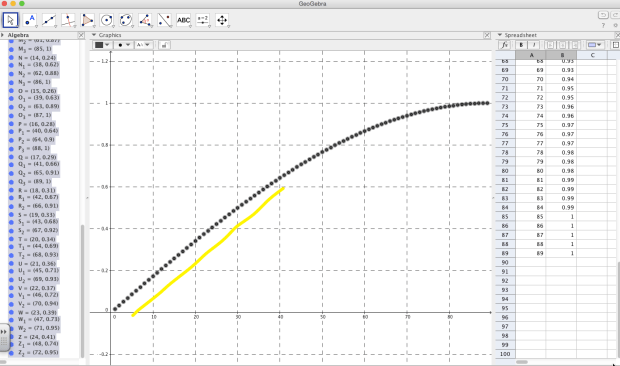
And finally, I most wanted to capitalize on the observation that I hadn’t anticipated… but discussing it would combat a great question kids don’t really grok well in higher grades… What is the shape of the sine curve? Usually they think it is linear from 0 degrees to 90 degrees. That there is a linear relationship between angles and the ratios. So here’s what I did:

I told students that I would be plotting on the x-axis angle number, and the y-axis Ratio 1. If this was a line, then if you pick any two points on this line and calculate the slope, the slope should be constant. [1]

Each kid chose two different angles, and looked at the associated Ratio 1 numbers, and calculated the slope. While they did that, I was doing a little magic in Geogebra to show the data graphed.

Kids were getting different slopes. So they knew it wasn’t a line. But many slopes very close to each other! Curious.

geogebragraph.png

A kid saw the graph and said “Hey, it looks linear at the beginning” and that explained why so many slopes were similar but not the same. Kids were mainly ch0sing angles from the first page of the ratio table! Ha! Love it! Last year teaching geometry, I didn’t ever show them a sine curve. But this came up so naturally that I had to!

This was a bit on the fly and haphazard, but this discussion of whether the ratios were linear or not was one of my favorite things I’ve done recently! I should find a way to formalize it and build it into the curriculum in more solid way.

UPDATE: OMG I am an idiot. I forgot to mention something crucial. I want kids to recognize that if they have a trig table with only Ratio 1 (aka Sine), they can generate the entire trig table. We have an abundance of information! And this discussion of their noticings seems perfect for that. This is the follow up I used last year, and I will again use it this year.

The key point I’m getting to: the truth is we don’t need sine, cosine, and tangent. We only need one of them. For example, if I know sine, then cosine can be defined as \sin(90-\theta) and tangent can be defined as \frac{\sin(\theta}{\sin(90-\theta}. So why do we have all three? Life is easier. Look at triangle (g) above in this post. Try using a table with only Ratio 1 to find the missing angle. It is more work than if we had a table for Ratio 3. 


[1] Okay, yeah, so afterwards, I realized I could have just asked if the ratios had a constant difference. But my more complicated approach led to something interesting! Also: if I had more time, I would have asked kids to develop a way to decide if the ratios were growing linearly or not. I bet some would have said common difference, some would have said find the slope, and some would have said graph!