General Ideas for the Classroom

Optimization: An Introductory Activity & Project

I switched things around with optimization in calculus this year, and I realized if I had the time, I would spend a month on it. [1] I wonder if this shouldn’t be a crux of the class. Not the stupid “maximization and minimization” problems but finding some real good ones — in economics, physics, chemistry, ordinary situations. There have got to be tons of non-crappy ones!

Anyway, I wanted to share with you two things.

First, how I introduced the idea of optimization to my kids. Instead of going for the algebra/calculus approach, I wanted them to toy with the idea of maxima and minima, so I had them spend 35-40 minutes working on this in class:

[doc]

I thought it was pretty cool to see my kids engaged. I rarely do things like this, but I did it (I was being videotaped during this lesson… and I had never done it before… and I had the idea to create it the night before…). It was fun! And although I cut the debrief the next day short (ugh, why?), I enjoyed seeing kids engaged in problem solving through various strategies. And there was a healthy level of competition. (The winners for the 1st and 2nd tasks got a package of jelly beans, but they were so gross I threw them out! One student gave them to his rabbit who likes jelly beans, and even the rabbit didn’t like them!) But when it came down to it, it drove home the idea that optimization was something that trial and error is good for, sometimes we do it intuitively, sometimes our intuition is terrible and sometimes it is good, and sometimes we get an answer but we don’t know how to prove there isn’t a better answer (e.g. in problem #3). Some kids liked that this felt more “real world” than this world of algebra and graphing that we’ve been meandering in.

Second, I have allotted a few days for students to work on this project during class (it’s the week before Spring Break and kids are overburdened, so I didn’t want to have them do something which involved a lot of at-home time). They’ve been working on it this week, and I’ve heard some good conversations thus far. (They’re doing this in pairs, and I have one group of three.) The fundamental question is: with a given surface area, what are the dimensions of a cylinder with maximal volume?

[.doc]

Now I don’t quite know how their posters will turn out yet, or whether students will have truly gotten a lot of “mathematical” knowledge out of it. But each day, I’ve had a couple kids say things that indicate that this isn’t a terrible project. (I don’t do projects, so that’s why I’m very conscientious about it.) A few said something equivalent to “Wow, the companies could be giving me x% more creamed corn!” or how they like doing artsy-crafty things. At the very least, I can pretty much be assured that students — if I ask them if there is any question that calculus can answer at the grocery store — will be able to say yes.

Next year I will probably add the reverse component (for a given volume of liquid you want to contain, how can we package it in a cylinder to minimize cost… what about a rectangular prism… what about a cube… what about a sphere… etc.?).

[1] The one thing I found in this book my friend gave me (on science and calculus) was an experiment where you shoot a laser at some height at some angle into an aquarium, so that it hits a penny at the bottom (remember the laser beam will “change” angles as it hits the water) to minimize the time it takes for the photon to travel from the laser to the penny. I almost did it, but deciding to do it was too last minue.

Two crazy good Do Nows

Recently, I’ve been trying to be super duper conscientious of every part of my lesson. For example, I wrote out comprehensive solutions to some calculus homework, paired my kids up, handed each pair a single solution set, and had them discuss their own work/the places they got stuck/the solutions. I actually had made enough copies for each person, but I very intentionally gave each pair a single solution set. It got kids talking. (Afterwards, I told them I actually had copies for each of them.) That’s what I’m talking about — the craft of teaching. I don’t always think this deeply about my actions, but when I do, the classes always go so much better.

In that vein, of super thoughtful intentional stuffs, I wanted to share two crazy good “do nows” from last week. Not because they’re deep, but because they were so thought-out.

For one calculus class, I needed my kids to remember how to solve 5\ln(x)+1=0 (that equation was going to pop up later in the lesson and they were going to have to know how to solve it). I also know my kids are terrified of logs, but they actually do know how to solve them.

I threw the slide below up, I gave them 2 minutes, and by the end, all my kids knew how to solve it. I didn’t say a word to them. Most didn’t say a word to anyone else.

How I got them to remember how to solve that in 120 seconds, without any talking, when they are terrified of logarithms and haven’t seen them in a looong while?

I can’t quite articulate it, but I’m more proud of this single slide than a lot of other things I’ve made as a teacher. (Which is pretty much everything.)  Not deep, I know. It’s not teaching logs or getting at the underlying concept, I know. But for what I intended to do, recall prior knowledge, this was utter perfection. The flow from each problem to the next… it’s subtle. To me, anyway, it was a thing of perfection and beauty.

The second slide is below, and I threw it up before we started talking about absolute maximums/minimum in calculus.

As you can imagine, we had some good conversations. We talked about (again) whether 0.9999999… is equal to 1 or not (it is). We talked about a property of the real numbers that between any two numbers you can always find another number (dense!). I even mentioned the idea of nonstandard analysis and hyperreal numbers.

So I know it isn’t anything “special” but I was proud of these and wanted to share.

Infection Points: The Shape of a Graph

Everyone here knows that I think Bowman Dickson is the bee’s knees, the cat’s pajamas, ovaltine! Recently he posted about how he introduces inflections points in his calculus class… and just a couple days later, I was about to introduce how we use calculus to find out what a function looks like.

Usually, I introduce this in a really unengaging lecture-format. But he inspired me to … copy him. And so I did, extending some of his work, and I have had an amazing few days in calculus. So I thought I’d share it with you.

The Main Point of this Post: By creating the need for a word to talk about inflection points on graphs, we actually saw the math arise naturally. And through interrogating inflection points, we were able to articulate a general understanding of concavity. In other words… the activity we did motivated the need for more general mathematical concepts.

First, definitely read Bowman’s post. All I did was formalize it, and extend it in a few ways, by making a worksheet. I put my kids in pairs and I had them work on it (.docx):

What naturally will happen when students generate their graphs is they will get a logistic function. (Which has a beautiful inflection point! But they don’t know the word… they just see the graph.)

So here we are. The students have a graph, and they’ve been asked to explain their graph for (a) the layperson and (b) the mathematician. Most get some of it done with their partners, and then they take it home to finish individually.

The next day, at the start of class, I assign students to work in groups of 3 (with different people than their partners the previous day). They are asked to take a giant whiteboard and:

(Now I want to give credit where credit is due. I have really been struggling with using the giant whiteboards well, and having students present their work effectively and efficiently. My dear friend Susanna, when I told her about this activity, suggested the groups, the underlining of the mathy words, etc.)

This worked splendedly.

(click to enlarge)

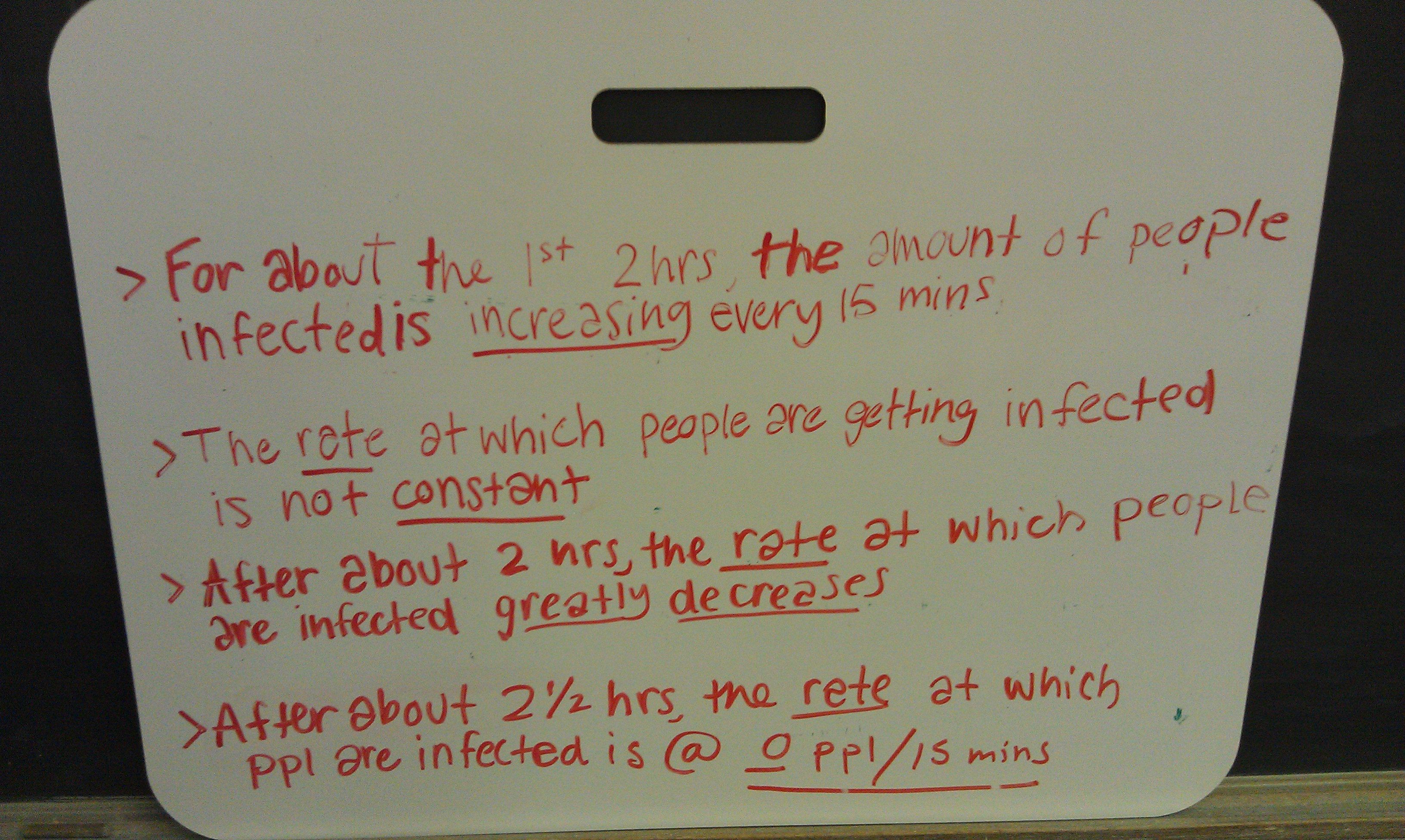
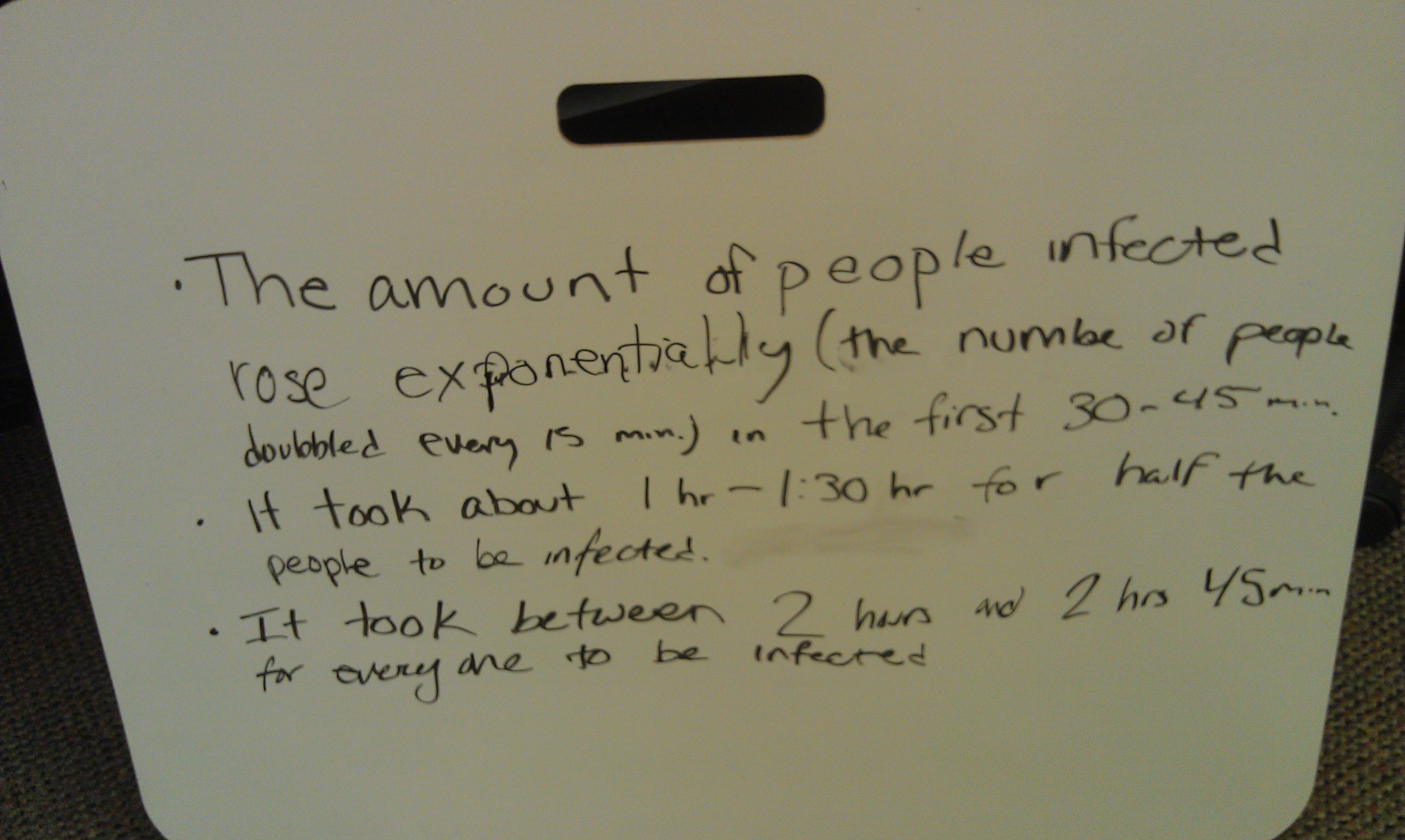
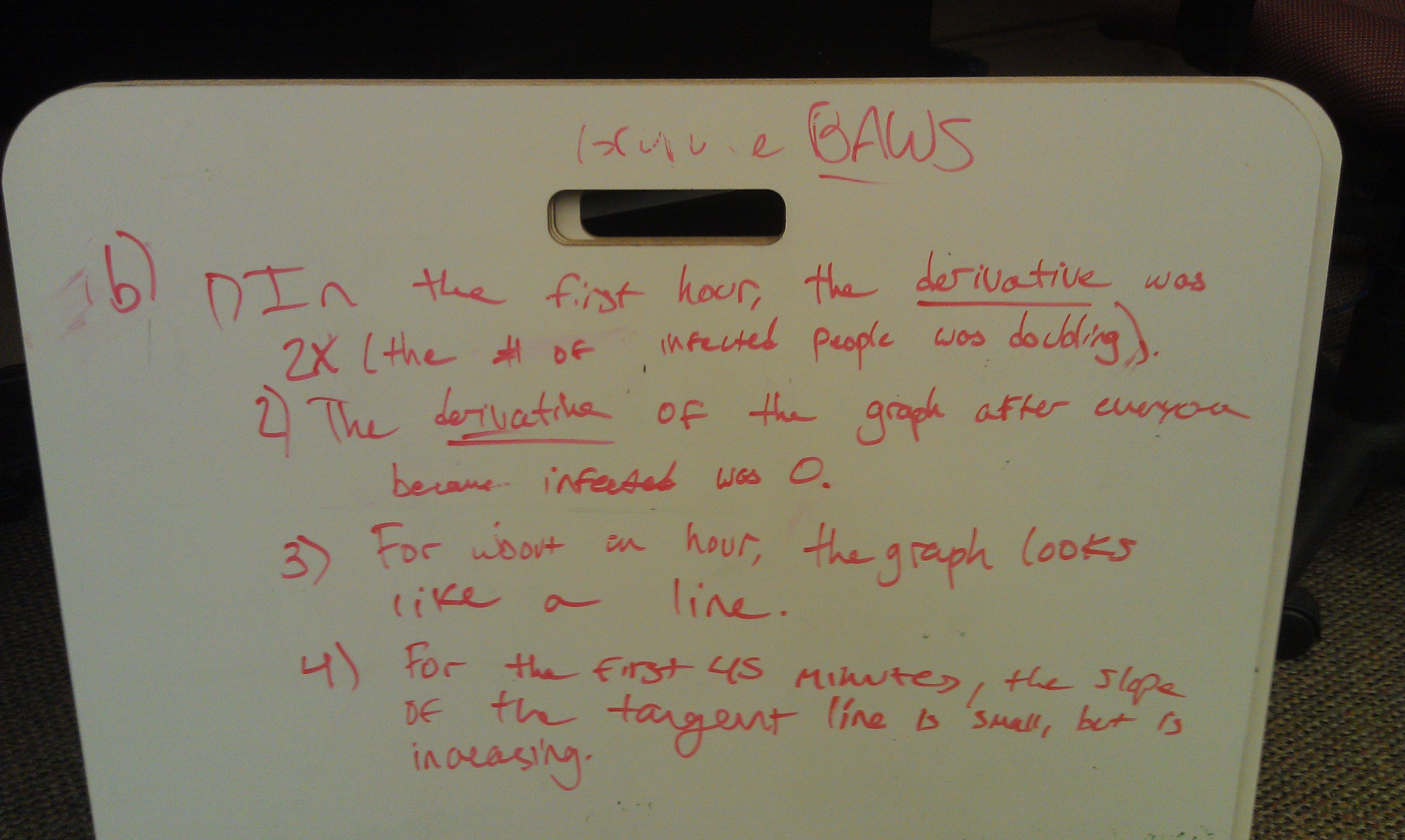
And they had such great observations. Some groups picked up on that change where the function was increasing in one way to increasing a different way. Others talked about how the rate of change (of infected over time) was greatest. Others talked about how the function was “exponential” for the first thing, seemingly linear for the middle third, and “something else” for the last third.

Those gave rise to good short discussions, and we came up with the language for inflection points (which I call INFECTION POINTS!!! GET IT!?!) and concave up/down.

After they had a sense what those words meant, I had students work in partners on the following (.docx):

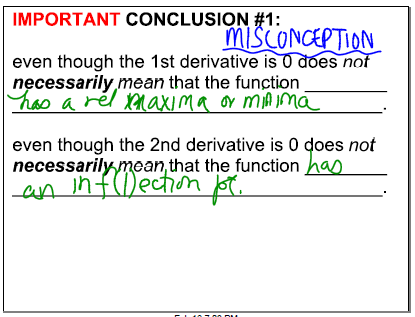
The point was to get students comfortable with the ideas before we delve into the heavy mathematical lifting. It was powerful. Especially the last page, which got students thinking about patterns, exceptions, and ways to generalize. Our big conclusions:

And with that, I’m too exhausted to type more. But that’s the general sense of what went on in an attempt to teach how to use calculus to analyze the shape of a function.

Next Semester

You know my philosophy about blogging… blog only when you want to blog. If you put pressure on yourself, it becomes a chore. And why would I make myself do a chore? More than that, it would be like a chore I created just to make my life harder. Like: every day, make sure you windex the windows to your apartment. (FYI: I have never windexed the windows to my apartment since moving in two and a half years ago.) (That’s what rain is for.) (And curtains.)

However, now that it’s been over a month since I’ve blogged, I wonder what’s going on?

We did have two weeks off, so it’s not like I could blog about school stuff when we didn’t even have school…

True. But that’s me rationalizing. Or how about…

I don’t have time because I’m just so busy…

I think. But this year I’m no busier than previous years. In fact, I might be less busy with school stuff. (However, I should say that I’m making good on my school year motto this year: “I’m doing me.“)

Actually, I think that is the problem. I wonder if I’ve gone stale, like that moldy bread in the back of my fridge? I only think it’s moldy, actually. I keep on putting things in front of it, because I’m scared to take it out, but I don’t want to look at it. It’s like smelling milk that might have gone bad. I don’t do it. I just throw it out, because the mere thought of smelling rancid milk makes me want to puke. Where was I going… oh yes, feeling stale. I’ve grown accustomed to having my SmartBoards that I slaved over years ago, and my worksheets and packets that I created ages ago. I’m tweaking. I’m not inventing. Or really even reinventing. I don’t have much to post because I haven’t been doing a lot of creation. And that’s always when I feel excited about posting. Invigorated about what I’m doing. 

Now that I know this, I have an easy fix. Recreate. Invent. Reinvent. I’m also meeting with my department head on Friday to talk about course assignments for next year, and I’m going to ask to teach a course that will be new for me next year.

With all this mind, I’m going to keep a list (that I will update) with possible ideas/goals for next semester, which will be starting in a little over a week.

  • In Algebra II, remember to do group work, and do more “participation quizzes” during that group work.  I did a bunch in the first quarter, and then the groupwork dropped off in the second quarter. Booooo, me! Keep it going, and strong!
  • In Algebra II, remember to utilize the Park School of Baltimore curriculum, especially when working on Quadratics, Transformations, and Exponential Functions. It didn’t quite fit in with our 2nd quarter material, but it will align with our 3rd and 4th quarters.
  • In Algebra II — since we don’t have a midterm for students to see a broad view and get a review of all the 1st and 2nd quarter’s material — have the 3rd and 4th quarter problem sets include “review problems” from topics from the first semester. Or if not, have review problem assignments, in addition to the problem sets.
  • In Algebra II, do a written “final exam study guide” project again, to continue having kids work on their writing skills. Provide feedback, and an opportunity to do revisions, and fix errors. (Video study guides from years ago, paper study guides more recently.)
  • Create this “pencils and eraser” station for kids who forget pencils.
  • In Calculus, continue having kids work in groups on challenging problems every so often.
  • In Calculus, do problem sets in the 3rd and 4th quarters, but make them shorter and give less class time than the 2nd quarter. Continue to make the problem sets have a “group” component and an “individual” component.
  • In Calculus, consider creating a “reading group” where students are asked to read chapters from books, or watch videos that I find online, dealing with calculus (from Charles Seife’s Zero, from David Foster Wallace’s Everything and More, from … well, I have think of the resources!), and we discuss them every other Friday in the 3rd and 4th quarters. I’m not sure how this would work. The point would be to add a more “cultural” component to the class, and a lot of my kids love reading and learning about tangents. But I don’t know how to make it interesting enough that kids will actually do it. (At my school, kids are so busy that they don’t really do things that won’t impact their grades, and I don’t want grades to be a threat to make kids do this… I need to come up with a way that they will do it because it interests them. One thing that’s buzzing around is having kids do the reading, but if they come to class not having done the reading/viewing the video, they don’t get to participate in the discussion/activity, and they have to do something else that’s calculus related and not busywork, but much more boring than whatever we’re doing.)I don’t know. This is tricky for me, because I don’t have a vision for it yet. That has to be clear to me first: the vision, the purpose, and then how to achieve that comes next. I don’t want to do it just because it “seems cool.” I want kids to buy in. Maybe I give them a choice: book/video club, an independent final project, or regular class?
  • I finally got large whiteboards for my students. I’m struggling to use them. So in the 2nd semester: use them. Even if it doesn’t go well, I need to keep using them. I need to have some practice and experience with them, even if to show me what works and what doesn’t work.
  • Now that we’re starting the 2nd semester, have built in time to review the course expectations, and collaboration guidelines for all of my classes.
  • Consider making changes with my Binder Checks in Algebra II? More frequent? Have kids leave their binders in class, and have time set aside for them to organize themselves? This year their binders are not improving much. It may be that I need to baby them. Some things might include: putting “correct the home enjoyment that we went over today” each day on the course conference (the place where I post the nightly work), having binder checks every two weeks instead of every five weeks (or random “homework correction checks” in addition to the five week binder checks), making test corrections a homework assignment (instead of just telling them they need to have it done by the binder check date), and showing kids how to create their own “checklist” to make sure they have everything in the binder done. I am a little surprised that sophomores and juniors are still finding this so challenging.

Some things I need to do regarding this blog:

  • Blog about problem sets in Calculus and Algebra II
  • Blog (briefly) about the change I made to Standards Based Grading in Calculus (scale is now out of 5). And also how this year is going compared to last year (read: better). And what still feels like it’s missing…
  • Blog about talking about Early Action/Decision with my seniors
  • Blog about achieving my goal from last new year’s… to read 52 books. And how I did it (short answer: I don’t know. It feels kind of miraculous.)
  • Make a new Favorite Tweets (even though I haven’t been on twitter lately so it will be short)
  • Update the Virtual Filing Cabinet

That is all.

Review Activity for Rational Equations

Last year, I did a review game that I got from Sue Van Hattum. I wrote that:

[this game] forces students to ask themselves: what do I know and how confident am I in what I know? (It’s meta-cognitive like that).

I set kids up in pre-chosen pairs, and they are asked to work together. In fact, I gave kids their new seats for the quarter, so this was their introduction to their new seat partner! They then are given a booklet with problems — and each pair is asked to work only on ONE problem at a time. (For those who finish a problem before others, I have alternative problems for them to work on.) When I see almost all pairs are done, I’ll give a one minute warning… Then I ask all students to put their pencils down and pick up a pen. We go over each problem, kids correct their own work, and using the honor system, they figure out how many points they have. (Scoring below.)

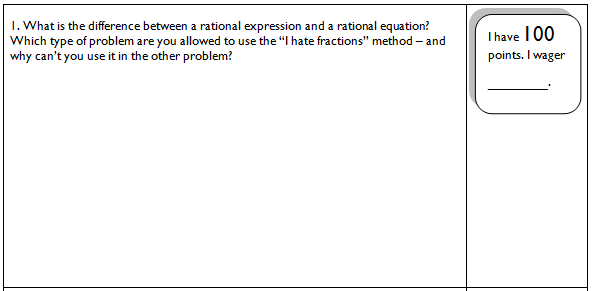
You can see three sample questions from our review game below…

[The .pdf and .doc file of the 6 questions are linked.]

I explained in my last post how scoring worked…

Each group started with 100 points to wager — and they lost the points if they got the question wrong, and the gained the points if they got the question right.

Some possible game trajectories:

100 –> 150 –> 250 –> 490 etc.

100 –> 10 –> 15 –> 30 etc.

Anyway, what was great was that the game really got students engaged and talking. Each student tended to work on the problem individually, and then when they were done, they would compare with their partner.

(If you try this, you have to make sure that students know NOT to skip ahead… everyone is working on one problem at a time. Then you go over the problem, and THEN everyone starts the next problem.)

So there you go… I don’t do reviews a lot, but for rational expressions, rational equations, and circuit problems, I figured we’d need a day to tie things up. And since this is one review I think works amazingly, I figure I’d share it a second time! Thanks Sue!

Compiling A List Of Posts

Hi all,

I need some help, if you have a few minutes. I am looking for some quality blog posts and/or websites which offer the following:

Stories from the Front: On the ground experiences of teachers teaching problem solving in the math… the good, the bad, the ugly

War Strategies:  Different ways teachers actually do problem solving in the classroom, and maybe some hints/tips/technqiues (e.g. whiteboarding, Moore Method, Harkness Table, problem sets, grouping ideas, hint tokens, etc.)

Weapons:  Good websites (or books) which contain good math problem solving problems (e.g. Exeter problem sets, AMC questions, etc.). My personal thought on questions is that they don’t need to be hard to be problem solving… In fact, the harder the problems are, the less accessible and fun the problem solving will be, and the more my kids will be turned off.

What I’m not really looking for is Polya’s How To Solve It, which is great reading but lacks in the day-to-day practicality and concreteness I’m looking for. I don’t need to know what problem solving is (like Potter Stewart, I know it when I see it), or read philosophical exhortations about how important it is in promoting meaningful and deep learning. I want practicality. Stories, resources, tips, etc.

If I get some responses in the comments, I will compile them into either a comprehensive post, or if there are a lot, I’ll make a new page (a la the Virtual Filing Cabinet) for it.

The reason behind this is selfish, but I’m hoping the output could be collectively useful. My department is thinking seriously about how to integrate problem solving into our curricula… and I wanted to show them: “hey, there are a ton of good ideas from teachers who do it!”

So if you could help a teacher out…

PS. Not to make you jealous, but yesterday I designed and ordered these buttons! (You have to recognize I don’t know what I’m doing with Photoshop, so the pictures aren’t all that great. And these buttons have a large bleed area, so the text will actually be just near the outer rim of the button instead of with all that blank space between the text and the outside of the pin.)