General Ideas for the Classroom

How Much and How Little: Exit Slips

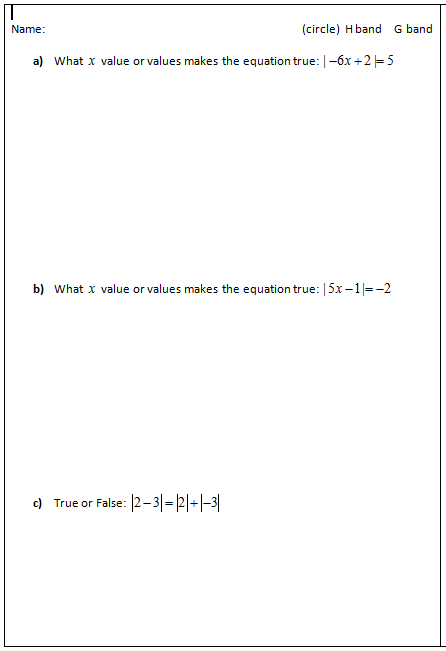
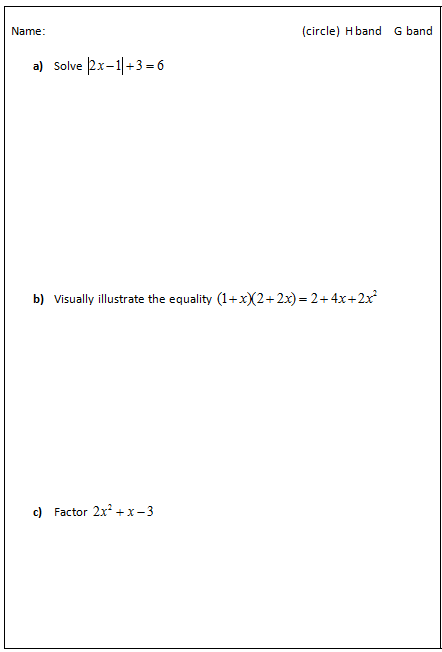
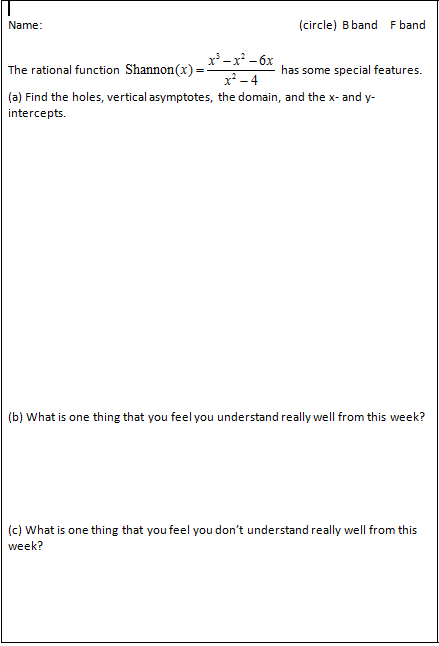
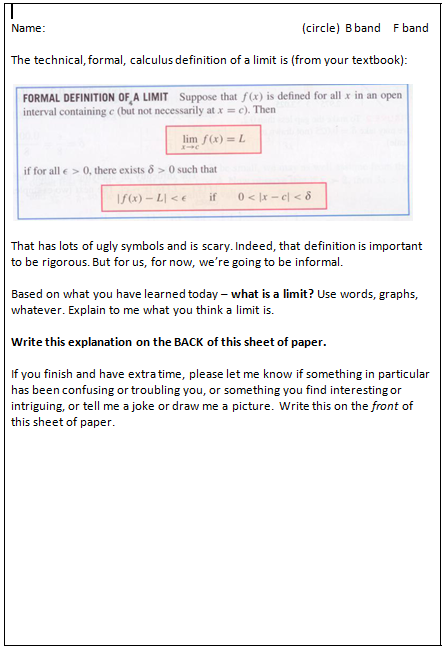
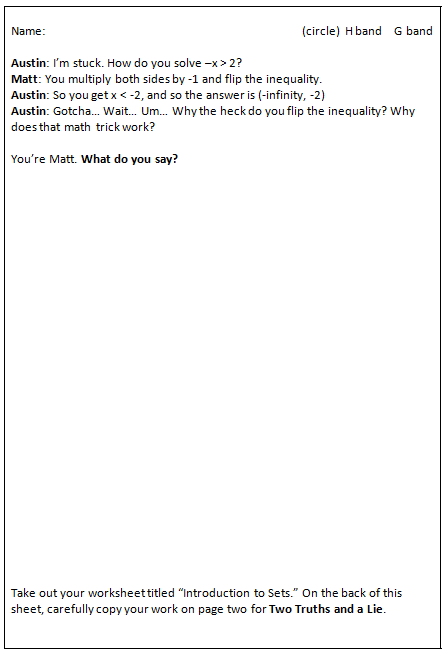
This year I’ve been trying to use “exit slips” at least once a week in my classes. They’re to let me know whatever I want to know. Do my kids have any questions? Did they take away what I hoped they’d take away from class? Can they actually solve a problem we were supposed to have mastered a couple days ago?

What they’ve really done for me is highlighted how little my kids learn — especially my tenth and eleventh graders — in class. And how much more time I need to build into my plans to have them practice problems and ask each other questions and, well, basically go through that time to struggle in front of me. Of course where that time will come from, I don’t know. But I need to find it.

But I’m amazed and horrified that I have never done this before. It’s the most eye-opening thing to be able to know exactly what your kids can do. And even when I felt like I did a bang up job in a class, and I thought my kids were getting it from walking around and watching them work, how there were a good number that didn’t. A good number that I wouldn’t be aware of before the summative assessment.

Anyway, I thought I’d share with you the exit slips I’ve used in my Algebra II and Calc classes. I repeat to my students that these aren’t a test in any way. They’re for ME to know what they’re understanding and what they’re not so I can better help them. And they’re for THEM to get a sense of how well they understand stuff we’ve done in class, so they know if they’re on top of the material or not. Plus I get to identify and address misconceptions, and also bad notation!

Without further ado:

Algebra II

Calculus

If you use exit slips, or something similar in your class, please throw down any tips you might have for what works for you — what kinds of questions you put on there, what are the types of questions to avoid, what specifically and concretely do you do with the information once you’ve gathered it, etc.?

And So It Begins…

The year in full swing, and it feels like I’ve been teaching for days upon days, even though it has only been two days, so I suppose I should have said “day upon day.” It shocks me (BZZZ!) that a person can go from lazing about, jaunting off for coffee, picking up a book and reading it through in a day, watching an entire season of real housewives of (insertanycityhereandit’sprollytrueforme), going to the restroom whenever you please… to being trapped in a building (no AC!) with a hierarchy, having to answer to a lot of someone elses, having inhaled and not having the opportunity to exhale until hours later. And then you remember: oh yeah, I have to plan for the next day.

So it’s like I’ve never left. And I love it. There are things I cringe at, but heck if seeing my kids and my colleague friends, and getting to think about how I can do what I do but less sucky: it’s thrilling. I suspect this glow will be gone in a week, so don’t worry: my normal self will return soon enough.

Glow Self:

I just wanted to talk about the first two days of Algebra II. I usually start out the year with a honest but (upon reflection when I looked at it a few days ago) boring exhortation about mathematics and why it’s useful, beautiful, interesting. Then I talk a bit about the course expectations. And then we jump straight into talking about sets. I did it this way because I wanted to dive right in and show them what I valued: doing math. This wasn’t going to be a class where we get derailed with non-math things.

Well, I was unsatisfied with that, because it was boring. A boring set of slides with me speaking (albeit with a wildly inflecting voice, which can make anything less boring), followed by possibly the most boring topic: union and intersection of sets. It also was me lecturing about sets.

This year I vowed to take risks in how I teach. Less lecturing. Less partner work. More group work. More deep thinking and problem solving. And since I made a post saying some of the things I wanted to try, I decided to scrap everything and start anew.

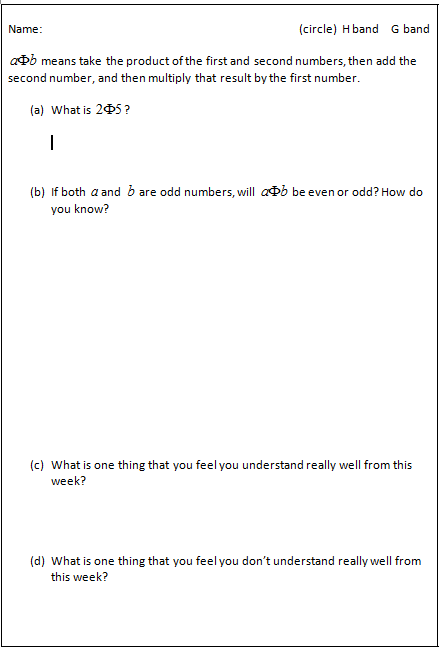
I looked through the Park School of Baltimore’s curriculum and found a perfect thing to transition us into sets: mathematical symbols.

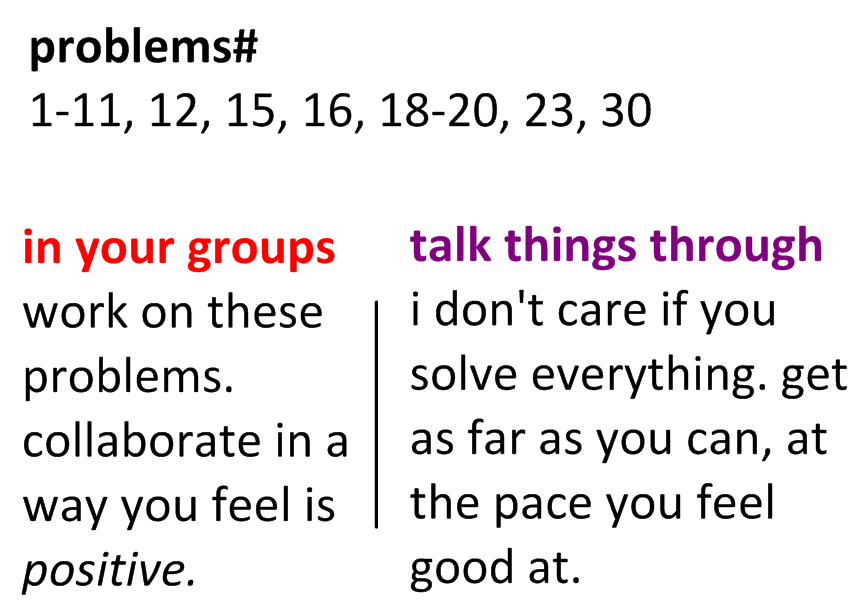
So on the first day, I sat kids down in their seats, I explained how they were to move their chairs to get in their groups. I asked them how they were feeling, I told them my goal was to make them feel good about math. Then, suddenly, I asked students to get in their groups. I projected the first page of the Park School packet that I photocopied. We did one part of one problem together (I had kids read the problem aloud and work in their groups to come up with the answer). Then I set them free, after handing out the packet, with only the following instructions.

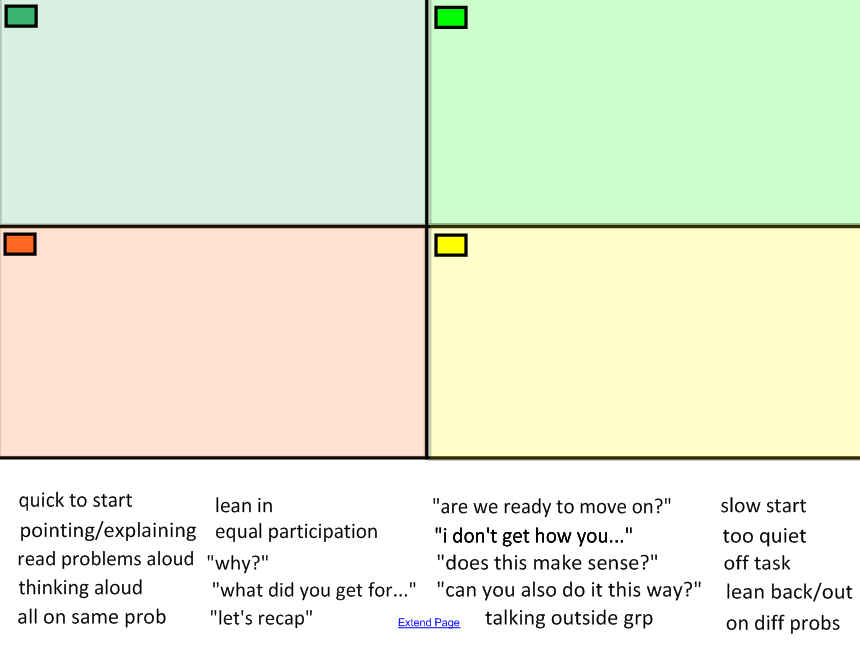
Then they started (some faster than others) and I went to the following SmartBoard page [update: here if you want to download it]…

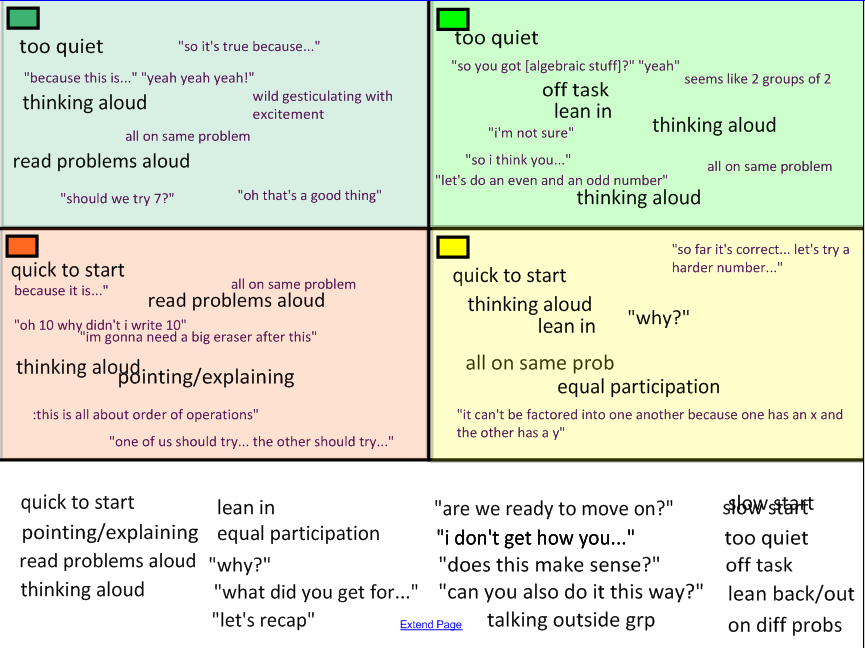
… and started the participation quiz (what I’m calling “groupwork feedback”). [To understand what comes next, you have to read the link above.] I didn’t explain anything. I just typed and dragged and typed and typed and walked around. Kids would ask me questions, and I would just shrug. They stopped asking me questions and started relying on each other and their brains. I didn’t stop groups which were off task. One group of four broke up into two groups of two, and then rejoined. I just kept on filling in the grid, not talking about it.

Honestly, the idea that I would have to be filling in this grid scared me. I didn’t know if I was going to be able to do it. I didn’t know if I would have the heart to put “off task” if a group were off task. I didn’t know if I could keep up, or if I could hear the kids talking, or keep track of everything. But it was easier than I thought. Students worked for about 30 minutes. I think that’s the right amount of time, because I wouldn’t have gotten a critical mass of feedback if they had worked any less.

Then I stopped them. What I noticed after doing it in two classes is that engaging in this type of observations of groups is super interesting and helpful for me. I had a good sense of which groups knew how to do groupwork already and which groups didn’t. I heard some great conversations, really great conversations, about some rich problems (“does it mean that the only way to get an odd number is with …”). I saw group dynamics at work (especially the difficulties that present themselves with groups of 4). I also saw that one of my two classes already has a good handle on how to work in groups, and the other is going to need some time and coaching.

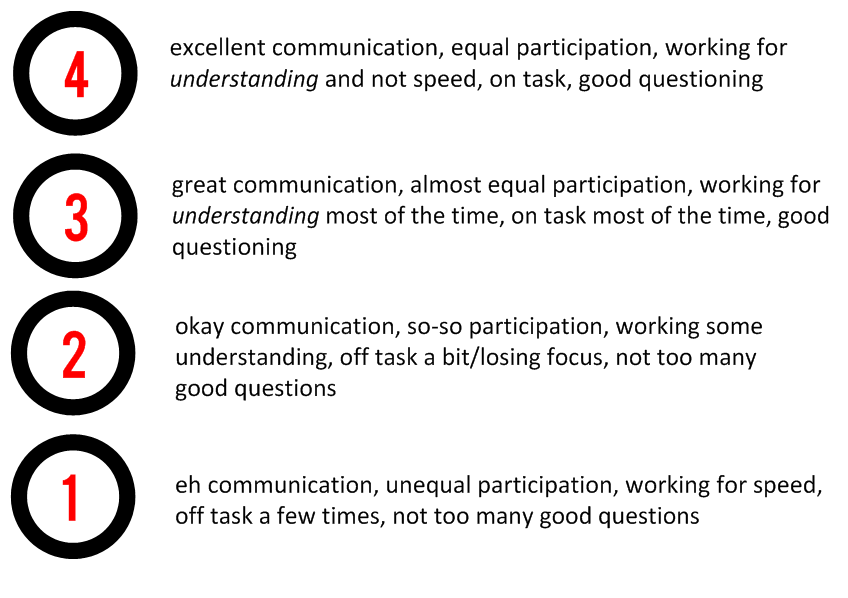
We spent 12 minutes talking about the results. We talked about if “I don’t know” is a good or bad thing to have on that chart (it depends…) and finally I asked groups to look at this thing that I whipped up (not great, but I needed something) and to classify themselves, and to think of some ways they could improve and think of some things they did well. And we went around and had each group explain.

Although terrifying, I’m glad I did it on the first day. It was scary to try something new (new problems! groupwork feedback!). I feel confident that I showed my kids what I hope to value in the classroom this year. Communication. True thinking. Independence. Collaboration in the learning process. (I don’t see the last two things as contradictory.)

That was the first day. Today (the second day) I saw only one of my classes. And what I did in it didn’t unfold nearly as well, in my opinion. I wanted kids to present their solutions. The night before I had them do a few more problems on their own, so I gave groups 8 minutes at the start of class to talk through their work, telling ’em that they were going to be asked to explain.

Then I had individual students come up and explain their work for some of the problems (after a short discussion on how it’s great to not get something and to have misconceptions / confusions, because that’s where we learn, and a discussion on how to be a good audience for the explainers).

They put their work up under the document projector. And talked. But what I learned is: I need to work on having students be effective presenters. And how to encourage the audience engage with the presenters more. And how to balance me intervening versus letting the student go on. (It’s hard for me to let go of the “explain” part of class.) So now I know I have to work on this. (Luckily I was meeting with my teacher friend mentor for lunch, who does a lot of modeling work in her classroom, and she had a lot of good things to suggest. )

So there we are. I’m trying to be very intentional (thanks @bowmanimal for the word) in how I start the year. I also printed out “exit slips” for my classes tomorrow because my goal is to get formative feedback at least once a week in each class. And I tried to do “What’s the Question?” (known in my class as “Que es la Pregunta?”) in Calculus to activate prior knowledge on rational functions. However it kinda totally fell flat. It did what it should have, but it wasn’t as enjoyable/fun as I hoped. I think I might need to rethink how I set it up.

And there you are. Some words on the first couple days of school.

The Clock, Counting Down

It’s Monday night and the first day of classes is Wednesday. I am teaching only two preps this year — the first time since I started teaching! I have a couple Algebra II classes and a couple Calculus classes. Also for the first time ever, I’m in a single classroom for all of my classes. It’s not a pretty classroom, really, and it is one of two rooms in the entire school with chalkboards (ugh! chalk!), but it’s mine! And I share it with another math teacher. So go me.

The past few days have gotten me to school, doing lots of logistical things. Like making minor revisions to my course expectations (here they are from two years ago, and not too much has changed) and my calculus SBG rubric (a 5-point scale, now, taken almost wholesale from @cheesemonkeysf), and photocopying them.

I made a few small changes to how I’m grading in calculus: now 80% of a student’s grade will be their SBG score, and 20% will be projects/problem sets/groupwork. Basically it’s an “other” category which will involve synthesis, problem solving, and less-routine-thinking. Although 20% might not seem like too much, I don’t have all these things lined up (I do plan on doing a lot of Bowman’s activities tho!), and I didn’t want to overwhelm myself this year by having to create all this new stuff. After much deliberation I decided not to grade homework, even though students last year clamored for it in their evaluations.

In Algebra II, the grading will be pretty much the same as in previous years, except we are integrating problem sets into the mix. So we are having 70% formal assessments, 10% binder checks, 10% home enjoyment (“homework”), and 10% problem sets. More about the problem sets as they develop, but I think they’re going to be heavily related to the habits of mind work that the Park School of Baltimore engages in. I honestly think that when their curriculum is finally published (I’ve gotten to see a bunch of it), it’s going to change how so many of us teach.

I figure I’d share a few concrete things I plan on doing throughout the year, with my emphasis on formative feedback, growth mindset, and habits of mind.

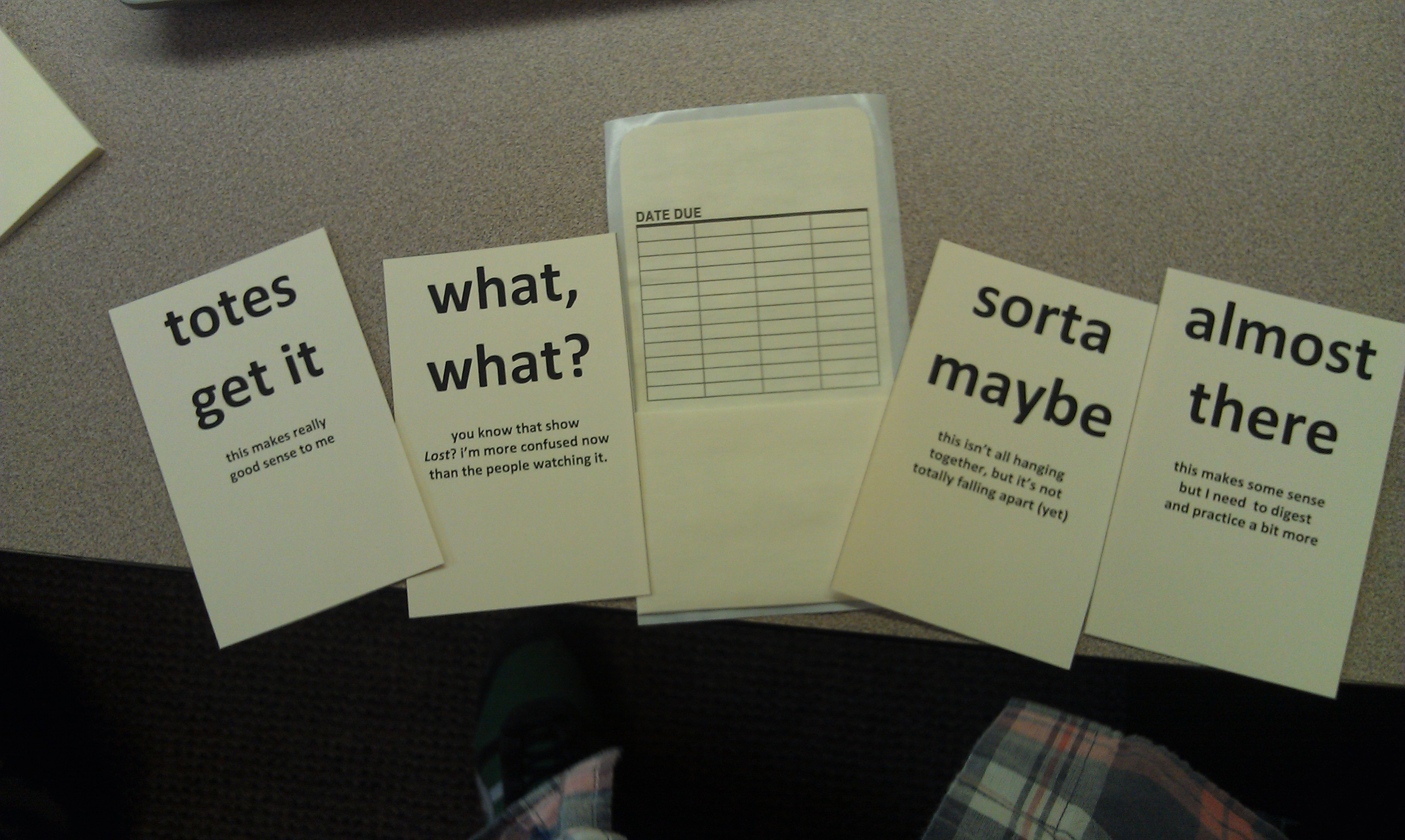
(1) To gauge where students are at, I created these pretty cards which I will use to get feedback and how kids are feeling about the material. So after maybe I have them do a sample problem, or do a think-pair-share, I’ll have ’em throw up a card to lemme know where they’re at — and from that I’ll know whether to move on, whether to switch partners for the remainder of the class (pairing someone who gets it with someone who doesn’t), or something else.

(2) But it would be crazy to have these cards, and not make them even more useful.

So these are the backs of the same cards. And so I can throw up a multiple choice question on the board, and have kids hold up their answers. Or anything that involves choices. If you’re going to do this, just know you shouldn’t write As on the backs of all the “totes get it” and Bs on the backs of all the “almost there” etc., because you don’t want anyone influenced by what other’s have up.

And yes, these were partially inspired by the fantastical Kate Nowak, and I’m really excited about them.

(3) @mythagon has an amazing way to get kids to start talking at the start of class: what’s the question? I can see it being really fun, get kids talking, and amazing for activating prior knowledge. I’m so doing this.

(4) Kate Nowak trying to instigate fights in her classroom by using good questions. I am going to try to instigate fights! FIIIIIIGGGGHHTTT!

(5) I have miniwhiteboards, but I’ve never really used them except occasionally and poorly in my seventh grade class in my first year of teaching. I want to use them, but want your advice on things that work. I was going to have kids do “check yo’self before you wreck yo’self” questions (math questions directly related to something we covered in class, right after we cover it in class) on them — and hold them up and I can walk around and see where we’re at. But there’s gotta be more and better uses.

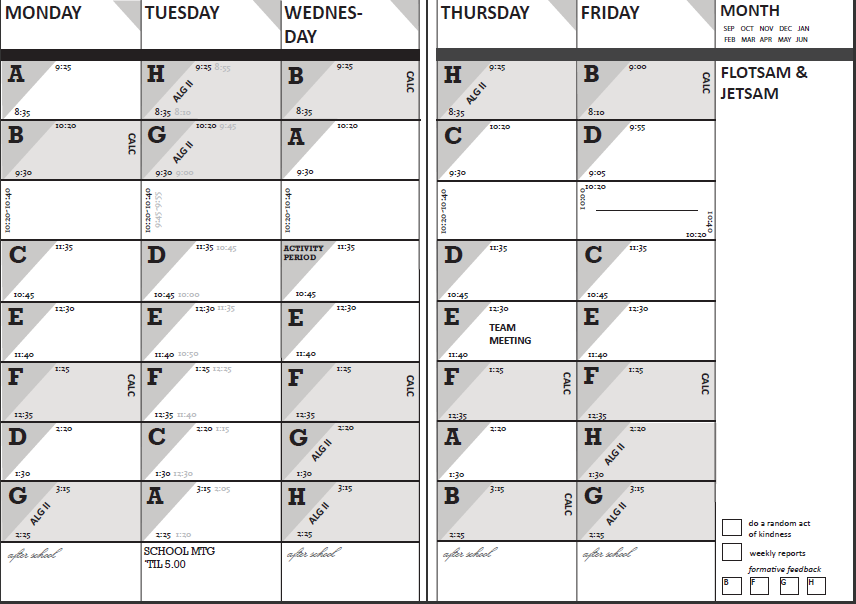
(6) I designed my planner (as I do every year) (and yes it’s beautiful and coveted by many)… and this year because of my emphasis on formative feedback, I made a small checkbox at the bottom which will help me see if at least once a week I either gave kids feedback (non-graded), or if I got (non-graded) feedback from my kids to help see where we go next.

(7) I hope to use exit slips this year at least once a week, either to check my kids’ understanding of the material we’ve been learning or to check in on my teaching. One idea I had was to have a coordinate plane, where the x-axis goes from booooring to engaging and the y-axis goes from no idea what’s going on to this is all coming up roses, and having kids mark down where they are.

(8) I historically tend not to do a lot of group work. Mainly partner work. This year I’m going to try to get more voices into the mix, and have students do things in 3s and 4s occasionally. But kids don’t know how to work in groups, and what it means to be working together effectively. And that’s because they’re not really taught. Which is why I love the idea of participation quizzes.

(9) I hope to put up a short agenda and a goal or two for the day, on the board, everyday. Where we go and what we do shouldn’t be a mystery. I always think it should — we’re unfurling mathematics, and in the unfurling we get the beauty — but that’s not how someone learning the material thinks or how they can organize information. They want a destination and to know how we’re getting there. I get that. When I’m in a class, I want that. I only want things unfurling in very special cases.

That’s about all I got for ya now. More to come as the year gets underway.

“Sticky” Notes

This past week, I attended a less-than-inspiring AP conference for AP Calc, as I am teaching the course for the first time come September. Though some parts were helpful, the presenter spent almost all of the 8 hours every day just lecturing about Calculus and going through mediocre worksheets with us. He was a perfectly warm and friendly guy, but he was also sloppy, disorganized and often slightly incorrect, not to mention not creative at all. I was pretty disappointed. [Disclaimer: People have given me far better reviews about AP conferences in the past… I think it depends on the presenter organizing].

But, while watching the Calculus curriculum being presented methodically on the board (without any distractions because my wireless wasn’t working), I was struck by how confusing it must be to stare up at a mess of disorganized mathematical notation. I decided to brainstorm ways to improve the taking-notes-from-the-board aspect of my own course – to make my notes more “sticky” in my students mind and to make them more useful for the problem solving. We can all inspire some day to have a completely student centered, inquiry based, problem solving classroom, but even in those there is certainly room for (and a need for) teacher directed instruction… and that can always get better too.

Inspired by Square Root of Negative One Teach Math’s loop to convert logs to exponents to logs and Sam’s Riemann Sum setup, I tried to think of ways to use visual ways to connect conceptual math with notation (which is probably the biggest hangup with my students), to basically create a sort of intermediate form to help make the abstraction make more sense. Here are a few ideas I had… keep in mind I haven’t tried any of these with my students.

1. A Beefier Number Line for Graph Sketching

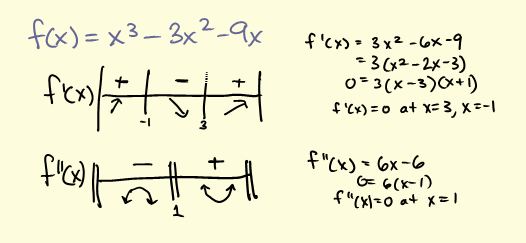
Problem: One of the things I noticed this past year is that my students would dutifully make number lines to test the derivatives but would sometimes totally forget what they were doing in the process. Also, many would mix up the first and second derivative.
Solution: Have the students immediately interpret their results with visual indications of increasing/decreasing and concave up/concave down. Make the separations on the second derivative number line be double lines instead of one to reflect the double prime part of the second derivative notation.

2. A Point-Slope Picture for Point-Slope Form

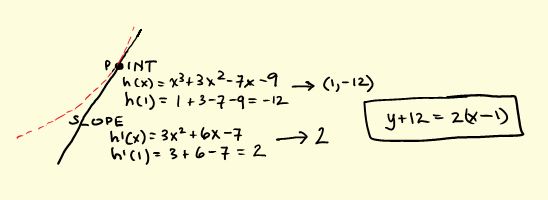
Problem: Anytime there are multi-step problems, many students either try to memorize algorithms or get completely overwhelmed calculating one thing that they lose other parts in their work.
Solution: Draw a picture of a tangent line and let the point be the O in POINT and the line be part of the L in slope. Then, finding these two items gets you everything you need to find the tangent line. Maybe arranging them vertically and carrying the final part of each step out to the side might keep students more organized. The bonus is that this is a picture that fits with the math and not just a forced acronym.

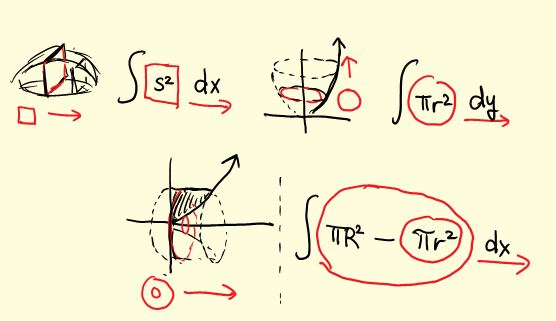
3. Enhancing Volume Integrals With Pictures of Cross Sections

Problem: The hardest part of figuring out the volume of solids is setting up the integral. Students have trouble figuring out what area equation to integrate and then which variable to use when integrating (i.e. which way to go).
Solution: Draw the cross-section near the solid and an arrow in the direction in which you are accumulating cross sections (or on the problem words if you skip the picture). Then draw the same shape next to the integral sign and an arrow. Inside the shape of the integral write the area equation as you would see it in geometry, and above the arrow write a d-whichever-way-the-other-arrow-goes. Then replace the area equation with something else that is in terms of the whatever in d-whatever. Works for the disk and washer methods in volumes of revolution too.

Okay, so maybe those aren’t all THAT helpful, but I personally prefer thinking about small changes when I have so much on my mind about the school year. Though these are obviously not replacements for deeper understanding, maybe they could be crutches to help students go from something that might make sense to them to the abstraction of notation. Main point: I’m going to pledge to sit down and try to think about how to make notes more “sticky” before every unit.

from @bowmanimal

Participation Quizzes

I am going to be doing a lot more intentional group work next year with my classes. I’m definitely envisioning this for my Algebra II classes, and if I can come up with some good materials, for my Calculus classes too.

Today at PCMI, I was introduced to a way to do groupwork well. I am dismayed that I haven’t seen this before, because in some ways, it’s so obvious that I don’t know why it hasn’t made the rounds into my brain. I need to type it out here to codify it in my brain.

It’s called a “Participation Quiz.

What I’m going to do is describe the video we watched of a teacher implementing it.
The teacher has students sitting in groups of 4. She introduces a worksheet she created to help students multiply binomials, but with some positive and some negative constants — because she saw that it was tough for her kids to deal with negative numbers when multiplying binomials. She had everyone’s attention on her, at the front of the room, and she says “today will be a participation quiz.” She then lays out her classroom norms for groupwork, some of which included:

  1. Everyone in the group must participate equally. There isn’t a leader, or the same person leading the show. The voices are shared.
  2. Students should not work too quickly. If they work simply to finish the sheet, without any other consideration, they aren’t doing it right.
  3. No one moves on until everyone understands. This isn’t about everyone having the same thing written down — but everyone has to know why.
  4. Students should think out loud. Students should check in with each other. Students should ask questions of one another.

She then let’s them get started.

As the groups work, she is both circulating, and sometimes at her laptop. When she is at her laptop, she is taking notes on each group — and displaying her notes on her smartboard live. Initially, her smartboard has group names (“purple group” “red group” …) written on there. It also has some specific actions which can be copied/pasted under each group, if they occur. Examples are:

negative actions: too quiet, talking outside group, off task, texting, different problems [students in the group are on different problems, not on the same problem]

good phrases: “I don’t get how you…”, “What did you get for…?”, “Can you also do it this way…?” “How did you…?” “Are we ready to move on…”

good actions: quick start [group started right away], reading directions out loud, same problem [everyone in the group is on the same problem], pointing and explaining, WHY???, BECAUSE!!!, calling group members out, all heads in, checking calculations/work, thinking out loud, equal participation.

Notice that these are specific things the teacher is listening for and looking for. They are actions — body language, speaking, interactions, etc.

The teacher watches and listens as she walks around or is at her computer. If she noticed any of the actions/phrases/comments, she typed them in her computer under the group name. It appears automatically on the SmartBoard for all to see.
At one point, one of the groups wasn’t working together. The teacher sat down and re-explained what the participation quiz to them, and even said “I’d rather you all work together and be stuck on one problem the entire class. This is about working together and coming to a shared understanding.” She then started getting them talking to each other, and then left.

The teacher also didn’t only copy and paste from the pre-written list on the SmartBoard, but also transcribed specific phrases/actions: everyone trying combos,  oh right, you’re multiplying” “would it be -21?” “so you mult… and…” “I got… that’s because…” “what do you think about that?”

At the end, her SmartBoard was full — a bit messy, but full. She did not shy away from writing the negative comments too. One group had “off task” written 3 times! What’s nice is that the teacher had a mathematical learning goal, but the lens through which she viewed the class (and the lens through which she had students view the class) was about classroom participation/engagement/teamwork. The two aren’t divorced.

She recapped the mathematical goal, but then she talked briefly about what she observed. She asked them questions about her SmartBoard. Under one group, her note said “I don’t know what to do after this?” and then she asked the class if that was a good or bad interaction. Most of the class said “bad” but through discussion she got them to realize it was good! That by saying that, someone is going to help that student, and the student may soon understand something. Through this process, she started clarifying the group norms for teamwork.

Fin.

There are so many amazing things about this. For me, this sort of activity, done a lot at the beginning of the year, is a concrete way to provide meaningful feedback for kids when talking about something as vague and “in the air” as participation. It builds the expectations for the rest of the year. It generates good conversations about what good groupwork is, and why. It provides the teacher a tool to get students to talk mathematically, and provide feedback. (Carol, one of the PCMI organizers, told me she will sometimes told me that sometimes she will do this and tell her kids she will only be looking for students justifying mathematics and those are the only notes she puts on the board.)

I don’t know if the teacher in the video actually assigned grades to each group. I think that’s something we’re going to be discussing in our groups tomorrow. But at the very least, it’s a really powerful way to spend 50 minutes on a mathematical goal while you are inculcating your class with a more “hidden curriculum” goal too.

I also think that a class, collectively generating groupwork norms (and the teacher adding missing but important ideas) could be a powerful exercise before engaging in this activity the first time. And using those norms as the lens to which to watch and critique students.
Random Ideas Gathered from the Klingon Math Curriculum Group

I also wanted to archive the random ideas I gathered from the Klingons, before they got lost in the ether:

  • Keep a physical toolbox somewhere in the room. And when kids are stuck, make a dramatic point of walking to the toolbox, taking it out, and loudly plopping it on the desk. “What tools are in our toolbox?”
  • Bring a construction helmet to class. When you need to get things settled and move on, put it on. “This is a work zone, people, a work zone.”
  • Play “Math Taboo” where you have kids evidence their understanding of concepts. Have notecards with things like “Coordinate plane” and have them try to explain to their team what it is, but without using other words on the card, like “x-axis” “y-axis” “graph” etc.
  • Ask a lot of what if questions. So, if you are in geometry and have covered that triangles have 180 degrees, ask: “What if we didn’t have a triangle, but a quadrilateral or pentagon? Would this still work? How many degrees do those have?” (This is very much under Polya’s art of problem solving philosophy.)
  • On the top of every homework page, students need to write a list of problems they had difficulty with and circle it. If they didn’t have any difficulties, they can write the null set and circle that. On that vein, don’t put up the solutions to the homework problems that weren’t from the book (or the even ones from the book) until 2 minutes into class. Students need to be talking with their partner and comparing answers and asking questions first. Then halfway through “homework check time” project answers. (This is only for classes where you check homework.)
  • Have practice tests (call them “scrimmage quizzes”) before tests, asking students to solve problems to assess their own understanding. But do NOT make them exactly like the summative assessment. They need to learn how to do problems without having the numbers be slightly changed. But make sure they cover the same ideas / understandings.
  • When you’re in a zany mood, use phonetic punctuation (http://www.youtube.com/watch?v=lF4qii8S3gw). You know, just for fun.
  • Have the class, at the start of the year, come up with a collective list of classroom norms. Make sure to refer back to that list throughout the year, and enforce it. These norms should be enacted each and every day. And students have ownership on them. (Add to the norms too, when need be.) Frame the norms positively. Also, collectively make a list of attitudes shared by good math students (e.g. tenacity, willingness to ask questions, etc.) and refer to those.
  • Change language. Don’t call problems “problems” but “challenges.” Don’t call tests “tests” but “celebrations of learning.” Don’t write the number of points off, write the number of points earned.
  • When students are asked to show their work to the class, don’t tell them to “show their work” or “show their solution.” Tell them to “teach the problem.”
  • If a student shows up late, say to them “I’m so glad you’re here. Thanks for joining. We value your thoughts.”
  • Keep a stack of postcards/little notes in your desk drawer. If a teacher does something really nice, or well, write a short note to the teacher telling “I appreciate…” and leave it in their mailbox.
Throw in other things below, if you want!

Senior Letter 2010-2011

Today was the last day of classes for the seniors. I had a fun day planned, where we spent most of the time laughing. I love laughing with these kids. This year has been a great year with the seniors and I’m still in the pnumbra of their glow. As it was the last day of class, I gave out my senior letters. (By the way, I love that @sarcasymptote is doing it too! I love that his kids cherish his letter, which is heartfelt and heartwarming. I don’t know if any of my kids cherish their letters in the same way his kids do — no one has ever mentioned them to me again — but I write it for me, not them.)

Now that I have handed them out, I can share with you this year’s letter. The message is always the same, every year, because when I think of what’s most important I can’t come up with anything more important: knowledge is awesome.

PS. I’m always super critical and I wrote and rewrote this dang thing like 4 times. And I’m still not totally happy with it. But it’s good enough for me, for now.