One of the kids I help after school showed me this drawing that his teacher showed him. After seeing him draw it in front of me, I know I will never forget the relationship between Gallons, Quarts, Pints, and Cups ever again.
I have a question about multivariable calculus, that I need some help with. My kids and I are both slightly stumped about this.
The question we are asked — in a section thrillingly titled, replete with semicolon, “Parametric Surfaces; Surface Area” — is to find the surface area of “The portion of the sphere between the planes and .”
In class, the formula we derived for surface area for any parametric surface is
.
We solved this by converting the (top part) of the sphere to a parametric surface:
Then we defined (where ranged between and and ranged between and . (Those limits for come from the fact that we want the surface area of the sphere between and — which correspond to and respectively.) [1]
So I calculate and .
So to use our surface area formula above, we need to find . Calculating that out, we get it to equal . Phew, now we have something we can plug into the surface area formula for that “norm of the cross product” thingie.
Here’s where the question comes in. We know
.
Why is it that when we finally evaluate this beast, is not equal to our normal area element for polar, namely ? For the answer to come out right, we need to let equal to simply .
WHY? Why don’t we plug in the normal polar area element?
Here’s my thinking. Even though we usually use to represent an area element, in this particular surface area formula, it doesn’t represent anything more than (for whatever parametrization gets made). The reason I think this? When I look at the derivation of the formula, it defines to be . Simple as that.
I used to think that had a fixed meaning: the area element in a particular coordinate system. However, I’m now thinking that it might mean different things in different equations? Either that or our book is being sloppy.
If anyone can follow what I’ve written here and has any help to proffer, I would be much obliged. It’s a small point — one that won’t really matter in the long run for this course — but both my kids and I would like to have this resolved once and for all.
[1] If you don’t see that, imagine you have this sphere and you make a slice at and another slice at . You want the surface area of that little curved “ring” — and if you find the shadow of that ring on the plane, you’ll get two concentric circles with radius and . That’s the region that you will be integrating over.
Sometimes it isn’t that we are bad teachers. And it isn’t that we aren’t giving students the lessons they need. It is that students aren’t willing to shore up their knowledge each night to make sure they know what they know, and figure out how to learn what they don’t know.
So I try to aperiodically remind them of that fact.
Yesterday, for example, I hinted to my students that they might have a pop quiz. We’ve been working on quadratics, and have seen questions like:
Solve
and
Graph
and the latest feather in our caps
Solve
It’s a lot. And quadratic inequalities killed my kids last year. So I told my students to spend the night just reviewing the material and making sure that they can organize the information in their heads. They come to class today and I give them a two question pop quiz, both questions on quadratic inequalities. 6 minutes. Most are frantic. Clearly many didn’t shore up their knowledge.
I then tell them to stop and put their pencils down. I tell them it wasn’t for a grade. I tell them I’m not collecting it. They breathe a sign of relief. We then had a conversation.
What was hard about the pop quiz?
Did you think you knew the material?
Did taking this quiz demonstrate that? Or did it tell you something else?
So here’s something for you to consider doing, if you’re cruel like me: a very occasional fake pop quizzes can be a nice conversation starter about studying and nightly responsibility.
UPDATE: So in this case, the faux pop-quiz was only moderately successful. Last year so many kids didn’t know what to do on the 1D quadratic inequalities question on the final unit assessment. This year they were less were confused. But still there were enough students who didn’t know how to solve it to give me pause. I realize now that we learned so many different types of linear/quadratic things that students kept confusing “what’s the question asking?” and “how do I solve that kind of problem?” So I need to come up with a way to emphasize at each point of the unit these two fundamental questions. And maybe designing a short activity where students are forced to answer those questions.
I did this a while ago — posted my favorite tweet conversations from days past. Favorite, for me at the moment, doesn’t really mean “advice on teaching” but just random convos. The best kind.
I had a very realistic teacher nightmare last night. Not realistic in the sense that it could happen to me. But realistic in the sense that it was one of those vivid dreams where you feel emotion when having it.
The day of the final comes and it is in a strange building for some reason. Before the exam, I am on the phone with my mother talking about something important. Taxes, maybe. Then as the final exam hour approaches, I take my leave from my mother and go to the classroom and see my children milling about. I look for the exams but they are not in my bag.
Wait!
I forgot to photocopy them!
I start getting really flustered. Really flustered. This was a dream where I felt emotion, and I was literally freaking out. This is so unlike me. [1] I don’t know what to do. So I open my computer to print out a copy, and realized I never finished writing the exam.
I didn’t even have an exam!
What’s on my computer is a document with a test that I got from somewhere, but I meant to modify to fit my class and I didn’t. I couldn’t give that to my class. I look at last year’s final, and it covers totally different material for some reason.
I go to this teacher’s lounge, literally paralyzed because I don’t know what to do. I’m frantically seeing if I have time to fix up the final, but I realize I don’t. I keep thinking about my kids in the classroom wondering what’s going on. I keep trying to figure out what to do. But my mind is stuck at this point and isn’t working. I’m mentally paralyzed, stuck in my own special world of freak-out.
I continue to frantically try to fix things, but I can’t. Basically, this goes on for two hours. (The exam is supposed to last three hours.) I don’t go back to the classroom. I don’t even know if they’re waiting there.
That’s where I leave off the dream, and enter in the waking world. I was unprepared, and a terrible teacher, who just decided to burrow in a hole and hide because he couldn’t effectively deal with this challenge.
AWFUL.
Update: The next night I had another teacher nightmare. I was covering class for another teacher, and students were supposed to be taking a test. They weren’t being totally silent, so I made the edict “The next person who talks will get a 0 on their test.” And someone talked. And so I took their test and told them they had a 0. Then other kids were complaining about that, so I took their tests. And it became this horrible battle of wills, with the frustration level of both me and the kids rising quickly. Blah. I don’t have this problem. I’m not (consciously, anyway) scared of having this problem. Why am I dreaming about it?
[1] In real life, I always have everything taken care of — jots and tittles and all. I never go to bed without all my work done.
Warning: Whining ahead. Skip this post to be spared.
I am in the middle of a hell week. In addition to my classes, I have a number of after school commitments which may lead to me frothing at the mouth, clutching my knees, and rocking back and forth, mumbling “no time, no time, never any time.”
Monday:
3:30-4: Proctor a math contest
4:00-5:15: Interview math candidates
5:15-6:15: Informally discuss candidates with hiring committee
Tuesday:
3:30-5: Math department meeting
Wednesday:
3:15-5pm: Administer the American Mathematics Competition (AMC 10/12) to 100+ students
Thursday:
3:30-4:30: Tutor
4:30-5:30(?): Interview math candidates
Friday:
3:20-4: Faculty and Staff Advisory Committee meeting
4-5:30(?): Interview math candidates
This is in addition to my regular school work. Which happens to be a lot this week. To say the least.
Some details about them. Each tshirt has a front and back, and there are a few different color tshirts. The front says (in various colors):
While the back says:
The #needaredstamp hashtag is always printed in red. [1]
I don’t know much about women’s t-shirts, but I know they are cut differently. So I made a few of those too. The cut of them looks like this:
There were tons of choices for the type of t-shirts to be printed on, but I figured I’d just choose the cheapest. And in case you were wondering, no, I’m not making money off of these or anything. I put the commission at $0 because, well, how awful would that be to profit off of my selfless and awesome twitterfriends.
FULL DISCLOSURE: I just made these, so I haven’t ordered one yet. They are definitely not high quality shirts. So I don’t know if they suck or if they rock.
[1] It wasn’t feasible without driving up the prices to include the detailed #needaredstamp picture I wanted to include. Plus, I figured if you taught Algebra I vs. Linear Algebra, the stamps would be totally different. If you don’t know what this hashtag means, read this from the bottom up.
UPDATE: My shirt arrived today, and I’ve been asked for photos. So here’s my narcissistic photoshoot!
 between the planes
  and
and  .”
.” is
is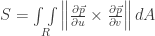 .
.


 (where
  ranged between
  and
and  and
and  ranged between
  and
and  . (Those limits for
  and
and  respectively.) [1]
 and
and  .
. . Calculating that out, we get it to equal
  . Phew, now we have something we can plug into the surface area formula for that “norm of the cross product” thingie.
 .
. is not equal to our normal area element for polar, namely
  ? For the answer to come out right, we need to let
  .
. (for whatever parametrization gets made). The reason I think this? When I look at the derivation of the formula, it defines
  plane, you’ll get two concentric circles with radius
  that you will be integrating over.













 Continuous Everywhere but Differentiable Nowhere