Author: samjshah

What is True Love? Winplot.

I am in love. Absolutely in love…

with Winplot (download it here – don’t be deceived by the ugly page). I discovered it on my hunt for a great program to make visuals for my Multivariable Calculus class. But now I’ve started using it when preparing lessons and graphs for all my classes.

The bad news: it has a pretty high learning curve. Some things are intuitive, many things aren’t. You have to, for example, type: y=root(3,x) to graph the cube root of x. But once you get the hang of it, it’s easy, breezy, beautiful.

The good news: what can’t it do?

I decided that either this weekend or next I’m going to spend 60 minutes going through
this comprehensive guide and learn all the features of this program in one go. Since the start of the year, I’ve been learning it piecemeal. I need to graph an inequality, I figure it out by looking around on the program. I need to get gridlines on my graph, I putz around until I figure it out. And in fact I thought I had a pretty good grasp on things without ever reading any documentation. However, it turns out that this program is way, way, way more powerful than I thought — because I only found out today that I can create pictures of volumes of revolution with the short click of a button! And so much more, apparently, after looking at the guide. So in my excited state, I felt compelled to write this post.
I know you’re dying for some screenshots, so I’m going to post screenshots cribbed from the guide linked to above here:

winplot1

winplot2

winplot3

A few more pictures after the jump…

(more…)

Juggling a ton of things

Read below for a challenge!

Tasks accomplished today:

1. Sent info to all high school students regarding the upcoming AMC competition.
2. Organized my advising conferences on Thursday and sent all my advisees this info.
3. Learned that I have to re-organize my advising conferences because of an administrative snafu.
4. Had someone proofread comments written for students who got a C- or below this quarter, and edited them, and gave the appropriate people copies.
5. Scanned and emailed a letter of recommendation for a student.
6. Planned tomorrow’s Multivariable Calculus class.
7. Did homework that I assigned the Multivariable Calculus class tonight.
8. Wrote an Algebra II exam and sent it to the other Algebra II teacher.
9. Put some copies of the Algebra II exam in the Learning Center for students who need to take it in a “distraction free setting”
10. Met with a number of students who had questions about math.
11. Met with administrator and student about a sensitive matter.
12. Talked with administrator about a sensitive matter.
13. Uploaded PDF of Smartboard for students to access in Algebra II, Calculus, and Multivariable Calculus.
14. Sent students homework in Algebra II, Calculus, and Multivariable Calculus.
15. Photocopied my Multivariable Calculus Quarter 2 students exams for my own personal records.
16. Emailed a lot of students about math — and setting up meeting times for individual help for tomorrow.
17. Met with administrator who observed my class last Thursday for him to debrief me.
18. Tried (and failed) to find out if my advisees were supposed to get their metro cards soon.
19. Reminded department head about upcoming Mu Alpha Theta induction.
20. Dealt with late homework.
21. Created a sign out sheet for students who are going to use the restroom in my classes.
22. Printed out my new seating chart for my Algebra II and Calculus classes.
23. Assisted the AP calculus teacher with a sticky math problem.
24. Read an email from a teacher friend at another school who wants to shadow a Biology teacher at my school next week; tried to set that up.

I was thinking today, with all my tasks large and small, about what I spend my time doing. Being a teacher is so much more than just planning classes and writing and grading exams. Such little time, proportionally, goes to those things. I know most teachers wish that we had more time to devote to lesson planning! At all points during the day, I am juggling a number of various responsibilities, small and large.

Challenge: Make a list of the things you did today. I’m curious what tasks, large and small, consume your attention. I think it’ll speak volumes about teaching in general, about your school culture and your teaching style in specific.

Completing the Square

Yesterday I ahem-ed and winked to my Algebra II class about them needing to know how to complete the square for class today. Teaching this topic last year was a nightmare. A total trainwreck. Students were having difficulty all over the place — they couldn’t simplify radicals, they didn’t get why the procedure worked, they were wondering how imaginary numbers came into play here, they confused the steps, they didn’t *get* it. And it was my fault.

Part of the problem was that we were doing too much, too fast. We had brought in graphing quadratics early on, and we were emphasizing the relationship between the equations and the graphs from the start. We also — in the middle of the quadratic unit — taught complex numbers. That’s too many huge things to deal with. Quadratics bring too much together, and we needed to keep the ideas and skills organized so they make sense.

So the other Algebra II teacher and I decided we’d try something different. First, this year, we introduced complex numbers without talking about quadratics. We motivated these numbers, and then we had students practice working with them, getting really comfortable with them. Second, when we started quadratics, we did so without any graphing. Period. We were doing all algebraic work.

Here’s how we progressed.

PART I: Review
Regular, very simple equations with solutions involving square roots, imaginary numbers, and real numbers:

quad1
Quick review of factoring:

quad2

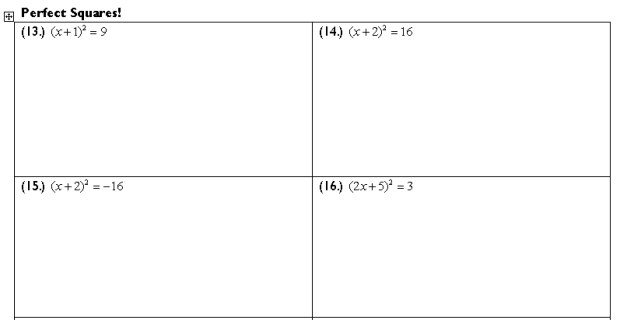
A brief discussion of solving equations with perfect square terms — with imaginary and real solutions:
quad3

Part II: Completing the Square

Perfect Squares:

quad4

We talked about what a perfect square is and noticed a relationship between the four terms — when you FOIL. Importantly, students are going to see that the second and third terms are the same.

***

Creating Perfect Squares!:

quad5

The next step of creating perfect squares really has them grapple with the fact that the missing constant term is simply half of the coefficient of the x term squared.

***

Completing the Square:

quad6

For me, it was this step, just a short distance from the last step, which made the entire unit a success. Because now my students had seen the relationship between all the terms in a perfect square and actually seemed to understand them. My favorite part was that most students were getting problem 10 right — and it involves fractions! We also talked about how important signs are for this process.

***

The End Game: Completing the Square

Before we actually “completed the square” I had students look at the last section of the review sheet.

quad3

We talked about how if you can write a problem in this form, that you can ALWAYS solve it. And what we were going to be doing is finding a way to write any quadratic equation in that form, so we can solve it.

Then, I went through an example — step by step — to get a problem to that form:

quad7

Then I had them solve it, like they had done previously. Most of them had no trouble solving it.

quad8

They practiced doing a few problems on their own — some which gave “nice” answers, some which gave answers with radicals, and some which gave complex answers.

Part III: Reinforcement

I made them practice a few more times, with some harder problems, and then I threw them a curve ball — a coefficient in front of the x^2 term. We conquered that, although there were same difficulties with fractions. Then I put some terms on one side and some terms on the other side (e.g. x^2=2x-15).

Overall, they really rocked it. How do I know they got it?

I started off this post by saying that I ahem-ed about giving a pop quiz in my class today. Well, I followed through on that. gave a pop quiz to my class on completing the square. I gave them one easy problem and one much more difficult problem — with fractions and radicals — on completing the square.

I got a whole bunch of perfect scores.

If you want, the worksheets I created are below:

Factoring Quadratics
Completing the Square, Part I
Completing the Square, Part II
Completing the Square, Pop Quiz
L’Hopital

Today a student in my calculus class asked why L’Hopital’s Rule works. I paused, and failed to think of an easy way to explain it. But now I’ve found a really easy way to explain it — at least for the 0/0 case. (Thanks Rogawski!)

We want to show that \lim_{x\rightarrow a} \frac{f(x)}{g(x)}=\frac{\lim_{x\rightarrow a} f'(x)}{\lim_{x\rightarrow a} g'(x)}.

At least in the 0/0 case, we know that f(a)=0 and g(a)=0. Great! If that be true, we can say that:

\frac{f(x)}{g(x)}=\frac{f(x)-f(a)}{g(x)-g(a)}

Of course that has to be true, because we’re subtracting 0 from the top and the bottom! Now we can say:

\frac{f(x)}{g(x)}=\frac{\frac{f(x)-f(a)}{x-a}}{\frac{g(x)-g(a)}{x-a}}

(We are dividing the top and bottom by the same number.)

Finally, we take the limit as x approaches a of both sides, to get:

\lim_{x\rightarrow a}\frac{f(x)}{g(x)}=\lim_{x\rightarrow a}\frac{\frac{f(x)-f(a)}{x-a}}{\frac{g(x)-g(a)}{x-a}}

By basic limit rules, we can rewrite the right hand side of the equation to be the limit of the top and bottom separately. But the limit of the top and bottom separately are just the derivatives! (See the definition of the derivative there?)

\lim_{x\rightarrow a} \frac{f(x)}{g(x)}=\frac{\lim_{x\rightarrow a} f'(x)}{\lim_{x\rightarrow a} g'(x)}

Q.E.D.

This Sunday: A Meandering Post

Today was exhausting. It’s been a while since I really, really planned for classes. The past week was this weird interim week where I didn’t work full-force. Midterms were canceled and classes continued, but in this half-hearted way. So it’s been a bit of a shock to sit down and plan 3 lessons, and do a giant pile of grading.

I counted. Today I graded 216 papers, which consisted of 600 problems (not counting parts a, b, and c as separate problems). I created 57 SmartBoard slides (well, some I cribbed from last year, or from previous classes). I entered 24 grades in my gradebook. I modified and printed one worksheet on the quadratic formula. I created my next problem set for my Multivariable Calculus class [1]. I set up my calendar for the next two weeks. Go me!

The next week is going to be brutal — the start of a new quarter, along with the task of entering and finalizing all the grades from the previous quarter.

I’m actually nervous about this upcoming week — but not only because of the work I’m going to have to do. Because of the student death at my school, two weeks ago, everything has been in disarray. Midterms were canceled, tests were modified to be open note or take home, movies were shown in classes (including some of mine), and students were given lots of flexibility. (“You were unable to focus last night? Of course you can take the quiz in study hall tomorrow.”) In other words, for the past two weeks, I unclenched my fist. My expectations were blurred. They were also greatly lowered. Starting tomorrow, I have to go through the process of re-clenching my fist. It’s going to be hard. I’m going to be clear with everyone that even though we’re not going to be the same, life has to go on in my classes. We’re going to go full force, and I am going to have the same high expectations for everyone that I had earlier in the year.

Here’s to hoping that the transition will go easily. I believe that as long as I’m clear with them, they’ll rise to the occasion. They have in the past.

[1] Actually, this problem set is going to be different from the others, and I’m hoping pretty interesting. I am assigning them one problem on using multivariable calculus to find the line of best fit (some of them are concurrently taking statistics), and then they are asked to create their own problem set for the material we’ve covered. Three problems. One which they have to make up themselves, but they can be inspired from any resources. The other two can come from other resources. Heck, you can read the problem set here. I’m hoping that having them dig for problems that seem interesting to them will keep them excited about the material. I’ll let you know how that goes.

In fact, here are all my problem sets so far.

multivariable-calculus-problem-grading-rubric
problem_set_1a
problem_set_1b
problem_set_2a
problem_set_2b
problem_set_3a
problem_set_3b

dy/dan’s “Feltron” contest

Just a quick link passing you along to Dan Meyer’s Annual Report contest.

Design information in four ways to represent 2008 as you experienced it. This can mean:

  • four separate PowerPoint slides with one design apiece,
  • one JPEG with four designs gridded onto it,
  • an Excel spreadsheet inset with four charts,
  • etc.

I had a blast working on it last year. To get a sense of what we’re talking about, check out examples from last year.