One Ring Equation to Rule Them All
On Monday, in Precalculus, I am starting conic sections.
I’ve made the decision to introduce conics through polar equations. This is totally backwards to the way that most people do it. Our textbook even sticks the polar version of conics at the end of the chapter of conics. However, I think it will be more powerful to do it this way.
You see, we just finished a unit on polar a hot minute ago, and I want to capitalize on that so students can draw connections between polar and conics. Additionally, we did a project on families of curves.
And in case you didn’t know this, the polar equation 

Noticing and Wondering
For you, I decided to take a few seconds to plot them on geogebra:

Instead of teaching them anything, on the first day I’m going to have them work in pairs. The plan:
- Have students get in pairs
- Have students use desmos.com to explore the family of curves using a slider to change
- Have each pair notice things and wonder things about what they see as they change the parameter — and record their observations on a google doc (this sample doc is set so you can view it)
- After each pair is done noticing and wondering about

I’m handing out this worksheet [.docx] to get us to do these things.
I don’t know how long this will take. Maybe 20 minutes, maybe 50 minutes? It really depends on how into the noticing and wondering. I’m a little uncertain where to go next with this — how to share the noticing and wondering… Each pair is going to have a group letter (A, B, C, … H, I, J). So I might have them spend a few minutes looking at the documents of those that preceed and follow their group (e.g. C will look at group B and D’s group’s observation).
Then I’m not sure how to wrap this all up. I think what I may do is leave it there, and not do a whole-class share. But after that, I’ll collate their noticings and wonderings, and as we introduce new things, I’ll tie them back to statements from these documents. For example, if a group notices “when 
Or maybe I’ll do nothing with them. Just the mere act of exploring, and coming with the conclusion that one family of polar curves can general four distinct general shapes (circle, ellipse, parabola, hyperbola) is good enough for me. Just paying attention to what’s happening to the graph, and learning to ask questions about what’s happening, that’s a skill in itself I should be content with cultivating.
(I should point out that I have rarely used the notice/wonder thing… so this isn’t fluent for my kids.)
Where I go from Here
From this activity, though, we are definitely going to talk about how we see four qualitatively distinct shapes, and we’ll name them:
circle, ellipse, parabola, hyperbola
And since we aren’t relying too much on the textbook, I am going to want them to make a schematic chart to organize what they’ve uncovered through observation.
And then we go on to the icky algebra, identifying various polar equations as different types of conics, and then eventually converting polar to rectangular form. (But in our polar unit, they already were asked to convert equations like 
[.docx]
This is all subject to change, obviously.
And then… then… when students have qualitatively understood conics as all emerging through one equation… when students see that the conics all gently slide into and out of each other as a single parameter changes… when students see two things they already know (parabolas and circles) and see two things they don’t know (ovals, weird pairs of curves that look almost like crossing lines)… then we’ve motivated this luscious mathematical journey we’re going to embark on. [2]
Then we can get to the rectangular form for conics and see how they come to look so similar, and why the differences arises… Why certain things open up and certain things open sideways… all the traditional stuff… But motivated by this untraditional beginning.
UPDATE: It’s Sunday, before I try this on Monday. I decided I want kids to understand why hyperbolas have asymptotic behavior from the polar form (and why ellipses don’t!). So I made this sheet [scribd online, .docx] which I think will get them to discover some algebraic connections behind some of the visual things they will have uncovered from their noticing and wondering.
UPDATE 2: My kids did their noticing and wondering. Because they were comfortable with Desmos from our polar unit, it went really smoothly. It took them about 25 or 30 minutes before they had exhausted all their observations. I walked around and pressed a few on some of the things they were doing/saying without giving anything away… Like if they said when 

[1] And, technically,
[2] I’m in the middle of Paul Lockhart’s Measurement and what’s amazing is I was reading it on the subway to school, and today of all days, I started his introduction to conics. He introduces it in a stunning way, through projections, and showed me one of the most elegant proofs I’ve seen dealing with ellipses and why the sum of the distances from the foci to the ellipse is a constant. I wish I could move away from our traditional curriculum to work as qualitatively and beautifully as he has done.
 and
and  equivalent expressions?” I have something pulling me in that direction too, saying that must be part of the “big idea” but haven’t quite been able to incorporate.
 ? So elegant! So coming up with equivalent expressions using the unit circle would be amazing for me. Anyone out there have this already done?


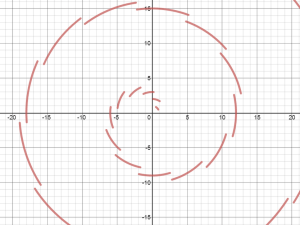
 is negative and when
  is negative. And then they do some plotting, and then convert from polar coordinates to rectangular coordinates. Most importantly, they figure out how to do these conversions on their own.
  , what does that mean about the
  coordinate? (“It can be ANYTHING! There is no restriction placed on
  , I hope they say “well
  , but the angle can be anything” (and similarly, for
  , “I suppose
  , but
, but  ) [2]
) [2] ) have on the interval $\latex 0\leq\theta<2\pi$?” question
 is really two equations to solve)
 ?). It’s just pulling a lot of stuff together.
 , what quadrant is
  in? Draw a picture. If
  is in the fourth quadrant, explain in words and with pictures why
  is in the second quadrant..
 Continuous Everywhere but Differentiable Nowhere