Have you given a presentation about the mathtwitterblogosphere?

I think this year, one of the biggest things that have happened to the mathteacherblogosphere (or whatever variant of that word you use) is that we’ve broken out of our own little community. We are no longer just a few of us talking with each other. There are a ton more of us, tons of blogs, tons of people twittering.

And more and more people are joining us, because they’re seeing what good things we have to offer.

Image

And now and then, on twitter, I’ll see that someone or another is giving a talk on this community, and what it has to offer. I’d love to create a list of presentations or talks that people have given about our little world. Partly, this is my archivist nature, trying to record all of this good stuff in one place. But mainly, because as more and more of us are building talks/presentations, it might be nice to have other talks and presentations to refer to.

Now I’m not talking only about hour long talks to huge groups of teachers. I mean anything — whether it’s a five minute talk to your department, to a 15 minute spiel to your school, to a three hour workshop you’ve crafted.

So if any of you have given talks, and have blogged about them, could you throw your links below? And if you could include any digital files you used (powerpoint, keynote, PDFs), an outline of how you actually lead it (if it was more than just you talking, but had participants actually do things), and anything else that might be useful… that would rock.

And if you have given a talk and haven’t blogged about it, BLOG ABOUT IT! Or if you don’t have a blog, because you mainly twitter, you can write a guest post on my blog if you want!

I hope to compile them as a list on this blog, or maybe include them on a special page on the mathtwitterblogosphere site.

Full confession: I haven’t really given talks or anything. I’m not really a teacher leader or anything and it feels weird to give talks when I feel like I’m not an expert teacher or a leader or whatever. So I’ve only done one talk to new teachers last summer [post here]. Here is a 7 minute presentation I gave at a summer math conference/workshop (PCMI) which I think went really well [post here].

Related Rates, Yet Another Redux

I posted in 2008 how I didn’t actually find related rates all that interesting/important in calculus. The problems that I could find were contrived, and I didn’t quite get the “bigger picture.” In 2011, I posted again about something I found from a conference that used Logger Pro, was pretty interesting, and helped me get at something less formulaic.

I still don’t know how I feel about related rates. I’m torn. Part of me wants to totally eliminate them from the curriculum (which means I can also possibly eliminate implicit differentiation, because right now I see one of the main purposes of implicit differentiation is to prime students for related rates). Part of me feels there is something conceptually deeper that I can get at with related rates, and I’m missing it.

I still don’t have a good approach, but this year, I am starting with the premise that students need to leave with one essential truth:

Often times, as we change one thing, it affects a number of other things. However, the way that the other things are affected can vary greatly. 

Right now, to me, that’s the heart of related rates. (To be honest, it took some conversation with my co-teacher before we were able to stumble upon this essential understanding.)

In order to get at this, we are starting our related rates unit with these two worksheets. A nice bonus is that it gets students to think about the shape of a graph, which is what we’ll be embarking on next.

The TD;DR for the idea behind the worksheets: Students study a circle which has it’s radius increase by 1 cm each second, and see how that changes the area and circumference. Then students study a circle which has it’s area increase by 10 cm^2 each second, and see how that changes the radius and circumference. The big idea is that even though one thing is changing, that one thing affects a number of different things, and it changes them in different ways.

[.docx] [.docx]

(A special thanks to Bowman for making the rocket and camera problem dynamic on Geogebra.)

It’s not like this is a deep investigation or they come out knowing anything super special. But the main takeaway that I want them to get from it becomes pretty apparent. And what’s really powerful (for me, as a teacher trying to illustrate this essential understanding) is seeing the graphs of how the various thing change.

***
IMAG2906

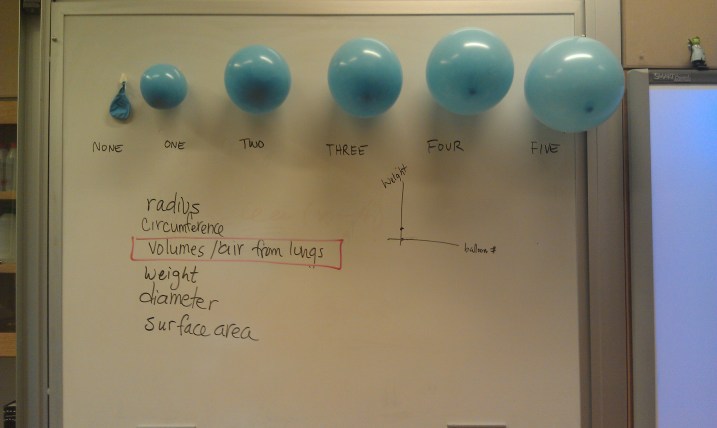
I had students finish the first packet one night. Before we started going over it, or talking about it, I started today’s class asking for a volunteer to blow up balloons. (We got a second volunteer to tie the balloons.) While he practiced breathing even breaths, I tied and taped an empty balloon to the whiteboard.

Then I asked our esteemed volunteer to use one breath to blow up the first balloon. Taped it up. Again, for two breaths. Taped. Et cetera until we got a total of six balloons taped.

Then I asked what things are measurable in the balloons.

Bam. List.

(We should have listed more. Color. What it’s made of. Thickness of rubber.]

Then I asked what we did to the balloon.

Added volume. A constant volume (ish) in each balloon.

Which of the other things changed as a result?

How did they change?

This five minute start to class reinforced the main idea (hopefully). We changed one thing. It changed a bunch of other things. But just because one thing changed in one particular way doesn’t mean that everything changed in that same way. For example, just because the volume increased at a constant rate doesn’t mean the radius changed at a constant rate.

***

 This is about all I got for now. I’m going to teach the rest of the topic the way I always do. It’s not up to my personal standards, but I still am struggling to get it there. I suppose to do that, I’ll have to see a more nuanced bigger picture with related rates, or find something that approaches what’s happening more visually, dynamically, or conceptually.

PS. The more I mull it over, the more I think that geogebra has to be central to my approach next year… teaching students to make sliders to change one parameter, and having them develop something that dynamically illustrates how a number of other things change. And then analyzing how those things change graphically and algebraically.

(A simple example: Have a rectangle where the diagonal changes length… what gets affected? The sides, the angle between the diagonal and the sides of the rectangle, the area, the perimeter, etc. How do each of these things get affected as the diagonal changes?)

Quick Questions on Proving Trig Identities

I’m sure that this question has been asked in a million high school math offices, so apologies for the rudimentary nature of the question.

I’m teaching Precalculus for the first time. And I’m about to teach proving trig identities, like:

\frac{\sin(x)}{\sin(x)-\cos(x)}=\frac{1}{1-\cot(x)}

I understand that the standard ways to prove trig identities is:

(a) pick one side of the equation, and keep morphing it until it matches the second side of the equation

(b) individually modify both side of the equations independently until they equal the same thing.

I always learned that what you cannot do is start mixing both sides of the equations. So, for the equation above, you can’t cross multiply to get:

\sin(x)(1-\cot(x))=1(\sin(x)-\cos(x))

and keep on simplifying both sides to show they are the same and the equality is true.


The reasons I’ve heard this is not allowed:

1. Because I said so.

2. You can only cross multiply if you know the equality is true. But that’s precisely what you’re trying to prove. You are assuming the statement is true to prove the statement is true.

However, both explanations are unsatisfying to me. The first one is for obvious reasons. My objection with the second one is that it seems to always work for these problems. Although I know it is logically unsound, I can’t quite pinpoint why with a concrete example to demonstrate it.. 

My questions are the following:

What do you do to explain to your kids why you can only work the sides of the equality independently? Does it convince them?

Does anyone have a good example involving trigonometric identities that illustrates that bad things happen when you don’t solve the sides independently, but start mixing them together? Like proving something that isn’t true actually is true… or proving something true that actually isn’t true?

Thanks for any help. I feel a little foolish, like I’m missing something obvious. Like I should know this. But hey, if I knew everything, I wouldn’t need all y’all.


Guest Post: Conics Project

This is a guest post from my friend Liz Wolf.

***

“The conics section comes at a tough time in our curriculum.  It’s a few weeks after Spring Break, and kids are always antsy in class and have major spring fever.  I wanted a way to make conics less abstract and show the kids how often they come up in every day life.  I came up with a project that not only got them outside, but also got them looking at things in a different way.  The photo of the water droplet on the swing set was my favorite.  The students really embraced this and I was impressed with how well they embraced GeoGebra having never used it before.”

***

Below are some examples of final products from her class, and the instruction sheet she used.

Image

Image

Image

Image

Update: Liz sent me her Geogebra instruction sheet!

Swampped

This is one of those days where the one good thing was hard to find. I had to reprimand one class for not doing their work at home, I am having to deal with juggling because a ton of students have been out, I’m dealing with a lot of this and that, and I have a HUGE amount on my plate for this weekend. Like: impossibly large amount of stuff to do. So my anxiety is through the roof. And, yes, I have that tickle in the back of my throat which could mean something or it could mean nothing.

But that’s precisely why we need this blog. So I’m going to post some of the small good things that happened. None of them were GOOD (like, enough to undo my stress) but they were positive.

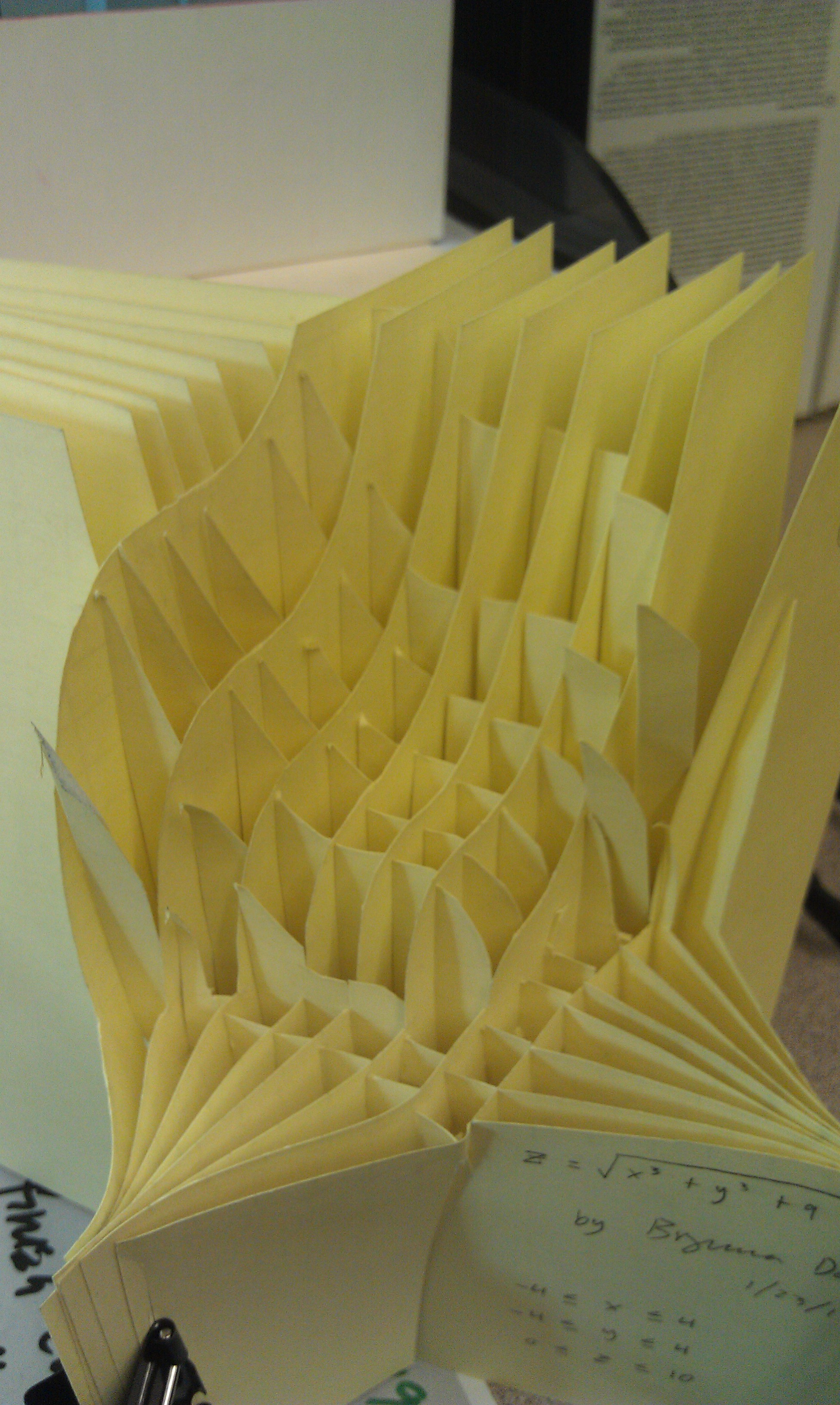
(1) Another multivariable calculus student turned in her aweeeeesome 3D function which is aweeesome possum…Image


(2) Some kids were really excited about showing me some of the stuff they did for their roller coasters in their calculus projects (which were due today).

(3) I took over a colleagues precalculus class while she took my multivariable calc kids (and one of her classes) to the Museum of Mathematics… and her kids were working on the same project mine are (the family of curves project). Her kids were soooo into it and were coming up with some stunning, beyond stunning in fact, pieces of artwork.

(4) A former kid who served for all my years on the SFJC came back to visit and we caught up after school. It was nice to hear what exciting things he has planned in the next five months!

That’s about it. When I’m overwhelmed and overextended, and when a lot of kids have their own things I’m dealing with, I can’t appreciate these small moments. So I am glad I took the time to force myself to think of these small moments, in a sea of mediocre ones.

Families of Curves #2

So today I started the Family of Curves project in Precalculus. Students are going to be given three in class days to work on this, and about a week or two of out-of-class to finish it on their own.

I started class showing around 4 or 5 minutes of this Vi Hart video with no introduction:

Then I showed a whole bunch of pictures… of tessellations, Escher prints, one of the things they were going to be creating on geogebra [but without telling them it was not a famous artist], and a few beautiful prints and the website for Geometry Daily.

Then I had them take out their laptops, and just get started working on Geogebra. The packet below takes them through the sequence command, and then shows them how the sequence command can create a family of curves…

Here’s the instructions getting kids started on Geogebra and what’s expected of them…

[.docx]

Note: My kids are getting more and more fluent with Geogebra… We have been using it on-and-off all year at various times.

They were silently working the entire class. I put on some music, and they started talking a bit. But since it’s an individual project, I suppose I can’t expect a lot of talking. Some kids have been asking me “how do you make circles?” and one student asked me how to fill in circles…

It took them pretty much the whole day today to do the geogebra introductory stuffs, so they didn’t all get to play around with their own functions. I expect tomorrow will be pretty awesome to watch them tinker and explore, and get cool things.

I don’t know if they are “into” this yet. I’ll see if I get any anecdotal evidence tomorrow.

One Good Thing

A short post:

For those of you who don’t know, Rachel Kernodle (@rdkpicklehttp://sonatamathematique.wordpress.com/) has started a group blog called “one good thing.” She wrote about it here, and you can visit the blog here.

Image

The idea is that even in the most frustratingly upsetting days as teachers, there is at least one good thing that happens — as long as you keep your eyes open to it. We may feel we suck, we may get all arrrrgh at students, a lot of random stress can take over and fill us with anxiety… and we get our blinders on, and lose sight of the bigger picture. Looking for one good thing each day helps us see the bigger picture when our vision narrows. And it also helps us archive the little moments, which are oh so important!

Right now there are about 7 authors posting regularly. This is one of the many projects that math teachers have going on (others are here)! I know Rachel wants to invite others who want to contribute regularly or semi-regularly to join in (it’s not an exclusive club!) — so she said you can throw your email in the comments here in the next couple days and she’ll add you as an author to the blog. Or you can tweet her to get added or find out more information. That simple!

What’s nice is this blog will soon be populated with a million little stories from a bunch of (math) teachers all around the world. A beautiful pastiche of why we teach, with concrete, on-the-ground examples.

(My entries on the “one good thing” blog are archived here.)