Multivariable Calculus

This Sunday: A Meandering Post

Today was exhausting. It’s been a while since I really, really planned for classes. The past week was this weird interim week where I didn’t work full-force. Midterms were canceled and classes continued, but in this half-hearted way. So it’s been a bit of a shock to sit down and plan 3 lessons, and do a giant pile of grading.

I counted. Today I graded 216 papers, which consisted of 600 problems (not counting parts a, b, and c as separate problems). I created 57 SmartBoard slides (well, some I cribbed from last year, or from previous classes). I entered 24 grades in my gradebook. I modified and printed one worksheet on the quadratic formula. I created my next problem set for my Multivariable Calculus class [1]. I set up my calendar for the next two weeks. Go me!

The next week is going to be brutal — the start of a new quarter, along with the task of entering and finalizing all the grades from the previous quarter.

I’m actually nervous about this upcoming week — but not only because of the work I’m going to have to do. Because of the student death at my school, two weeks ago, everything has been in disarray. Midterms were canceled, tests were modified to be open note or take home, movies were shown in classes (including some of mine), and students were given lots of flexibility. (“You were unable to focus last night? Of course you can take the quiz in study hall tomorrow.”) In other words, for the past two weeks, I unclenched my fist. My expectations were blurred. They were also greatly lowered. Starting tomorrow, I have to go through the process of re-clenching my fist. It’s going to be hard. I’m going to be clear with everyone that even though we’re not going to be the same, life has to go on in my classes. We’re going to go full force, and I am going to have the same high expectations for everyone that I had earlier in the year.

Here’s to hoping that the transition will go easily. I believe that as long as I’m clear with them, they’ll rise to the occasion. They have in the past.

[1] Actually, this problem set is going to be different from the others, and I’m hoping pretty interesting. I am assigning them one problem on using multivariable calculus to find the line of best fit (some of them are concurrently taking statistics), and then they are asked to create their own problem set for the material we’ve covered. Three problems. One which they have to make up themselves, but they can be inspired from any resources. The other two can come from other resources. Heck, you can read the problem set here. I’m hoping that having them dig for problems that seem interesting to them will keep them excited about the material. I’ll let you know how that goes.

In fact, here are all my problem sets so far.

multivariable-calculus-problem-grading-rubric
problem_set_1a
problem_set_1b
problem_set_2a
problem_set_2b
problem_set_3a
problem_set_3b

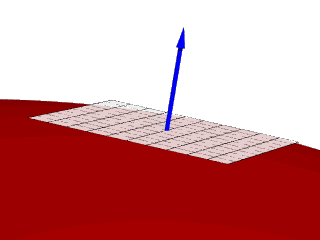
Why is the gradient related to the normal vector to a surface?

Today in Multivariable Calculus I was supposed to teach my students how to find the plane tangent to a surface at a point.

tangent3

The book, however, was not clear how to do this. They had an equation involving the gradient of a function, but the equation was derived via local linear approximations. Fine and dandy, but I didn’t like it. I didn’t “see” it or grasp what was going on.

What’s clear is that to find the equation for the plane — for any plane — we need a point and a vector pointed in the direction normal to the plane. We are given the point, but we need to find the direction normal to the plane. That’s the same as the direction normal to the surface!

normal

So I set my class up with the task of doing this on their own. They’re still working on it.

But honestly, I’m not quite there yet. I don’t want to just give them the equation and method on how to apply it, but I don’t think I can explain it in any good way. I’m almost there, at a conceptual tipping point, but I need one last shove over the edge. Anyone out there ready to help?

First of all, I decided that working with surfaces is silly and I’d reduce the problem to curves. So let’s start simple.

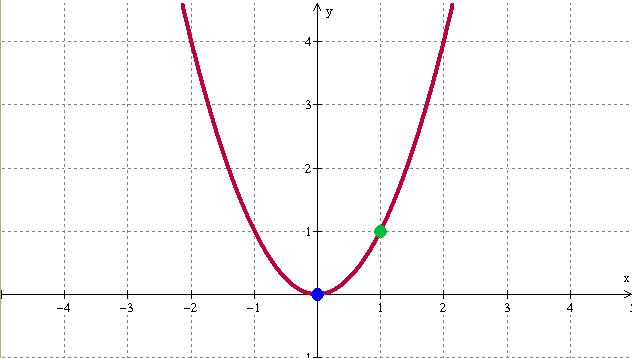
Let’s say we have the graph of y=x^2 and we want to find vectors normal to the curve at (0,0) and (1,1) (the blue and green dots).

parabola

Well, traditionally, we’d be crazy and parametrize the parabola by creating the vector-valued function \vec{r(t)}=<t,t^2> and then calculate the unit tangent vector (\vec{T}(t)=\frac{\vec{r}'(t)}{|\vec{r}'(t)|}) and then from that calculate the unit normal vector (\vec{N}(t)=\frac{\vec{T}'(t)}{|\vec{T}'(t)|}). [1] Then we’d calculate \vec{N}(0) and \vec{N}(1) to find the vectors.

But trust me, this is an awful amount of work, and \vec{N} is not a pretty function. We had to parametrize, take derivatives, and plug in values. And if you remember, we started out with such a simple equation y=x^2. Why can’t it be easier?

And it can. And this is where I need your help.

Instead of considering the plain old boring function y=x^2, we turn this into a surface by introducing a z direction: F(x,y)=y-x^2.

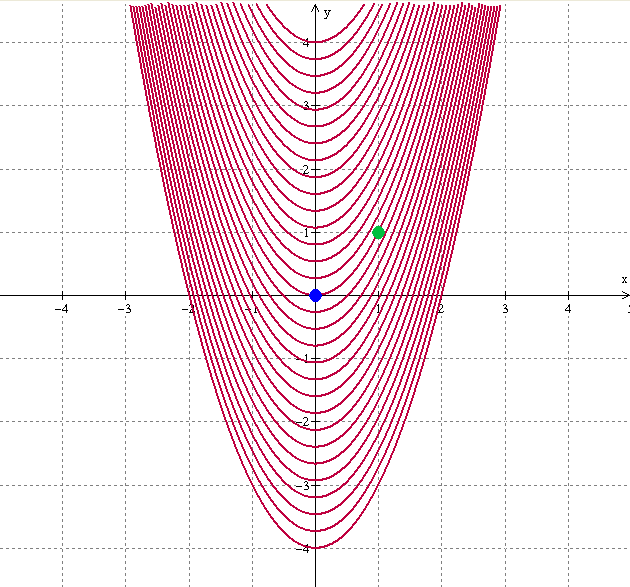
The function F(x,y) is a surface. We’re only interested in one slice of the surface, when F(x,y)=0 (when the height is 0). This will then reduce to our original equation y=x^2. The set of level curves of the surface is below. Note that the level curve that goes through the origin is the level curve we’re interested in.
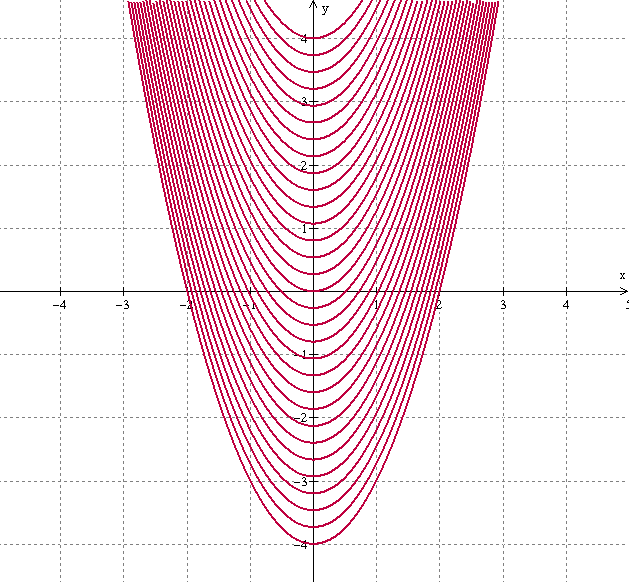
parabola-level-curves

Remember that one important (perhaps the most important) property of the gradient is that the gradient of a function points in the direction of maximum of steepness on a graph of level curves.

Let’s look at the points we’re interested in!

parabola-level-curves-dots

Just looking at the graph shows we’re onto something. Look at the blue dot. Which direction is the steepest, if you were standing at the blue dot and wanted to walk in the steepest direction? Well, clearly it would be directly north. (You want to walk the shortest distance to get to the next level curve. Since the change in heights between level curves is constant, you want to minimize the distance you’ve walked to get to the next height to have the steepest slope.) What about the green dot? Clearly, northwest.

And actually calculating the gradient of F(x,y) gives us \nabla F(x,y)=<-2x,1>.

At the blue dot, we get \nabla F(0,0)=<0,1>, which is a vector pointing straight up.

At the green dot, we get \nabla F(1,1)=<-2,1> which is a vector pointing northwest.

I’m plotting them below.

parabola-level-curves-dots-arrows

And without all the pesky level curves to distract us.

parabola-level-curves-dots-arrows-2

Clearly this method works. We take the original function y=x^2 and bring it into a higher dimension (F(x,y)=y-x^2). We use the fact that the gradient gives us the direction which is “steepest” on this surface, if we were trapped at a particular point. (In this case, (0,0) or (1,1). Notice these points lie on the level curve we care about, the level curve which actually is the equation we were initially concerned about (y=x^2). Then we recognize — somehow — that the gradient of the higher dimension equation somehow gives us the normal vector of the original equation we were concerned with.

The questions I have after doing this:

(1) Why did we have to change our nice curve y=x^2 into a surface F(x,y)=y-x^2 to solve this problem? And why this surface?

(2) How can we understand that the vector normal to the curve somehow is “magically” the gradient of the surface we created — one of whose level curves is the curve we’re interested in.

(3) Extending this analysis to problems where we want to find the normal vector to a surface like an ellipsoid (like 9x^2+4y^2+z^2=49) at a particular point, we’re going to be using the function F(x,y,z)=9x^2+4y^2+z^2-49 — whose level curves will be surfaces, stacked one on top of another. To find the normal vector, we take the point on the “level surface” which describes our ellispoid, and find the quickest way to get to the next “level surface”? Is that right? I think that seems right. Strange, but right.

(For a picture of some level surfaces, check it out here.)

Anyway, this is just my musings, my way of thinking through this. I’m not quite there. Any help you can give, great. If not, that’s cool too.

[1] I guess to make things simpler, we could simply calculate the direction of the normal vector and not worry about making it a unit normal vector, so we could simply calculate $\vec{T}'(t)$ only. We’re not concerned about the magnitude of the normal vector, only the fact that it’s normal.

I feel awesome

I handed back a graded problem set back to my multivariable calculus class last week. One student emailed me to meet to go over it with him. We did that today.

But the best part? One of my comments was that there were not enough words and motivation for each mathematical step. His response — totally unprompted by me — was something to the effect of “Now that I had to do all that writing for the Kepler paper, I now think I know what sorts of things I’m needing to explain, that I wasn’t explaining before.”

If there was any smidgen of doubt left in my mind that our Kepler “unit” wasn’t useful, it has been eradicated. The skills I wanted them to pick up? They can now apply them to the rest of the course. HUZZAH!

Topological Maps, Google, and Multivariable Calculus

Right now, I’m about to start teaching Partial Derivatives in my multivariable calculus class. I’m going to teach them in a traditional way, to build a sense of what they are. However, I really want to create a project that has students take actual data and find something useful with it.

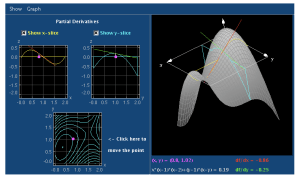
To take you down my train of thought, look at this applet:

picture-1

So of course we will soon relate partial derivatives to the gradient which will get us to exploring topological maps. Pretty standard stuff.

However, wouldn’t it be neat if each student could pick a place on the globe and create a topological map for it? (And then, using some simple computer tools or a protractor and ruler, come up with estimations about the steepness or flatness of the terrain at various points?) Well, I can easily make this happen! Because now GoogleMaps has a Terrain feature, and if you zoom in enough, you get to see the level curves with the height of the land marked. And you can use sites like this to calculate the distance between two points!

Here’s some random place in Alaska.

picture-2

I’m thinking that having my students actually work to calculate some of these values by hand might really hammer home what these strange calculus concepts are. It’s easy to take the derivative with respect of x of f(x,y)=3x^3y^2. It’s less easy to understand what that means, or what the gradient means, or how they are calculated.

I don’t know if I’ll have time to whip this up, but I think it could be a really great activity.

Kepler’s Laws, reprise

You might recall that in my multivariable calculus class (four students), we’ve been turning a really badly written section in our textbook on Kepler’s Laws into a great learning experience. The section was really unclear, the authors didn’t motivate any algebraic work, nor did they relate the equations to any conceptual understanding of what was going on.

We decided — well I decided, but my students agreed to play along — to rewrite the textbook to make it clearer. We wanted to focus on motivating each step of the derivation, we wanted to organize the derivation in a more sensible way, we wanted to be explicit with each of our calculations so the reader isn’t left wondering “where the heck did that come from?”

My students got into the project. Heck, I got into the project. We spent about 5 class days working on it. Most nights I didn’t assign homework. One night, I asked students to each individually outline how they thought the rest of the paper should go. Another night, I asked students to proofread what we had written for stylistic and conceptual inconsistencies. We finally came up with a formula describing all conic sections — which describes how the earth moves around the sun. We didn’t get to actually derive Kepler’s Laws (see below for why).

The students are really proud of this paper. They want to send it to the math department head who left last year, the publisher of the textbook, and their calculus teacher who retired last year. (We will send it to all three!) We embarked on this together (I didn’t know anything about this section; I was going to skip it but the students really wanted to cover it), and I let them do a lot of the thought work themselves. It’s hard to let go as a teacher, because I have this drive to explain and clarify everything when someone doesn’t “get it.” But these kids are advanced enough that they can grapple with the material, ask each other questions, and be okay with getting stuck. And I suspect it is precisely because of this, because they did it, that they feel ownership of the paper.

Two of my favorite parts of the paper:

picture-3

picture-4

Our current draft is here.

Their next “problem set” isn’t like the others. I pretty much said: “we learned how to read the book, and make sense of that which we thought we could never figure out. Now your task is to each individually finish his paper off. We’ve gone 2/3 of the way to the end together. Go try to do the last 1/3 yourself. With this formula we came up with, your textbook, the Internet, and your wits, write the final part of this paper. That’s right: you derive Kepler’s Laws.”

Their problem set it due on Friday. I’m excited to see what they do with this!

If you’re wondering what our class looked like when we were working together on this paper:

Imagine four students, sitting at a square table. Each has photocopies of the relevant textbook section in front of them. I am sitting at the front of them, laptop on, with Lyx (my LaTeX editor) open. The screen is being projected so the students can read what I’m typing. I prompt: “so what do we want to write?” and we’re off. The students talk with each other about the section — not only asking questions and answering each other on the mathematical content, but about how the section should be presented. One might say “I think we should say something about how vector b will actually be crucial to understanding everything. The book introduces b and then forgets about it and never really explains it.” Another might respond, “Yeah, we should devote a whole section of our paper to explaining b.” And they’re off. I sometimes interject to ask questions, or to get them on the right track, but it’s rare that I’m directing. Finally, when I see they’re coming to some sort of consensus, I say “so what am I going to type — what’s my heading? The introductory paragraph explaining what you’re planning on doing?” And then one of them will say “In this section, we will introduce a new vector, b, which will end up being unchanging over time. This constraint on the motion will …” And then another student might say “maybe after ‘unchanging over time’, we should say “no matter where the earth is or what speed it is moving at.”

And we’re off to the races. This goes on for 50 minutes. Which always seemed too short. Each day we got about 1 to 1 1/2 pages (single spaced) written. At the very end I scanned in the images that one student drew as we worked our way through the material.

This project was hands down the best thing I’ve done in any of my classes all year, in terms of student learning.

Kepler’s Laws

In my multivariable calculus class, we spent last Friday reading the textbook as a group, trying to understand the section on Kepler’s Laws. We got done showing that if there is a sun-like object and another object with a particular initial position and velocity, it will either fall into the sun, be an circle, be an ellipse, be a parabola, or be a hyperbola.

Today we were going to move onto using this result to derive the three Keplerian laws of planetary motion.

But then I decided to scrap that. Because even though we read the book and followed the text, line by line and equation by equation, we lost sense of what we were doing. We lost sense of the conceptual underpinnings for each equation. We didn’t know what motivated the book to make the moves it made. It’s largely the book’s fault, which is really unclear — if you’re a high school student and not used to having your book say “we leave this as an exercise to the reader.” (Seriously, it did that.)

One of the things you’ve heard me say is that I want to foster the skill of students learning to communicate math well.

So, I decided to scrap the plan of moving forward, and we’re devoting two or three days to

WRITING OUR OWN TEXT EXPLAINING THE DERIVATION OF KEPLER’S LAWS.

We started out the class outlining a basic structure to it (Part I: What we want to show; Part II: Initial Conditions; Part III: Gravitational Pull; etc.). Then the four students started talking about what they wanted to say. (One agreed to draw the diagrams we’re going to include in our text.) I just sat up front, and when they decided, I typed it up in my LaTeX editor — projected so that students could tell me to fix or reorder something. Sometimes I prompted them (“you told me to write \vec{v} but you never told the reader what that is” or “does it matter if the initial velocity weren’t orthogonal to the position vector?”). And it took us 50 minutes to get about a third of the way done.

But you know what? It is working. They’re talking, they’re thinking, they’re arguing with each other, they’re asking questions. And they’re learning to work through things, and explain them to someone else.

I was so pleased. Hopefully the next few days go as well.

Mathematics Illuminated & the Carnival of Education

1. The Carnival of Mathematics 43 is out. There’s some really great stuff there! Including a really wonderful problem for an Algebra II class! And a great way to do test review!

2. Today in my MV Calculus course, I was teaching curvature. One of my students asked for the dimensions of curvature. Love those sorts of questions! In any case, when I was looking online for some good resources, I came across this website which explains curvature — and a bunch of other really interesting math topics — to the layperson.

So, here’s my present to you: if you’re a math teacher and you have an extra class to introduce the ideas behind advanced mathematics, without going into all the equations and nuances, you have your lesson plan laid out here, at Mathematics Illuminated. Totally awesome stuff! Plus, if you register (for free!), you can stream videos on teach topic. Unfortunately, I haven’t been able to watch one yet, so tell me if you get a chance if the videos are any good in the comments.