Month: March 2015

A Semi-Circle Conjecture

At the very start of the school year in geometry, we started by having students make observations and write down conjectures based on their observations. We had a very fruitful paper folding activity, which students — through perseverance and a lot of conversation with each other — eventually were able to explain.

However we also gave out the following:

And students made the conjecture that you will always get a right angle, no matter where you put the point. But when they tried explaining it with what they knew (remember this was on the first or second day of class), they quickly found out they had some trouble. So we had to leave our conjecture as just that… a conjecture.

However I realized that by now, students can deductively prove that conjecture in two different ways: algebraically and geometrically.

Background:

My kids have proved* that if you have two lines with opposite reciprocal slopes, the lines must be perpendicular (conjecture, proof assignment).
My kids have derived the equation for a circle from first principles.
My kids have proved the theorem that the inscribed angle in a circle has half the measure of the central angle (if both subtend the same arc) [see Problem #10]

Two Proofs of the Conjecture

Now to be completely honest, this isn’t exactly how I’d normally go about this. If I had my way, I’d give kids a giant whiteboard and tell ’em to prove the conjecture we made at the start of the year. The two problems with this are: (1) I doubt my kids would go to the algebraic proof (they avoid algebraic proofs!), and part of what I really want my kids to see is that we can get at this proof in multiple ways, and (2) I only have about 20-25 minutes to spare. We have so much we need to do!

With that in mind, I crafted the worksheet above. It’s going to be done in three parts.

Warm Up on Day 1: Students will spend 5 minutes refreshing their memory of the equation of a circle and how to derive it (page 1).

Warm Up on Day 2: Students will work in their groups for 8-10 minutes doing the geometric proof (page 2).

Warm Up on Day 3: Students will spend 5-8 minutes working on the algebraic proof (page 3). Once they get the slopes, we together will go through the algebra of showing the slopes as opposite reciprocals of each other as a class. It will be very guided instruction.

Possible follow-up assignment: Could we generalize the algebraic proof to a circle centered at the origin with any radius? What about radius 3? What about radius R? Work out the algebra confirming the our proof still holds.

Special Note:

Once we prove the Pythagorean theorem (right now we’re letting kids use it because they’ve learned it before… but we wanted to hold off on proving it) and the converse, we can use the converse to have a third proof that we have a right angle. We can show (algebraically) that the square of one side length (the diameter of the semi-circle) has the same value as the sum of the squares of the other two sides lengths of the triangle. Thus, we must have a right angle opposite the diameter!

I’m sure there are a zillion other ways to prove it. I’m just excited to have my kids see that something that was so simply observed but was impossible to explain at the start of the year can yield its mysteries based on what they know now.

The two semi-circle conjecture documents in .docx form: 2014-09-15 A Conjecture about Semicircles 2015-03-30 A Conjecture about Semicircles, Part II

*Well, okay, maybe not proved, since they worked it out for only one specific case… But this was at the start of the year, and their argument was generalizable.
Add yourself to the MTBoS Directory!

Jed Butler (@mathbutler, blog), in the past week or two, has worked to create a beautiful directory for math teachers who use twitter and who blog. We have had a few spreadsheets out there trying to do the same thing, but they tend to get outdated and lost. This directory is the real deal.

The point of this post is to get you to add yourself to the directory. If you’re already convinced, do it now. If not, read on to why you ought to…

MTBoS

It not only is beautiful, simple, and sleek, but it has the following features which blew me away:

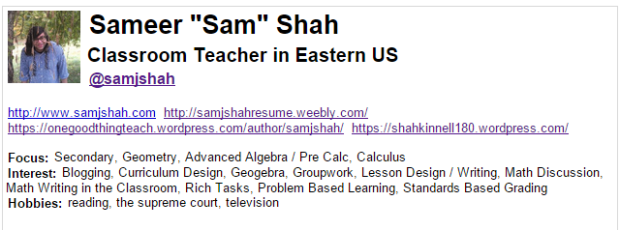
(1) For each person, it creates a little index-card-like profile, which not only has our twitter picture on it but also has links with our interests. I confuse people easily (and really, why are 30% of math teachers named Chris?), and having a little picture icon, and all of their information easy for me to look at is going to be so so so helpful.

profile

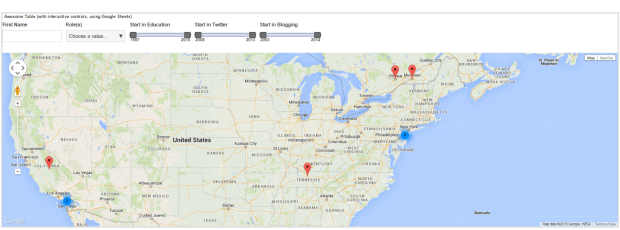
(2) It has a map which each person in the directory can easily add themselves to, and this map is searchable. I can, for example, zoom into NYC to see who the NYC educators are… or type my friend’s name into the search bar to remind myself which part of the country (world!) they are in.

map

(3) The directory itself is crazy searchable. Say you wanted to find teachers who have been teaching since 2000 who are in the Northeast US who teach Geometry and are interested in Groupwork. Done.

SearchBar

(4) If you want to quickly update your information, you can… no muss no fuss it is super easy!

Which is all to say: take 5 minutes and add yourself to the directory.

My Introduction to Trigonometry Unit for Geometry

I’ve been mulling over how to introduce trigonometry to my geometry students. I think I’ve finally figured out a way that is going to be conceptually deep, and will have kids see the need for the ratios.

I don’t know if all of what I’m about to throw down here will make sense upon first glance or by skimming. I have a feeling that the flow of the unit, and where each key moment of understanding lies, all comes from actually working through the problems.

But yeah, here’s the general flow of things:page

Kids see that all right triangles in the world can be categorized into certain similarity classes… like a right triangle with a 32 degree angle are similar to any other right triangle with a 32 degree angle. So we can exploit that by having a book which provides us with all right triangles with various angle measures and side lengths. (A page from this book is copied on the right.) Using similarity and this book of triangles, we can answer two key questions. (1) Given an angle and a side length of a right triangle, we can find all the other side lengths. (2) Given two side lengths of a right triangle, we can find an angle.

By answering these questions (especially the second question), kids start to see how important ratios of sides are. So we convert our book of right triangles into a table of ratios of sides of right triangles. Students then solve the same problems they previously solved with the book of triangles, but using this table of values.

Finally, students are given names for these ratios — sine, cosine, and tangent. And they learn that their calculator has these table of ratios built into it. And so they can use their calculator to quickly look up what they need in the table, without having the table in front of them. Huzzah! And again, students solve the same problems they previously solved with the book of triangles and the table of values, but with their calculators.

Hopefully throughout the entire process, they are understanding the geometric understanding to trigonometry.

(My documents in .docx form are here: 2015-04-xx Similar Right Triangles 1 … 2015-04-xx Similar Right Triangles 2 … 2015-04-xx Similar Right Triangles 2.5 Do Now … 2015-04-xx Similar Right Triangles 3 … 2015-04-xx Similar Right Triangles 4)

It’s a long post, so there’s much more below the jump…

(more…)

Time Travel

This quarter, I’m letting kids — totally optionally — do a more in depth Explore Math. This time it isn’t getting a “taste” of a bunch of little things, but rather it’s explore one thing in detail. Anything math related that kids are interested.

Today and yesterday, I had three different meetings with a few different kids who wanted to discuss options. These conversations revolved around:

  • Park Effects on baseball batters (sports statistics)
  • Understanding why a particular algorithm creates the math art pictures it does
  • The Goldbach Conjecture and the Collatz Conjecture
  • Time dilation (and time travel)
  • How restaurants do their finances and stay in business

Super fun conversations, with kids who just want to learn stuff that they’re fascinated by. For example, the kid who wanted to talk about the Goldbach conjecture said that he wanted to work on proving the Goldbach conjecture (“I will not give up!” he wrote) — and the reason he wanted to do this is because he always had trouble with prime numbers and understanding them. Melting! MELTING!

Previous posts about Explore Math:

“Explore Mathematics”

Explore Math (Reprise)

“Explore Mathematics: Part II”

The site that launched Explore Math (mini explorations) last quarter for my kids:
http://explore-math.weebly.com/